
We may earn a commission if you buy through links on this page. It never changes a score or a ranking. How we make money
The bottom line
A broad API-based payments platform; get a quote and verify SDKs, limits and exit terms before building.
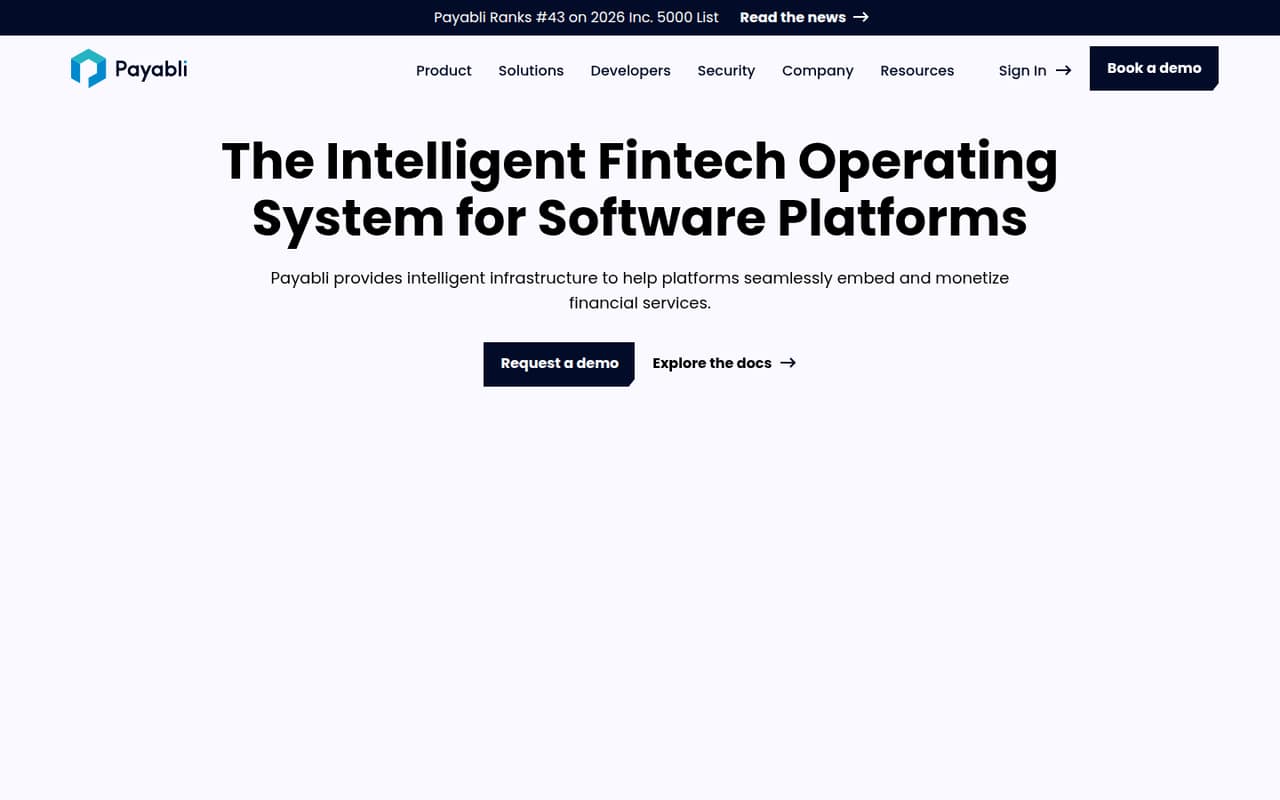
Payabli is embedded payments infrastructure for software platforms, combining payment acceptance, payouts and payment operations. Developers can use direct APIs, Query APIs, webhooks and embeddable components; the platform also describes AI tools with MCP support.
Pricing is custom and quote-based, with no published starting price or free plan. The platform covers a wide range of payment workflows, but buyers should confirm SDK support, rate limits, security responsibilities, data export and contract terms before committing.
Good fit if
- Platforms embedding payments and payouts
- Teams needing payment operations tools
- Products offering no-code payment components
Skip it if
- Teams requiring a public rate card
- Projects needing a self-hosted payment stack
- Builders seeking named SDKs and language guides
ScoresHow it rates
What works
- Combines payment acceptance, payouts and payment operations
- Offers direct APIs, Query APIs and webhooks
- Embeddable low- and no-code components are available
- Supports online and in-person payment workflows
- Vendor lists email, Slack and phone support
What doesn't
- Pricing is custom, with no published starting price
- The homepage names no SDKs or programming languages
- Public rate limits are not stated
- Licence and self-hosting details are not published
- Data export and migration terms need confirmation
01What Payabli is, technically
Payabli is embedded payments infrastructure for software platforms: a vendor-provided platform exposed through APIs and embeddable components, rather than a library or command-line tool. It is designed for products that need to add payment acceptance, payouts and payment operations without building each function as a separate system.
In a software stack, Payabli sits between a platform’s application and payment workflows. Its Pay In offering covers online and in-person acceptance, wallets, bill pay, lockbox, remote deposit capture, invoicing and pay links. Pay Out covers managed payables, on-demand payouts, spend management and vendor portals. Pay Ops covers merchant onboarding, pricing and billing, risk and underwriting, and reporting.
The platform also describes AI tools for risk monitoring, onboarding, payment queries, authorization and reconciliation. These capabilities make Payabli broader than a payment form or gateway integration: buyers should assess how its APIs, operations and components fit their existing merchant, accounting and support systems.
02Payabli API, SDKs and docs
Payabli names direct APIs, Query APIs, webhooks and low- and no-code embeddable components as integration surfaces. Query APIs provide transaction data streams, while webhooks deliver near real-time event notifications. The homepage also describes APIs for invoicing customers and saving payment methods, and says its documentation supports implementation.
Payabli’s homepage names no SDKs or programming languages. Confirm supported SDKs, language versions and API examples in the vendor docs before choosing an integration path. It also does not name a CLI or plugins, so teams should verify whether either is available if their build process depends on them.
The AI tools use a standardized tool layer for agents to authorize, query and reconcile payments; the homepage lists MCP support. No-code components may reduce front-end work, while direct APIs give teams a more custom route. Payabli also offers integration advisory and solutions-engineering support, which buyers can discuss when scoping a deployment.
03Payabli pricing for developers
Payabli pricing is custom and quote-based. The listed pricing information gives no starting price, free plan, trial terms, plan tiers or add-on prices. Monthly versus annual billing is also not published, so a buyer cannot estimate the fixed platform cost from a public rate card.
The homepage describes payment revenue share, flexible pricing and billing tools, and visibility into wholesale costs. It does not publish a transaction fee schedule or explain how fees change with payment volume, payment method, payouts, seats or API usage. Do not assume the cost model is a single per-transaction rate: ask Payabli for the fee schedule and a quote based on expected payment mix and volume.
For a production estimate, request all processing and payout charges, minimums, onboarding fees, contract length, termination terms and any costs for optional services. Ask how pricing changes as merchants, transactions and payout recipients grow, and whether the quote includes the payment operations and AI capabilities your product plans to use.
04Payabli: open source, self-hosting and lock-in
Payabli is presented as a vendor-provided payments platform, not as an open-source package. Payabli does not publish a source licence or self-hosting option in the product material, so treat it as a vendor-managed service unless the vendor confirms otherwise. Ask whether any components can run in your environment and what data leaves your systems.
The vendor also does not publish data-export formats or an exit process. Before signing, ask how to export transaction, merchant, payout and reporting data, and whether records remain accessible after termination. A migration would involve replacing the Payabli integrations and the payment workflows built around them; the effort depends on how much of onboarding, billing, reporting and payouts your product relies on. Get portability and transition terms in writing.
05Payabli in production
Payabli describes webhooks as near real-time, but does not publish rate limits, webhook delivery guarantees, API availability targets or scaling limits in the published product material. Ask for the current limits, retry and replay behavior, idempotency guidance, versioning policy and service-level commitments before relying on it for critical payment flows.
The vendor describes the platform as fully compliant and lists risk and underwriting tools, but buyers still need to establish their own security and compliance responsibilities. Confirm which party handles each requirement, what controls apply to stored payment methods, and how incident response and audit evidence work. The homepage does not list specific certifications or security controls.
For production planning, request documentation for reconciliation, error handling, settlement timing and payout failures. Also confirm whether the AI features that authorize, query or reconcile payments require separate configuration or have usage limits. Test failure paths and data reconciliation in your integration before moving live traffic.
Questions people ask
What does Payabli do?
Payabli provides embedded payments infrastructure for software platforms. Its offerings cover customer payment acceptance, payouts to vendors and platform partners, and payment operations such as merchant onboarding, pricing, risk management and reporting. It also provides APIs, webhooks and embeddable components for integrating those workflows.
How do developers integrate Payabli?
Payabli names direct APIs, Query APIs, webhooks and low- and no-code embeddable components. Query APIs expose transaction data streams, and webhooks provide near real-time event notifications. The homepage does not name programming languages or SDKs, so confirm current SDK support and implementation guides in the vendor docs.
How much does Payabli cost?
Payabli pricing is custom and quote-based. No starting price, free plan, trial, public fee schedule or monthly-versus-annual billing details are listed. The vendor describes revenue share and flexible pricing tools, but buyers need a quote covering processing, payouts, minimums and any optional services.
Can Payabli be self-hosted?
Payabli is presented as a vendor-provided payments platform, and the vendor does not publish a self-hosting option or source licence in the product material. Treat it as vendor-managed unless Payabli confirms otherwise. Ask about deployment choices, data handling and export terms before signing.
What should I check before using Payabli in production?
Ask Payabli for API and webhook limits, delivery and retry behavior, availability commitments, security controls and compliance responsibilities. Confirm settlement and payout failure handling, reconciliation guidance, data-export formats, and pricing as payment volume grows. The product material does not publish specific rate limits or service-level targets.