
We may earn a commission if you buy through links on this page. It never changes a score or a ranking. How we make money
The bottom line
A hosted web-retrieval API suite with useful agent workflows and usage-based production costs.
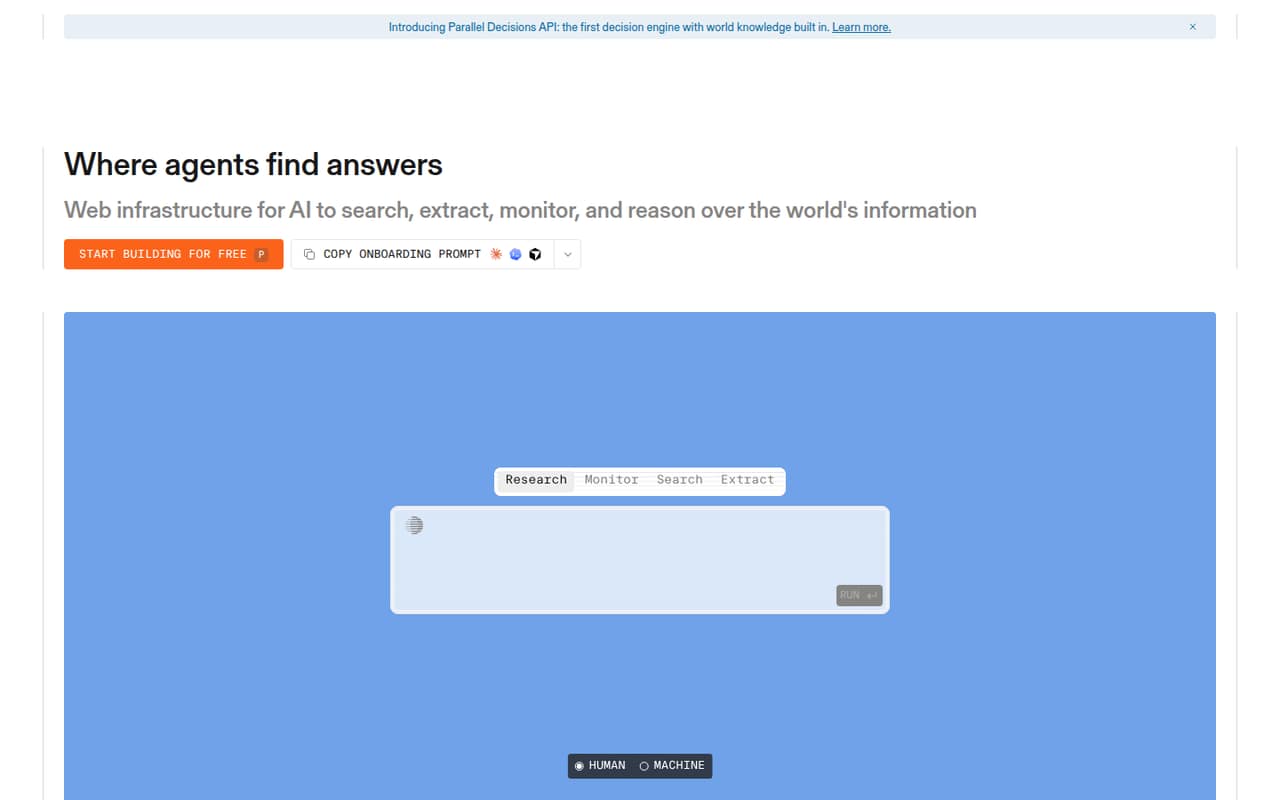
Parallel is hosted web infrastructure for agents: APIs cover search, extraction, monitoring, research and structured enrichment. Outputs can include citations, provenance and confidence scores, which can help applications show where answers came from.
The free Launch plan is for personal use; production teams can use Build’s usage-based billing or Scale’s monthly credits. The API surface is broad, but the homepage does not name SDKs or languages, and Reddit feedback is too sparse to establish broad user sentiment.
Good fit if
- Agents needing fresh web context
- Cited research and account briefs
- Monitoring web changes at scale
Skip it if
- Teams requiring self-hosted search
- Projects needing a named SDK today
- Workloads without usage monitoring
ScoresHow it rates
What works
- Search, extraction, monitoring and research APIs
- Outputs can include citations and provenance
- Structured enrichment includes confidence scores
- Build includes up to 5,000 free monthly requests
- Scale includes $1,000 in monthly credits
What doesn't
- Launch limits vary for personal use
- Homepage names no SDKs or programming languages
- Build usage is charged after credits run out
- Scale credits do not roll over
- Reddit feedback is too sparse to assess sentiment
01What Parallel is, technically
Parallel is a hosted web API service for AI agents, not a self-hosted search server or a standalone application library. It sits between an agent or product backend and the public web: your application sends a search, extraction, monitoring, research or enrichment task, then uses the resulting information in its own workflow. Parallel says its outputs can include citations, provenance and confidence scores.
That makes it retrieval and research infrastructure for products that need information fresher than a model’s training data. The homepage describes use cases such as cited answers inside assistants, alerts when tracked companies or pages change, and structured profiles for accounts or people. Deep research can produce cited briefs for markets, accounts or investment theses. The service’s output is intended to feed products and workflows; it does not replace the agent, model or application layer that decides what to do with that information.
02Parallel API, SDKs and docs
The integration surface is Parallel’s web APIs, with product areas for Search, Extract, Monitor, Task-based deep research, FindAll enrichment and Decisions. The homepage also offers an API Playground, an onboarding prompt and an agents.md file, plus an option to open onboarding in Claude Code, Codex or Cursor. Launch includes web search through Parallel MCP, as well as web page fetch and grounded decisions.
The homepage names no programming languages or SDKs. Confirm supported clients and request formats in the vendor’s docs before choosing an implementation path; the MCP option is a separate named integration surface, not evidence of a language-specific SDK. Build includes 100+ integrations, though the homepage does not enumerate them. The Playground can help explore API workflows, but production code still needs to handle usage, rate limits and the output fields its own application depends on.
03Parallel pricing for developers
Launch is free for personal use and hobby projects. It includes web search through Parallel MCP, web page fetch and grounded decisions, with variable limits for personal use; it is not a published production allowance. Build is usage-based and includes up to 5,000 free requests per month, a $5 monthly credit and up to $80 at signup. After credits run out, usage is charged at published API rates.
Rates start at $1 per 1,000 Search requests, Extract URLs or Decisions requests; $5 per 1,000 successful Task runs; $10 per 1,000 successful Responses requests; and $3 per 1,000 Monitor checks. Additional Search results cost $1 per 1,000. Build’s Search and Extract limit is 600 requests per minute. Scale costs $1,000 per month for credits that do not roll over, with a $10,000 upfront annual option for $12,000 in credits over 12 months. Its Search and Extract limit is 1,500 requests per minute. Enterprise pricing and rate limits are custom.
04Parallel: open source, self-hosting and lock-in
Parallel is presented as a hosted API service. The vendor does not publish an open-source licence or self-hosting option on its homepage, so teams should treat the service as hosted-only unless Parallel confirms otherwise. The homepage also does not describe data export; ask the vendor how to retrieve stored monitoring state, configurations and results before committing to long-running workflows.
Migration is likely to involve replacing API calls and adapting application logic, rather than moving a local index. The parts to account for include task definitions, response schemas, citations, confidence scores and any integrations built around Parallel’s monitoring or research workflows. Keep your own durable records of inputs and outputs where your policies allow, and isolate the provider-specific API behind an internal interface. That will reduce the work of switching retrieval providers, but it will not make their indexes or results interchangeable.
05Parallel in production
Build’s Search and Extract limit is 600 requests per minute; Scale’s is 1,500. Launch has variable personal-use limits, while Enterprise offers custom rate limits. These published figures do not cover every API or guarantee capacity for a particular workload, so confirm endpoint-specific limits and expected throughput with the vendor. The vendor does not publish a general uptime target on its homepage; Enterprise includes an uptime SLA.
Check the data terms alongside throughput. Scale offers zero data retention as Hybrid ZDR after a signed agreement, and Enterprise lists custom data retention and a HIPAA BAA. Build and Scale list different support arrangements: Build’s plan details do not include a support commitment, while Scale includes email support. That is not enough user feedback to judge reliability or production outcomes.
From the threadsWhat users say
Its launch claims are positive, but they are not independent user reports, so broad sentiment remains unclear.
designed specifically for AI agents
higher accuracy, reduced costs, and faster latency
proprietary web index
Discussion on HN: https://news.ycombinator.com/item?id=45837425
Questions people ask
What is Parallel?
Parallel is hosted web infrastructure for AI agents. Its APIs cover web search, page extraction, monitoring, deep research and data enrichment. The vendor says outputs can include citations, provenance and confidence scores for use in products and workflows.
Does Parallel have a free plan?
Yes. Launch is free for personal use and hobby projects. It includes web search through Parallel MCP, web page fetch and grounded decisions, with variable personal-use limits. Build also includes up to 5,000 free requests per month, plus a $5 monthly credit and up to $80 at signup.
What programming languages does Parallel support?
The homepage names no programming languages or SDKs. It presents web APIs, an API Playground, an onboarding prompt, an agents.md file and Parallel MCP for Launch. Check the vendor’s documentation for current SDK and language support before selecting an integration.
Can I self-host Parallel?
Parallel is presented as a hosted API service. The vendor does not publish a self-hosting option or open-source licence on its homepage. If self-hosting is a requirement, ask Parallel directly whether it offers a deployment option under your intended plan.
What are Parallel’s API rate limits?
Build lists a limit of 600 requests per minute for Search and Extract. Scale lists 1,500 requests per minute for those APIs. Launch has variable limits for personal use, and Enterprise offers custom rate limits. Confirm endpoint-specific limits for your workload with the vendor.