
We may earn a commission if you buy through links on this page. It never changes a score or a ranking. How we make money
The bottom line
A governed visual platform for enterprise apps and agents, with custom pricing and migration trade-offs.
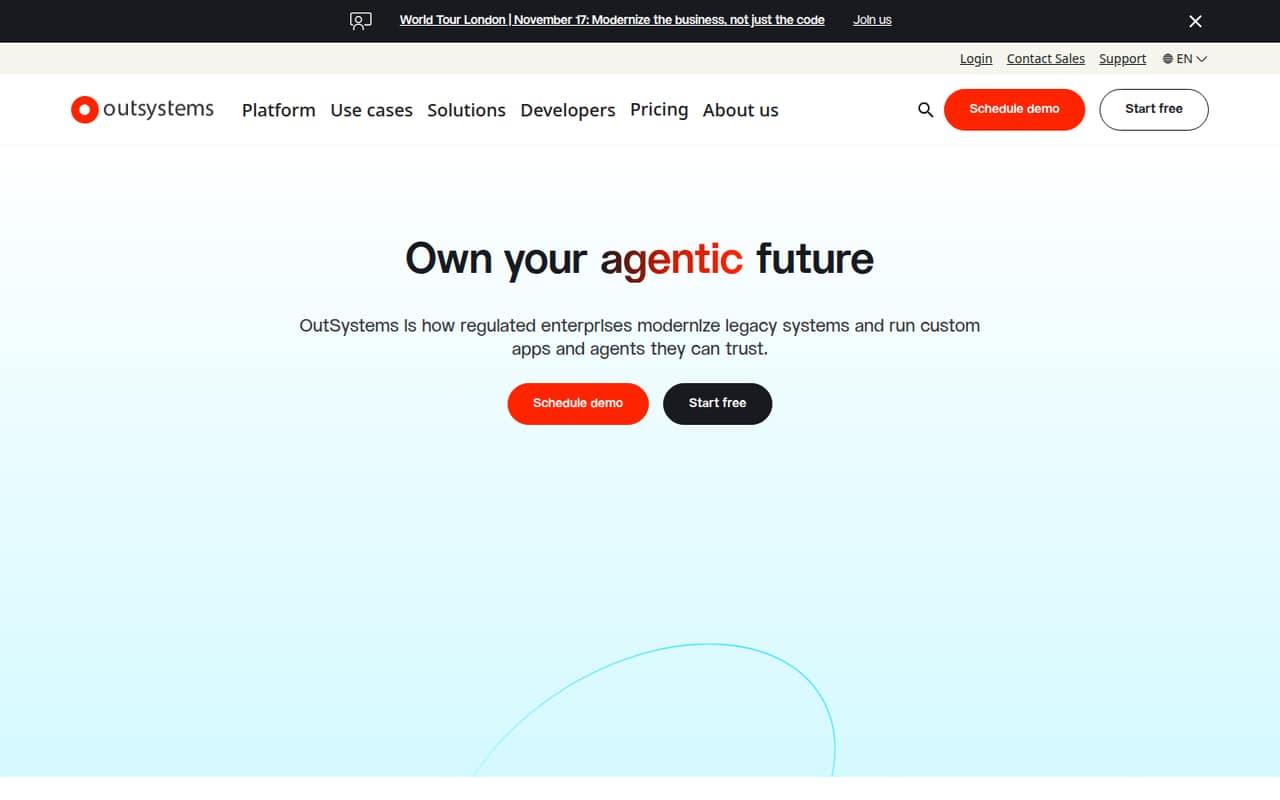
OutSystems is a visual, model-driven development platform for custom enterprise applications and AI agents. It combines an IDE, AI-assisted development, workflow orchestration, a virtual data layer and enterprise integrations. Personal Edition is free, while production plans and add-ons require a quote.
Developer sentiment is mixed: Reddit commenters describe faster delivery for suitable internal apps, but warn that extensive customization and inexperienced implementation can add complexity. We’d evaluate it against the skills, governance needs and expected lifetime of the applications in scope.
Good fit if
- Governed enterprise app teams
- Legacy modernization projects
- Internal workflow applications
Skip it if
- Teams needing open-source tooling
- Highly bespoke front-end work
- Projects requiring public rate cards
ScoresHow it rates
What works
- Visual, model-driven application development
- AI agent creation and coordination tools
- Guardrails, evaluations and monitoring for agents
- Virtual data layer for apps and agents
- Free Personal Edition for evaluation
What doesn't
- Production platform pricing is quote-based
- User and runtime additions can raise costs
- Self-hosting is an add-on option
- No named SDK or programming language in the homepage overview
- Reddit users warn against excessive customization
01What OutSystems is, technically
OutSystems is a governed, visual application development platform for building custom enterprise applications and AI agents. Developers work in a model-driven environment, with an IDE for inspecting and refining components created with AI assistance. The platform sits between a team’s application requirements and its existing systems: it provides the development environment, application runtime options, workflow tools and integration layer rather than acting as a standalone library or command-line tool.
The platform includes Agent Workbench for creating and coordinating agents, Agentic Workflows for human-agent handoffs, and Data Fabric as a virtual data layer for AI apps and agents. Enterprise integration is positioned around connecting systems, applications and AI models. OutSystems Cloud deployment is included in Personal Edition; the enterprise plan lists development, testing and production runtimes. Self-hosting options are available as an add-on, so deployment architecture should be confirmed as part of the enterprise quote.
02OutSystems API, SDKs and docs
The core development path is visual and model-driven: build application components in the IDE, use natural language with the AI coding agent to create applications, then inspect and refine the result. Agent Workbench adds tools to create and coordinate agents with guardrails, evaluations and monitoring. Agentic Workflows handle automated processes and human-agent handoffs; Data Fabric provides a virtual data layer.
The homepage positions integrations at the level of systems, apps and AI models, and points developers to documentation, training, community forums and the Forge marketplace. It does not establish a particular coding language or SDK as the integration standard. Before committing, confirm in the vendor’s docs which SDKs, API protocols and extension options fit your codebase, including whether your required REST API, webhooks, CLI or plugins are supported. Also confirm how generated components, existing services and deployment pipelines fit together; those details affect how much work remains outside the visual environment.
03OutSystems pricing for developers
OutSystems Personal Edition is available at no cost. It includes up to 100 internal users, one development runtime, OutSystems Cloud deployment and 8×5 professional support. That makes it an evaluation option, but it is not the listed configuration for a production enterprise app with separate testing and production runtimes.
The OutSystems Agentic Systems Platform is quote-based and starts with 100 internal users, three runtimes for development, testing and production, a 99.5% uptime guarantee, ISO 27001 compliance and 8×5 professional support. The vendor doesn't publish monthly or annual prices, or a per-request or compute rate, so teams need a quote to model actual spend. The listed add-ons include additional internal and external users, more non-production and production runtimes, 24×7 support, 99.95% uptime, certifications, mobile app shielding and self-hosting options. Ask how your user count, runtime needs and support level change the quote before sizing a production project.
04OutSystems: open source, self-hosting and lock-in
The vendor doesn't publish an open-source licence or a data-export process. The platform should therefore be evaluated as a governed development environment, not as a source-available framework that can be forked and maintained independently. OutSystems lists self-hosting options as an add-on, so it is not limited to OutSystems Cloud, but the deployment terms and supported configurations need to be confirmed in the quote.
Applications built in a visual, model-driven environment can create migration work if a team later moves to another stack. The degree of that work depends on how much application logic, workflow coordination, data access and agent behavior relies on OutSystems-specific components. Before signing, ask for the export formats and procedures for application logic, data and configuration, and identify which parts would need to be rebuilt outside the platform.
05OutSystems in production
The enterprise plan lists three runtimes for development, testing and production, a 99.5% uptime guarantee and ISO 27001 compliance. Higher uptime at 99.95%, 24×7 support, SOC 2 Type II, PCI DSS and other certifications are listed as add-ons. Confirm the service terms, operational responsibilities, supported deployment model and any limits relevant to your workload before treating those plan features as a production guarantee.
OutSystems promotes integration with existing systems and AI models, but production teams should validate the specific connections, data flows and agent guardrails their applications need. Reddit commenters report that the platform can speed up suitable work, while warning that customization and weak implementation choices can create problems. One commenter describes it as “só mais uma camada de abstração”; another says that ease of development can increase the chance of mistakes. Plan architecture, review generated and visual components, and assign experienced developers to production governance.
From the threadsWhat users say
Reddit sentiment is mixed. Commenters credit OutSystems with faster delivery for suitable projects, but some report complexity from customization, poor implementation and the platform’s abstraction layer.
A nivel de front-end sim. Aquilo complica mais do que ajuda, e as vezes "à mão" aquilo saía mais rapido. Verdade. Mas o valor está em tudo o resto, backend, lógica
Ja vi boas implementações e péssimas implementações
Outsystems é só mais uma camada de abstração
quando se começa a customizar muito começam a trazer mais problemas do que os que resolvem
Questions people ask
What are the drawbacks of OutSystems?
The main trade-offs to assess are quote-based production pricing, added costs for more users or runtimes, and reliance on a visual development platform that may create migration work. Reddit commenters also warn that excessive customization or inexperienced implementation can increase complexity. The impact depends on the application and team.
Does OutSystems have a future?
OutSystems is positioning its platform around enterprise applications, AI agents, agentic workflows and legacy modernization. Its homepage describes Agent Workbench, Data Fabric and enterprise integration as platform capabilities. Those product directions do not guarantee any specific roadmap or longevity, so buyers should assess support terms and exit plans.
Is OutSystems a good company for developers?
It can suit developers building governed enterprise apps and workflows, particularly where visual development and integration with existing systems matter. The platform may be a weaker fit for teams that require open-source control or extensive custom front-end work. Reddit feedback is mixed on the benefits and complexity of the abstraction.
Who are OutSystems' main competitors?
A buyer should compare OutSystems with other enterprise low-code platforms that target governed application development, legacy modernization and workflow automation. The right shortlist depends on deployment, integration, licensing and migration requirements. Confirm each vendor’s current features and commercial terms rather than assuming category-level similarities.
Can OutSystems applications be self-hosted?
OutSystems lists self-hosting options as an add-on. Personal Edition includes OutSystems Cloud deployment, while the enterprise platform has a quote-based configuration. Ask the vendor which self-hosted deployment models are available for your plan, what infrastructure you must operate, and how support and upgrades work.