
We may earn a commission if you buy through links on this page. It never changes a score or a ranking. How we make money
The bottom line
OpenTelemetry-native agent observability with a free, Apache 2.0 self-hosted edition.
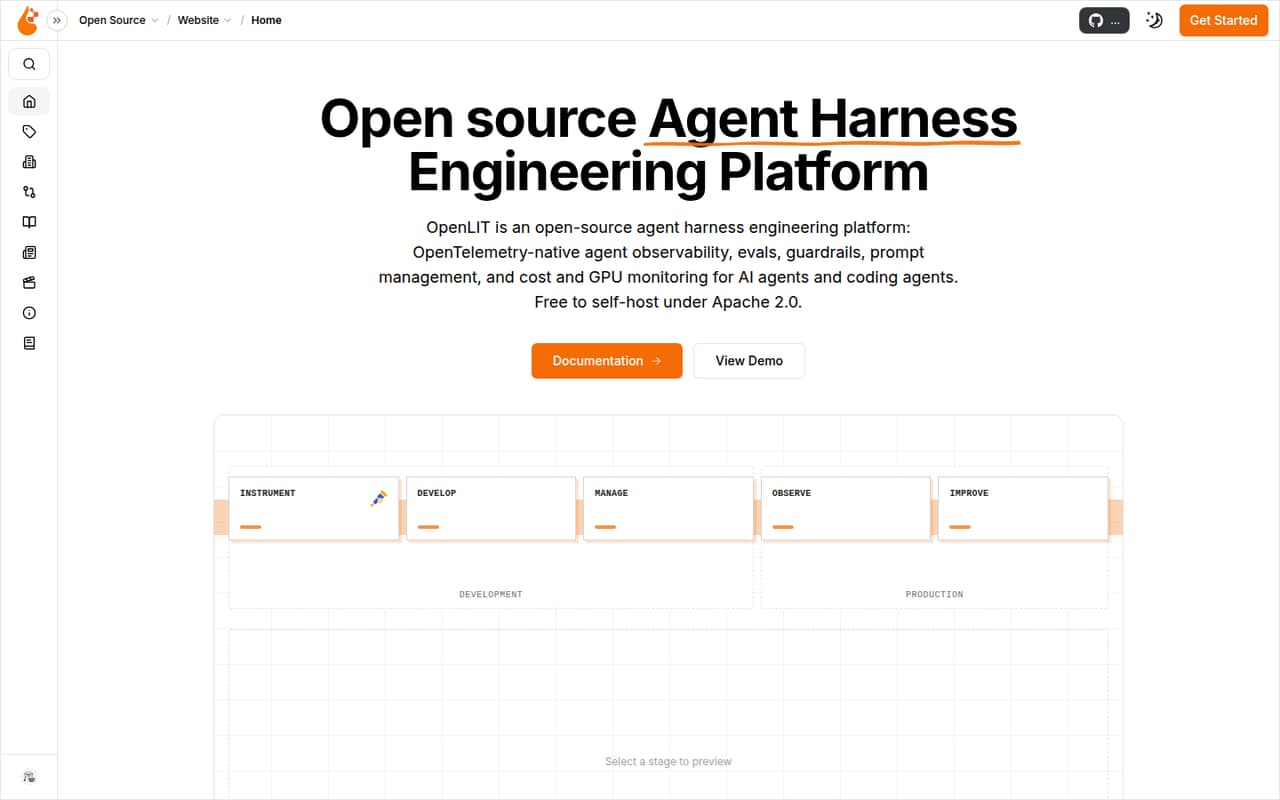
OpenLIT is a self-hosted platform for tracing, evaluating and managing AI agents. Its OpenTelemetry-native design lets teams send traces to OpenLIT or export them to other OTel backends, while the OSS plan is listed at $0 with no per-trace fee.
The trade-off is operational ownership: you run the platform, and the vendor does not publish a cloud launch price or production rate limits. We’d shortlist it for teams already using OpenTelemetry that want agent traces, GPU monitoring and prompt management together.
Good fit if
- Teams already using OpenTelemetry
- Self-hosted AI infrastructure
- GPU-backed LLM deployments
Skip it if
- Teams needing published cloud pricing
- Buyers requiring documented rate limits
- Teams seeking managed-only deployment
ScoresHow it rates
What works
- Apache 2.0 self-hosting is listed at $0
- No per-trace fee for self-hosted usage
- OTLP traces can go to other backends
- Python, JavaScript and Go SDKs are named
- GPU monitoring supports NVIDIA, AMD and Intel
What doesn't
- Cloud pricing is not published
- Enterprise pricing requires contacting the vendor
- Rate limits and usage caps are not published
- Self-hosting puts operations on your team
- A Reddit user reported trouble sending test-app data
01What OpenLIT is, technically
OpenLIT is an OpenTelemetry-native observability platform that you can self-host, rather than only a hosted API or an instrumentation library. The platform receives telemetry from its SDKs and other OTel sources, then provides a UI for tracing, evaluation, prompt management, agent monitoring and cost analysis. It sits beside your application and model stack: instrument your code or send OTLP data to OpenLIT, then inspect traces and metrics in its interface.
The vendor describes the platform as free to self-host under Apache 2.0. Deployment options named on its homepage include Docker Compose and Kubernetes with Helm. OpenLIT also lists a GPU collector and an Enterprise Edition eBPF controller for zero-code instrumentation. The product targets teams that need visibility across LLM calls, tool use, retrieval and agent steps, with evaluations and prompt changes tied to that workflow. Its OpenTelemetry foundation also makes it possible to send telemetry to other OTel backends rather than keeping every trace inside OpenLIT.
02OpenLIT API, SDKs and docs
The homepage names native SDKs for Python, JavaScript and Go. Its Python quick start is pip install openlit followed by openlit.init(). For existing instrumentation, point OTel SDKs, OBI, OpenLLMetry or another OTLP exporter at OpenLIT; the homepage shows an OTLP endpoint using port 4318. It also lists an Enterprise Edition eBPF controller installed with Helm, and a GPU collector run in Docker.
OpenLIT says it supports 56+ integrations across LLMs, agent frameworks and vector databases. Named examples include OpenAI, Anthropic, Ollama, LangChain, LlamaIndex, ChromaDB, Pinecone and Qdrant. The vendor links to documentation and integration listings. The homepage does not describe a separate CLI or REST API as the core integration path, so confirm the exact setup and SDK coverage in the docs for your framework. A Reddit maintainer says the SDK adds auto-instrumentation for supported GenAI tools and emits traces and metrics for OpenLIT or other OTel tools.
03OpenLIT pricing for developers
The pricing page lists the OSS plan at $0 per month for teams self-hosting OpenLIT. It includes unlimited self-hosted usage and no per-trace fee, under Apache 2.0. That makes the software price predictable as trace volume grows, but it does not remove the cost of running the platform: budget for your own compute, storage and operations.
The Enterprise plan is licensed per organisation and listed as “Contact us”; its price and billing terms are not published. The Cloud plan is marked “Coming soon,” with pricing to be shared at launch. No add-ons are listed, and the vendor does not publish usage-based overages, seat charges or rate limits. For the free self-hosted tier, there is no published trace cap to budget against, but infrastructure capacity remains your responsibility. Teams that need managed hosting or contractual enterprise terms should ask the vendor for availability, pricing, billing units and any usage limits before committing.
04OpenLIT: open source, self-hosting and lock-in
The core platform is Apache 2.0 licensed, and OpenLIT says teams can fork, modify and contribute to it. Self-hosting is supported, with Docker Compose and Kubernetes using Helm named as deployment options. The vendor also describes unlimited self-hosted usage under the OSS plan.
Telemetry portability is a clear architectural advantage: OpenLIT uses OpenTelemetry-native traces and metrics, and the vendor says you can export to Grafana, Datadog and any OTLP backend. You can also bring existing OTel instrumentation. That reduces lock-in for telemetry data compared with a proprietary trace format. Moving the surrounding workflow may still require work: prompt versions, evaluations, dashboards and secrets are platform features, so plan how to migrate those separately. Confirm export behavior and formats for each data type you need to retain before making OpenLIT a long-term system of record.
05OpenLIT in production
OpenLIT groups tracing, evaluations, prompt management, API key storage and GPU monitoring in one platform, but a self-hosted deployment means your team owns availability, upgrades and capacity planning. The vendor lists GPU utilization, memory, temperature and power monitoring for NVIDIA, AMD and Intel hardware. It also describes a vault for storing and rotating provider keys and other secrets, with AES-256 shown on the homepage. Check deployment-specific security controls, retention, access policies and compliance requirements with the vendor before storing production data or credentials.
The vendor does not publish rate limits or production scaling figures. One Reddit user reported being unable to send data from a test app, while a maintainer asked how it was integrated. In an older Reddit discussion, a maintainer said logs were not supported at that time and pointed to trace attributes and exceptions for debugging; confirm current logging behavior in the docs. Test your own exporters, failure handling and storage growth before relying on the platform for incident response.
From the threadsWhat users say
Reddit discussion is mostly encouraging about OpenLIT’s OpenTelemetry approach and GPU visibility. The small set of comments also includes an integration snag and questions about what telemetry is collected.
We provide traces in OpenTelemetry format which can be used in different other llm observability platforms as well like grafana, datadog etc
Congrats, looks like a good product tho I cannot get any data to be sent to it via my test app
Yeah, So metrics its mainly requests, prompt tokens, completion tokens ,total tokens, cost
We additionally support GPU data metrics if you are using
Questions people ask
Is OpenLIT free to use?
The OSS plan is listed at $0 per month for self-hosting, with unlimited self-hosted usage and no per-trace fee. The core platform is Apache 2.0 licensed. You still need to provide and operate the infrastructure. Enterprise is listed as “Contact us,” while Cloud is marked “Coming soon” with pricing to be shared at launch.
Which languages does OpenLIT support?
The homepage names native SDKs for Python, JavaScript and Go. It shows a Python setup using pip install openlit and openlit.init(). For other languages, the vendor describes OTLP ingestion from existing OpenTelemetry sources and an Enterprise Edition eBPF controller for zero-code instrumentation. Check the integration docs for the specific framework and instrumentation path you plan to use.
Can OpenLIT export telemetry to other tools?
Yes. OpenLIT says its traces and metrics use OpenTelemetry and can be exported to Grafana, Datadog and any OTLP backend. The vendor also says teams can send data from OTel SDKs, OBI, OpenLLMetry and other OpenTelemetry instrumentations. Confirm export behavior for the data types and retention period your team requires.
Can OpenLIT monitor GPUs?
Yes. The vendor lists a GPU collector that reports utilization, memory, temperature and power for NVIDIA, AMD and Intel GPUs. The homepage describes running the collector in Docker. OpenLIT also lists GPU monitoring alongside tracing and cost analysis for AI workloads; verify hardware and deployment requirements in the GPU collector documentation.
Does OpenLIT offer a hosted cloud plan?
The pricing page lists Cloud as “Coming soon” and says pricing will be shared at launch. It does not give a launch date or price. The Enterprise plan is listed as licensed per organisation with pricing available by contacting the vendor. Teams that need managed hosting should ask about availability, support terms and billing before choosing a deployment.
Sources
- OpenLIT homepage
- OpenLIT pricing, compiled via web search from openlit.io
- Reddit: OpenLIT: Monitoring your LLM behaviour and usage using OpenTelemetry
- Reddit: OpenLIT: Open source Observability and Evals for LLMs & GPUs
- Reddit: OpenLIT: Open source Observability and Evals for LLMs & GPUs
- Reddit: 🚀 Launching OpenLIT: Open source dashboard for AI engineering & LLM data