
We may earn a commission if you buy through links on this page. It never changes a score or a ranking. How we make money
The bottom line
Flexible agent workflows and self-hosting, with setup friction and a 5,000-session Teams cap to weigh.
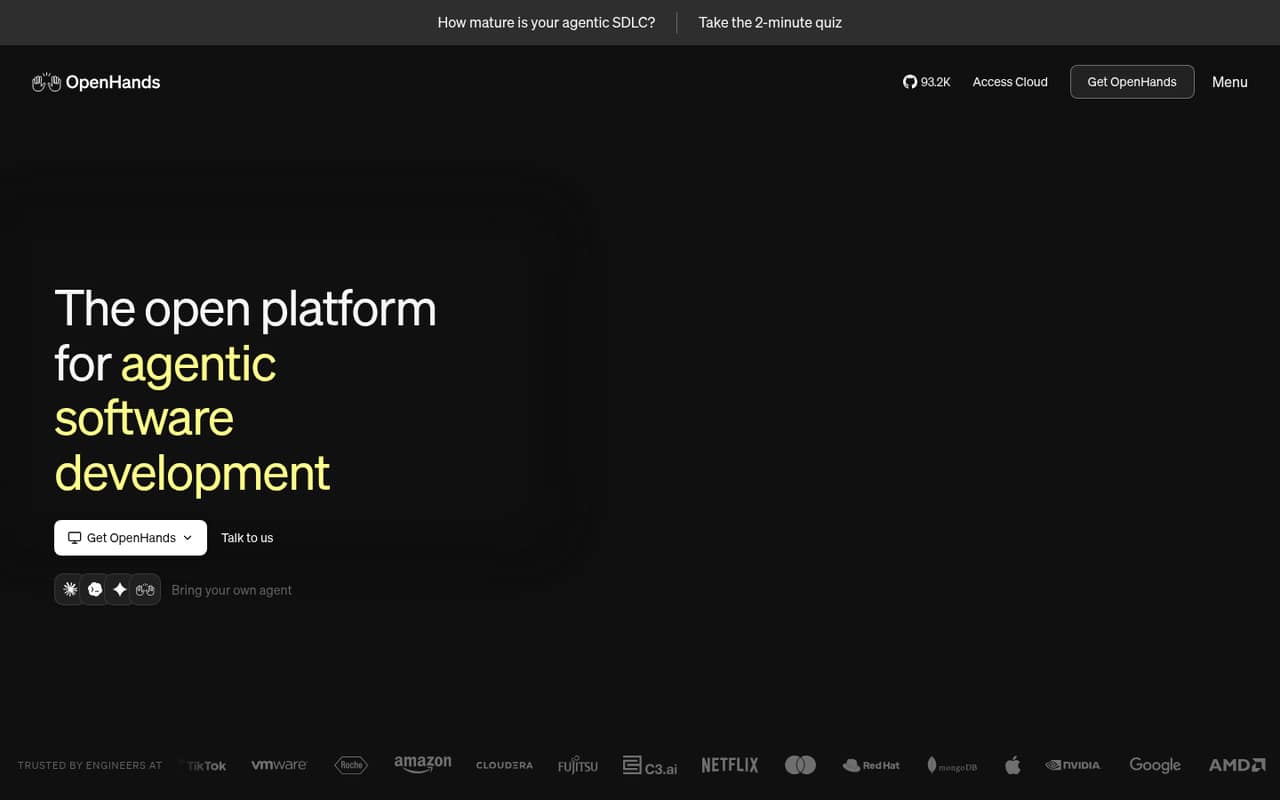
OpenHands is an open platform for agentic software development, with workflows that can run locally, in the cloud or in your VPC. It connects engineering tools such as GitHub, Slack, Jira and Linear, and lets teams choose agents and models.
Agent Canvas is free and MIT-licensed. Teams costs $500 per month for up to 10 users and 5,000 sessions; extra seats are $50 per month each. Reddit comments praise the interface but report setup and documentation problems, particularly around running local models.
Good fit if
- Teams automating repeatable engineering workflows
- Developers who want self-hosting options
- Organizations choosing agents and models
Skip it if
- People who want zero-setup installation
- Teams needing published session overage rates
- Buyers requiring detailed SDK guidance upfront
ScoresHow it rates
What works
- Run locally, in the cloud or in your VPC
- Choose from multiple agents and models
- Trigger workflows from events, schedules and connected tools
- Agent Canvas is free and MIT-licensed
- Teams plan includes identity and role-based access control
What doesn't
- Reddit users report friction setting it up outside Docker
- The homepage does not name SDK languages or API styles
- Teams is capped at 5,000 sessions per month
- Extra Teams seats cost $50 per month each
- Vendor does not publish data export details
01What OpenHands is, technically
OpenHands is a platform for building and running agentic software-development workflows, rather than just a model API or a code editor. It puts agents between engineering signals—such as pull requests, issues, messages and scheduled tasks—and actions such as reviewing code, investigating failures or preparing a change.
The product lets teams choose agents, models and runtimes. Listed agent choices include Claude Code, Codex, Gemini CLI and OpenHands; models can include closed models or open weights such as Kimi, DeepSeek and Qwen. Runtime options include a local machine, the cloud or a team's VPC. That makes it a layer in an engineering stack: it connects tools, gives agents a workflow to execute and supports oversight from planning through monitoring.
Agent Canvas is the interface for building and running automations. OpenHands also lists Cloud, Agent Control Plane and SDK as product areas. Teams can connect tools including GitHub, Slack, Jira and Linear through MCP.
02OpenHands API, SDKs and docs
The homepage lists an SDK as a product area, but does not name its supported languages, API style or command-line interface. We would confirm SDK coverage, installation steps and supported versions in the vendor's docs before designing an integration around it. Do not assume a particular REST API, CLI or language binding from the homepage alone.
The stated integration surface is workflow automation: trigger agent work from events, schedules and connected tools. The homepage names GitHub, Slack, Jira and Linear, and says teams can connect engineering tools through MCP. Examples include reacting to pull requests, triaging issues and responding to Slack mentions. Workflows can plan, execute, validate, ship and monitor work, with engineers retaining review, approval and merge decisions.
The product also presents agent and model choice as configurable, including Claude Code, Codex, Gemini CLI, OpenHands and open-weight models. Reddit users have reported difficulty configuring local Ollama models and gaps in setup documentation. Confirm the current setup path and MCP compatibility for your tools before committing to an automation.
03OpenHands pricing for developers
Agent Canvas is free and open source under the MIT license. Its listed package includes a single user or shared identity, self-hosting on a laptop or shared VM, bring-your-own LLM key and automations. That means the plan has no listed subscription price, but model usage is billed through the provider whose key you bring.
The Teams plan is listed at $500 per month for up to 10 users, 5,000 sessions per month and one organization. It includes self-hosting with identity and role-based access control, plus a 30-day trial. Extra seats cost $50 per month per seat. The pricing page lists no annual billing price, and it does not publish a charge for sessions beyond the monthly allowance; ask the vendor how excess sessions are handled before budgeting production use.
Enterprise pricing is custom. The listed plan includes unlimited seats and organizations, Standard or Premium Support, an enterprise agreement and a customer success manager. The pricing page lists a 30-day trial, but no separate model, compute or usage rates. Treat your model provider's charges and infrastructure costs as separate budget items.
04OpenHands: open source, self-hosting and lock-in
Agent Canvas is listed as free and open source under the MIT license. The platform offers local, cloud and VPC runtime options, while the free plan specifically lists self-hosting on a laptop or shared VM. Teams also lists self-hosting, with identity and role-based access control. These options let an organization keep deployment within its own environment rather than relying only on a vendor-hosted runtime.
The vendor does not publish data export details. Before adopting OpenHands for important workflows, ask how to export automation definitions, execution history and any stored project data. Also check how credentials and tool connections are managed and whether they can be recreated elsewhere. The MIT license can reduce restrictions on using the licensed code, but it does not by itself make workflow configuration or data portable. Migration effort will depend on the agents, integrations and runtime your team chooses.
05OpenHands in production
The clearest published capacity figure is the Teams allowance of 5,000 sessions per month. The pricing page does not list session overage charges, rate limits, concurrency limits or uptime commitments. Ask the vendor about these before routing production work through scheduled or event-driven automations. The product describes identity and role-based access control on Teams; Enterprise lists support options and a customer success manager. The published product material does not establish specific security certifications or compliance controls, so confirm your requirements directly with the vendor.
Reddit feedback points to setup as a risk. One r/LocalLLaMA thread calls the web frontend reasonable but reports broken environment-variable configuration and difficulty getting Ollama working with the documentation available to that user. Another commenter says setup outside Docker on a POSIX environment was difficult. Those are individual reports, not a measure of current reliability, but they make a small deployment test sensible. Verify model context settings, tool calls, authentication, failure handling and workflow recovery with your chosen runtime before expanding use.
Questions people ask
Is OpenHands free?
Agent Canvas is listed as free and open source under the MIT license. It includes self-hosting on a laptop or shared VM, automations and bring-your-own LLM key. Teams is a paid plan at $500 per month. With the free plan, budget separately for any charges from the model provider whose key you use.
How much does OpenHands Teams cost?
The pricing page lists Teams at $500 per month for up to 10 users, 5,000 sessions per month and one organization. Seats beyond 10 are $50 per month each. Annual billing prices are not published, and the vendor does not publish a price for sessions beyond the monthly allowance.
Can I self-host OpenHands?
Yes. The product lists local, cloud and VPC runtime options. Agent Canvas includes self-hosting on a laptop or shared VM, and Teams lists self-hosting with identity and role-based access control. Check the vendor's current deployment documentation for setup requirements, especially if you need to run outside Docker.
Which agents and models can OpenHands use?
The product lists Claude Code, Codex, Gemini CLI and OpenHands as agent choices, and says teams can bring their own stack. It lists closed models and open weights such as Kimi, DeepSeek and Qwen. Confirm support for your specific model, provider and runtime in the vendor's documentation before planning a deployment.
Does OpenHands provide an SDK or API?
The homepage lists an SDK as a product area, and describes connecting engineering tools through MCP and triggering workflows from events, schedules and integrations. It does not name SDK languages or an API style. Check the vendor's docs for supported languages, authentication, integration methods and current SDK capabilities.
Sources
- OpenHands homepage
- OpenHands pricing page
- Reddit: OpenHands + Devstral is utter crap as of May 2025 (24G VRAM)
- Reddit: Why has no one been talking about Open Hands so far?
- Reddit: Релизнулся лучший генератор кода — OpenHands напишет ЛЮБОЕ приложение по одному запросу. Прогеры на GitHub визжат — репа собрала уже 40 тысяч звезд. • Создает сложнейшие проекты с НУЛЯ, может даже склонировать YouTube или за секунду создать целый интернет-магазин.
- Reddit: which is the best agent harness?