
We may earn a commission if you buy through links on this page. It never changes a score or a ranking. How we make money
The bottom line
A capable local coding agent with broad model choice, but free limits and support need scrutiny.
OpenCode is an MIT-licensed coding agent that runs on your machine, with desktop, terminal, mobile and SDK interfaces. It connects to more than 200 model providers, including local models, and supports plugins, MCP servers, custom agents, permissions and undo.
You can start with free models without an account, or bring a subscription and pay for OpenCode Go. The main caveats are that the free-model limits are not published on the homepage and the SDK’s supported languages and API details need checking in the docs. Reddit discussions include both reports of V2 working well and complaints about limits and permission behavior.
Good fit if
- Developers who want model choice
- Local-first coding workflows
- Teams using MCP and plugins
Skip it if
- Buyers needing published free quotas
- Teams requiring stated support commitments
- Projects needing a hosted agent API
ScoresHow it rates
What works
- Runs on your machine across several interfaces
- Connects to more than 200 model providers
- Supports local models and free models
- Offers plugins, MCP servers and custom agents
- MIT-licensed source code is available
What doesn't
- Free-model quotas are not published on the homepage
- SDK languages and API details need checking
- Go Extra Usage pricing is not published
- No separate self-hosted server is presented
- Reddit reports mixed views on limits and V2
01What OpenCode is, technically
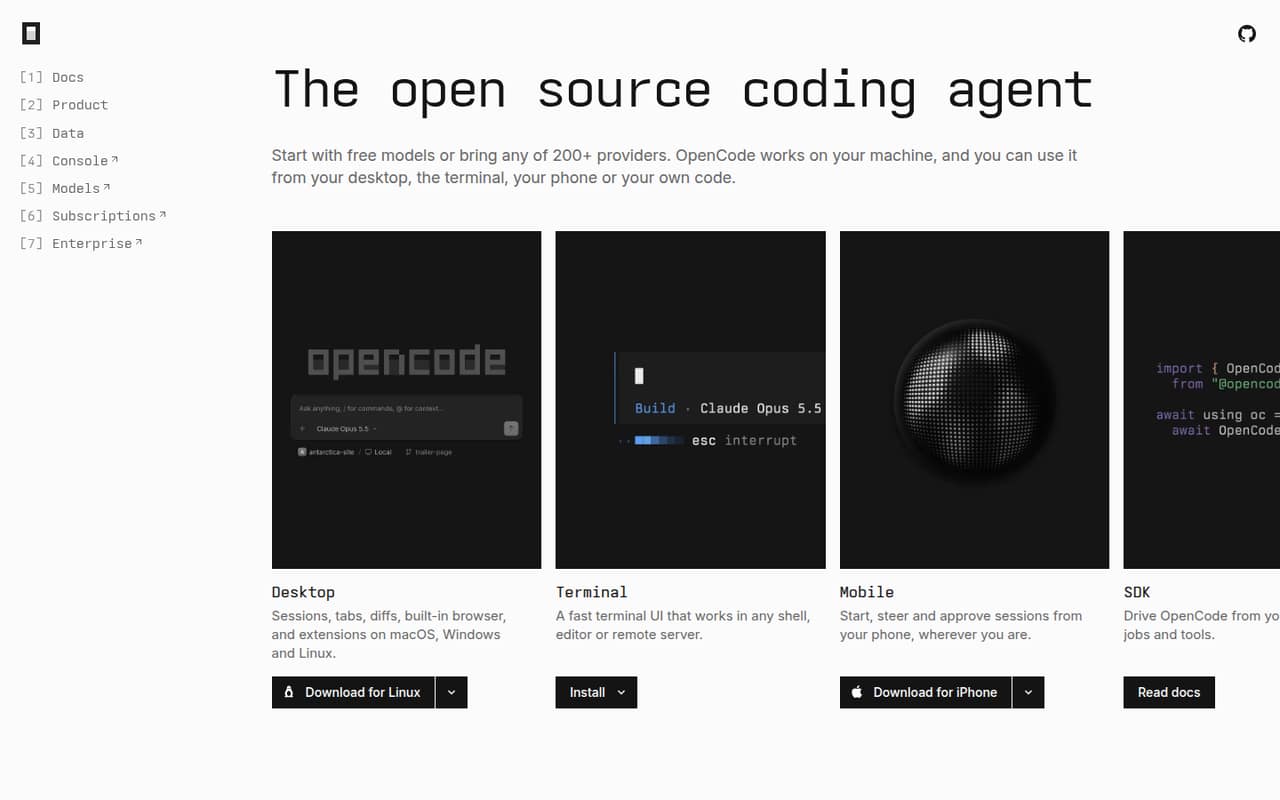
OpenCode is an open-source coding agent that runs on your machine, not a hosted coding API or a hosted-only SaaS app. It sits alongside your codebase: use its desktop app, terminal interface, mobile app or SDK to direct agents working on a project. The homepage lists desktop builds for macOS, Windows and Linux, a terminal UI, an iPhone app through TestFlight and Android as coming soon.
The agent connects to more than 200 LLM providers through Models.dev, including local models. You can start with free models without an account, bring your own subscription, or use OpenCode Go. This lets OpenCode serve as the interface and agent layer while model access comes from a provider or local model. It supports parallel sessions on the same project, MCP servers for additional tools, plugins, custom agents and permission controls. That is a broad integration surface, but it is not a server product that you deploy as a separate hosted service.
02OpenCode API, SDKs and docs
OpenCode offers an SDK for driving the agent from scripts, CI jobs and other tools. Its homepage links to SDK documentation but does not name supported programming languages or describe an API protocol. Before wiring it into a build system, confirm supported languages, methods, versioning and error handling in the vendor’s SDK docs.
For interactive use, the terminal UI works in any shell, editor or remote server. The homepage lists installation through a curl script, npm package @opencode/cli, Bun, Homebrew and paru. Desktop downloads cover macOS, Windows and Linux. The integration surfaces also include plugins that hook into events, local and remote MCP servers, reusable agent skills in SKILL.md files, and custom slash commands. OpenCode lists GitHub, Linear, Figma, Sentry, Notion, Slack, Supabase and Stripe among services that can be connected through MCP. The docs are the place to confirm setup and SDK support before committing to a particular language or CI environment.
03OpenCode pricing for developers
OpenCode is open source under the MIT license, and the homepage offers free models without an account. The free-model set has limits, but the homepage does not publish its quotas. You can also bring an existing subscription, including ChatGPT Plus or Pro or GitHub Copilot, so model charges depend on the subscription you use.
OpenCode Go costs $10 per month. The pricing page lists curated open-weight models and estimated allowances of 110 Kimi K3 requests or 1,050 DeepSeek V4 Pro requests per five hours. Go Plus costs $40 per month and lists 440 Kimi K3 or 4,200 DeepSeek V4 Pro requests per five hours. These are estimates, not a fixed per-request bill. The page lists no annual billing; subscriptions can be canceled any time. Credit top-ups for Extra Usage are available, but their price is not published. Go Teams starts with Extra Usage on. Check the current allowance and top-up terms before relying on a plan for sustained production work.
04OpenCode: open source, self-hosting and lock-in
OpenCode is MIT-licensed, and its source code is available on GitHub. The vendor describes it as working on your machine and supports local models, so the agent itself is not limited to a hosted interface. The product is presented as a desktop app, terminal UI, mobile app and SDK; the vendor does not present a separate self-hosted server product.
Model choice across more than 200 providers, including local models, gives teams options if they change model vendors. You can also bring an existing subscription rather than use Go. That reduces dependence on one model subscription, but does not establish that every workflow or configuration transfers cleanly. The vendor does not publish data-export details in the homepage text. Before adopting it for a team, check how conversations, settings and project changes are stored and exported, and how to preserve any agent configuration you depend on.
05OpenCode in production
Before putting OpenCode in a production workflow, check free-model quotas, Go allowances, Extra Usage pricing and the behavior when a model limit is reached. The pricing page gives estimated requests per five hours for Go and Go Plus, but those figures are model-specific. The vendor does not publish a rate-limit policy, uptime commitment or support response target in the homepage text. For CI, confirm SDK language support and failure handling in the docs.
Treat permissions and sandboxing as part of deployment review. One Reddit commenter said V2 no longer asked for permission to access other directories and argued that sandboxing mattered more as a result. Other Reddit users report that V2 works fine, including with local models; another thread includes complaints about hard limits on free use. These are individual reports, not a reliability assessment. Test the exact model, permissions and workload you plan to use, and set a fallback for provider outages or exhausted allowances.
From the threadsWhat users say
Reddit sentiment is mixed: some users praise V2 and local-model use, while others object to free-tier limits or raise permission concerns. The discussion is anecdotal and includes disagreements about whether the changes are a problem.
for person from third world its too much
Honestly v2 works fine, and you still have access to free models
The only thing that I think is questionable is that it does not ask anymore for permission for accessing other directories
Opencode v2 works perfect with local models
Questions people ask
Is OpenCode free?
OpenCode is open source under the MIT license, and its homepage says you can use free models without an account. Those models have limits, but the homepage does not publish their quotas. Paid OpenCode Go plans start at $10 per month; you can also bring an existing model subscription.
Which models and providers does OpenCode support?
OpenCode connects to more than 200 LLM providers through Models.dev, including local models. The homepage also says you can use free models or bring your own subscription. Check the current provider and model documentation before building a workflow around a particular model.
Can I use OpenCode from scripts or CI?
Yes. OpenCode offers an SDK for driving it from scripts, CI jobs and tools. The homepage links to the SDK docs but does not name supported programming languages or API protocols. Confirm language support, versioning and failure behavior in those docs before depending on it in a build pipeline.
Does OpenCode work on Windows and Linux?
The homepage lists desktop downloads for Windows and Linux as well as macOS. Its terminal UI is described as working in any shell, editor or remote server. Mobile access is offered through iPhone TestFlight, while Android is listed as coming soon.
Can OpenCode run multiple agents and control their permissions?
OpenCode supports multiple agents in parallel on the same project, custom agents with their own prompts, models and tools, and permissions that let you choose which actions need approval. It also offers undo and redo to roll back recent file and conversation changes.