
We may earn a commission if you buy through links on this page. It never changes a score or a ranking. How we make money
The bottom line
A capable self-managed traffic layer, but custom pricing and limited interface detail complicate evaluation.
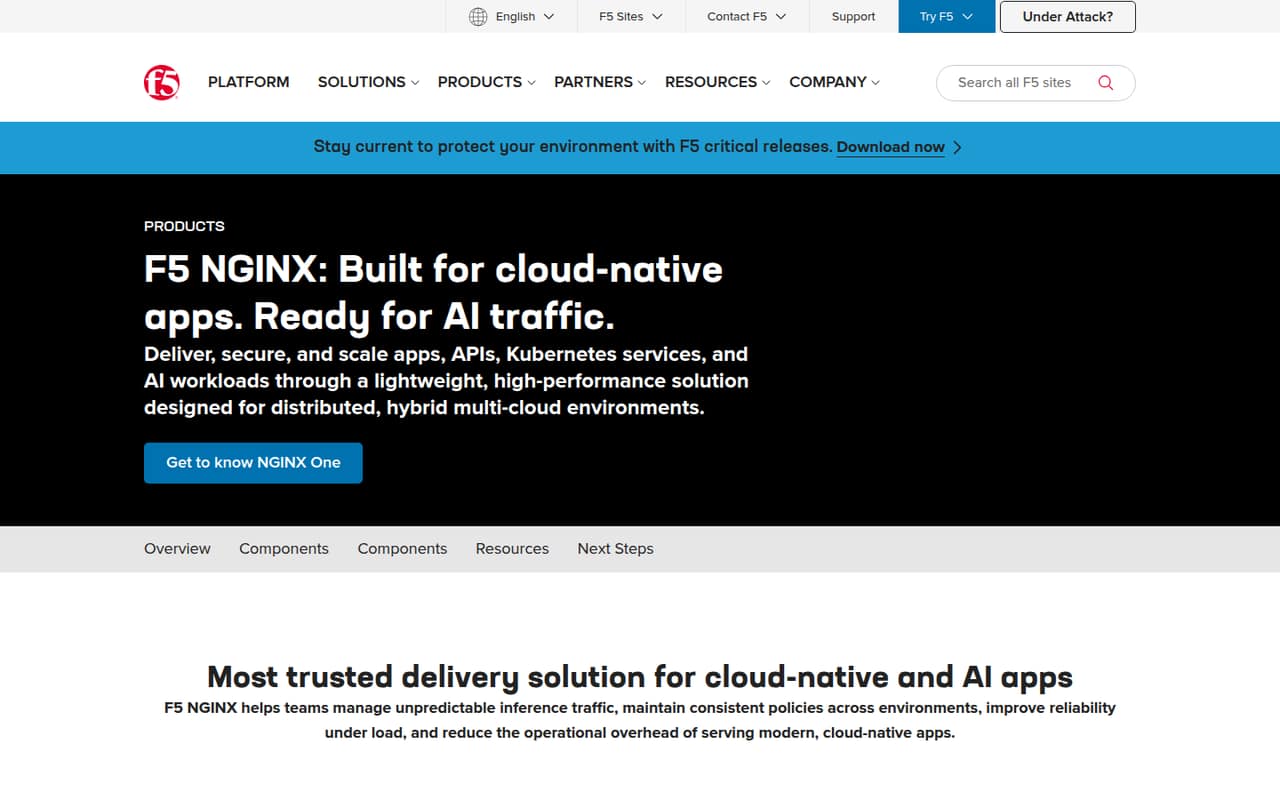
NGINX Plus is software you deploy as a load balancer, reverse proxy, web server, content cache and API gateway. It fits between clients and application services, including cloud-native workloads; NGINX One adds SaaS-based observability, management and security tools.
The pricing page lists a 30-day free trial, but the subscription price is custom and unpublished. Reddit discussions show interest in Plus features alongside concerns about cost, closed-source modules and access to metrics. Teams should confirm pricing, licensing and operational requirements with F5 before committing.
Good fit if
- Teams standardizing application traffic
- Cloud-native and hybrid deployments
- Organizations needing commercial NGINX features
Skip it if
- Projects requiring published subscription prices
- Teams requiring open-source-only components
- Small deployments with tight budgets
ScoresHow it rates
What works
- Combines load balancing and reverse proxying
- Includes web serving and content caching
- Provides API gateway capabilities
- Designed for cloud-native environments
- 30-day free trial is listed
What doesn't
- Subscription price is custom and unpublished
- Seat and usage limits are unpublished
- Public SDK and language details are limited
- Reddit commenters describe Plus modules as closed source
- A Reddit user reports frustration getting metrics
01What NGINX Plus is, technically
NGINX Plus is deployable software for the application traffic layer, not a hosted API or a standalone SaaS application. It combines a load balancer, reverse proxy, web server, content cache and API gateway. In a typical architecture, it sits between clients and application services, routing requests and serving or caching content as configured.
F5 positions it for cloud-native applications and distributed environments. The wider NGINX One offering adds SaaS-based tools for observability, management and security, while NGINX Plus is identified as one of its components. That distinction matters: NGINX One’s management console and SaaS tools are not the same thing as the NGINX Plus data plane.
The vendor also lists separate products for Kubernetes ingress and gateway functions. Teams should map those components to their existing traffic path before deployment, rather than assume every NGINX One component is included in a Plus subscription.
02NGINX Plus API, SDKs and docs
The vendor’s homepage links API documentation, deployment guides and integration guides. It does not name an API style, SDK, programming language or CLI for NGINX Plus. The vendor doesn’t publish those developer-interface details on the homepage, so confirm SDK support, configuration workflows and any management API requirements in the product documentation before planning an integration.
The main integration surface is the traffic layer itself: NGINX Plus handles application and API traffic as a load balancer, reverse proxy, web server, cache and gateway. The homepage also identifies NGINX Instance Manager for identifying, securing, managing and monitoring NGINX Open Source and Plus instances, and NGINX One Console for managing instances at scale. These are distinct components to assess for fleet operations.
The resource center lists product documentation, reference architectures, deployment guides, integration guides and a support portal. Check those materials for the specific protocols and deployment patterns your stack needs.
03NGINX Plus pricing for developers
The pricing page lists a 30-day free trial for NGINX Plus. It does not list a free plan or a starting price. The plan is described as custom, with monthly and annual rates unpublished; seat and usage limits are also unpublished. Ask F5 for a quote based on the intended deployment and confirm what counts toward the subscription.
The cost model is difficult to estimate from public information: there is no published per-instance, request, seat or compute rate to use for a production forecast, and the billing details do not state how charges grow with usage. Confirm whether test and production instances, support, or other components affect the quote before sizing a rollout.
F5 lists F5 WAF for NGINX as a separate component in NGINX One. A Reddit user discussing a small deployment reported being quoted separately for a ModSecurity build, but that is an individual account, not a published price or standard billing rule. Get any required security products and add-ons itemized in writing.
04NGINX Plus: open source, self-hosting and lock-in
NGINX Plus is software deployed in your environment, rather than a hosted-only service. F5 also lists NGINX Open Source as a separate product. In a Reddit discussion, commenters describe Plus as including closed-source modules and say that source packages are not available through the Plus package repository. Treat those claims as user reports, and confirm the current license and source-access terms with F5 before adoption.
Because Plus runs in your infrastructure, the migration work is likely to center on your NGINX configuration and the features your deployment uses. Do not assume that Plus-only modules or directives have direct equivalents elsewhere; inventory them and test replacements before switching. The homepage does not describe a data-export workflow. Clarify how configuration, logs and any management data can be retained or moved, especially if you also use NGINX One services.
05NGINX Plus in production
NGINX Plus is positioned for distributed, cloud-native application traffic, but buyers should validate the deployment limits and operational behavior that matter to their architecture. The pricing page does not publish seat or usage limits. Confirm capacity assumptions, support coverage, update processes, health-check behavior and any relevant availability commitments with F5 before using it as a critical traffic dependency.
Security scope also needs a close read: F5 lists WAF and denial-of-service protection as separate NGINX components, not as part of the NGINX Plus feature summary. Check which controls are included in the proposed configuration and subscription, then test them against your security requirements.
Reddit feedback is mixed. One commenter says getting metrics from NGINX requires Plus or substantial work beyond basic status metrics. Another thread discusses cost and source availability. These are individual reports, not product guarantees; validate monitoring and licensing directly against your requirements.
From the threadsWhat users say
Reddit sentiment is mixed: commenters value Plus features and enterprise support, but raise concerns about cost, source access and metrics.
Honestly WTF
Plus does have some nice features
There are no source packages
What really bothers me is that doing something simple like getting metrics from nginx requires plus (or a lot of hacking)
Questions people ask
What is the difference between NGINX and NGINX Plus?
NGINX Plus is F5’s commercial product combining load balancing, reverse proxying, web serving, caching and API gateway capabilities. F5 lists NGINX Open Source separately. Reddit commenters describe Plus as adding closed-source modules, but buyers should confirm licensing and feature differences in current vendor documentation.
Can I self-host NGINX Plus?
Yes. NGINX Plus is deployable software, rather than a hosted-only service. F5 also offers NGINX One SaaS-based tools for observability, management and security, but those are separate components. Confirm deployment, licensing and any required management services with F5.
How much does NGINX Plus cost?
The pricing information lists custom pricing and a 30-day free trial. Monthly and annual rates, seat limits and usage limits are unpublished. Ask F5 for a quote that covers the intended number of instances, environments, support requirements and any separate security components.
Does NGINX Plus include a web application firewall?
F5 lists F5 WAF for NGINX as a separate component designed to protect apps and APIs from layer 7 attacks. The NGINX Plus feature summary lists load balancing, reverse proxying, web serving, caching and API gateway capabilities. Confirm which security products and services are included in your quote.
Is NGINX Plus open source?
F5 lists NGINX Open Source separately from NGINX Plus. Reddit commenters describe Plus modules as closed source and say source packages are unavailable through its package repository. Verify the current license, source availability and redistribution terms with F5 before relying on those reports.