
We may earn a commission if you buy through links on this page. It never changes a score or a ranking. How we make money
The bottom line
A flexible, self-hosted monitor whose plugin model comes with configuration and migration work.
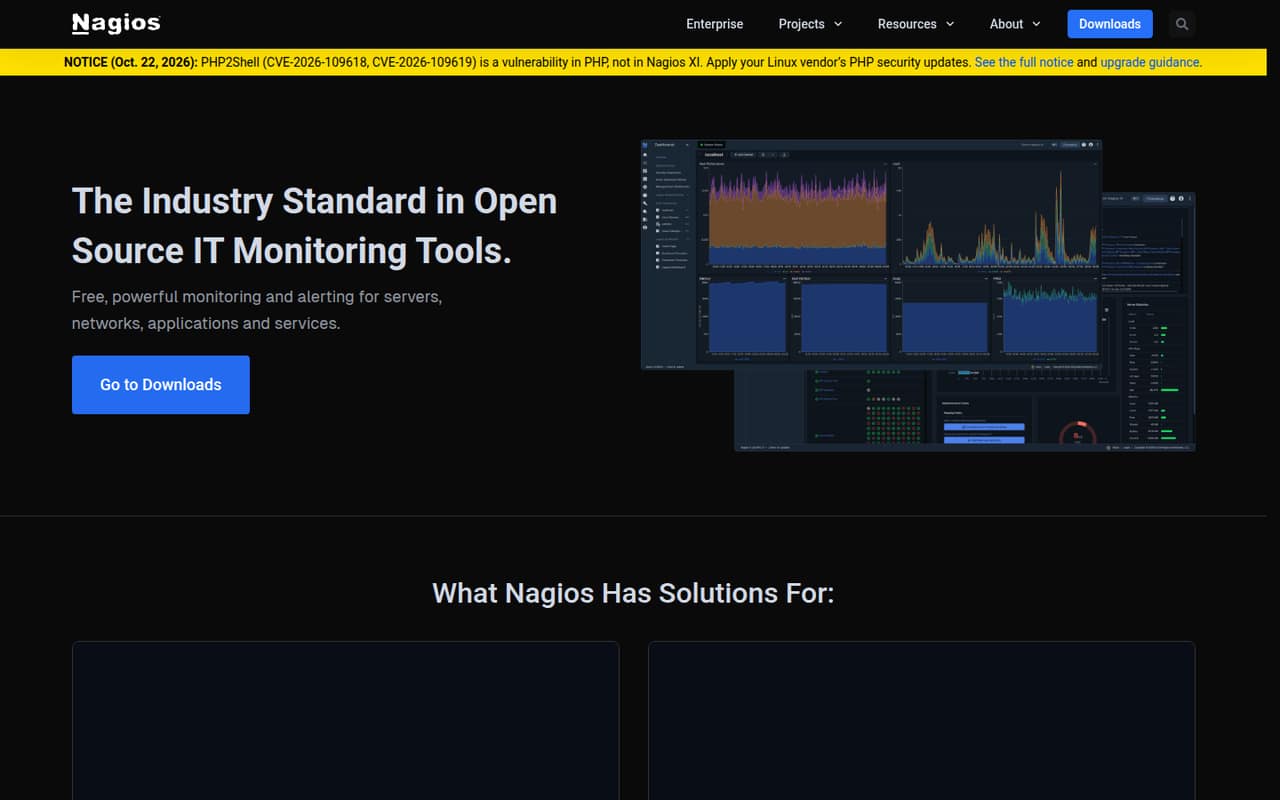
Nagios XI is self-hosted infrastructure monitoring software built around active polling, plugins, and web dashboards. It covers servers, networks, applications, databases, and cloud platforms, with configuration tools for teams moving from Nagios Core.
The free edition is limited to 7 nodes or 100 services, whichever comes first. Paid licenses are one-time purchases by node tier, with the first year of Maintenance & Support included. Reddit discussions flag migration and configuration friction, so budget time to validate imports and operational workflows.
Good fit if
- Teams monitoring mixed infrastructure
- Existing Nagios Core users
- Operators who need plugin flexibility
Skip it if
- Teams seeking a hosted monitoring API
- Projects needing broad free-tier capacity
- Teams avoiding Linux configuration work
ScoresHow it rates
What works
- Monitors Windows and Linux machines, networks, and services
- Active polling covers health, availability, and performance
- Supports databases, applications, and cloud platforms
- Plugin architecture includes NCPA, NRPE, and NSCA
- Enterprise dashboards and configuration tools aid Core migration
What doesn't
- Free Edition stops at 7 nodes or 100 services
- Paid licenses require upfront, node-tier purchases
- Core conversion can fail on required configuration fields
- SDK, API, and language support need vendor confirmation
- Maintenance renewal prices and overage costs are unpublished
01What Nagios XI is, technically
Nagios XI is installable monitoring software that runs in your environment, not a hosted observability API or a client library. It sits alongside the systems you operate and actively polls servers, networks, databases, applications, and cloud platforms for device health, service availability, and performance. Alerts and monitoring data feed its enterprise dashboards.
In a typical stack, XI is the monitoring control plane: operators configure checks and view status, while monitored systems and network devices provide the signals those checks use. Its place in the Nagios family matters. Nagios Core is the open-source monitoring foundation; XI adds enterprise dashboards and easier configuration for teams moving from Core. Nagios also offers separate products for centralized dashboards, log analysis, and network traffic analysis, so XI should not be confused with those components. The vendor describes Nagios as an open-source monitoring offering, but confirm the XI license and deployment requirements for your environment before standardizing on it.
02Nagios XI API, SDKs and docs
The integration model described by Nagios is active polling plus a plugin architecture. The homepage names thousands of plugins and add-ons, including NCPA, NRPE, and NSCA, along with custom monitoring solutions. That gives teams an extension point for checks rather than a stated requirement to build around a particular language or SDK.
The homepage text does not identify a REST API, CLI, SDK, or supported programming languages. Before automating configuration or wiring XI into deployment pipelines, confirm the available API and CLI surfaces, authentication model, and SDK support in the vendor’s docs. Also check how custom plugins are installed, updated, and monitored. The product offers enterprise dashboards and configuration tools, but a Reddit user attempting a Nagios Core import reported that the conversion tool did not add required fields to a hosts.cfg file. Treat migration as a configuration task to test, not a guaranteed one-click import. The homepage provides no rate-limit figures for an API.
03Nagios XI pricing for developers
Free Edition costs $0 per month and stops at 7 nodes or 100 services, whichever comes first. The user-seat limit is not published. A 30-day free trial is listed. For production beyond that free limit, Standard Edition uses one-time node-tier licenses: $2,595 for 100 nodes, $4,395 for 200, and $14,995 for 1,000; 2,000+ nodes requires contacting sales.
Enterprise Edition starts at $4,690 for 100 nodes, $6,490 for 200, and $17,090 for 1,000; 2,000+ also requires contacting sales. Both editions include unlimited services per licensed node and the first year of Maintenance & Support. The Enterprise add-on for Standard Edition costs $2,095. These are perpetual license prices, not monthly or annual subscriptions. The pricing page lists no renewal prices for Maintenance & Support or overage costs, so ask for those figures before budgeting. Costs rise by licensed node tier, not by published request or compute usage.
04Nagios XI: open source, self-hosting and lock-in
Nagios positions its monitoring offering as open source and presents XI as an upgrade path for Nagios Core users. That does not establish the specific license terms or source availability for every XI component; confirm those terms with the vendor before modifying or redistributing code. XI is operated as a self-hosted system: a Reddit user describes booting an XI VHD in Hyper-V, though teams should verify currently supported deployment targets.
The vendor homepage does not describe a general data-export format or export API. A Reddit user reports exporting configuration files from XI for use with Nagios Core, but that is not a guarantee that all XI settings or historical monitoring data transfer cleanly. Lock-in is likely to center on check configuration, plugins, and operational procedures. Test configuration export and a migration path with representative hosts before relying on them.
05Nagios XI in production
The published license tiers reach 1,000 nodes, with 2,000+ handled through sales; each licensed node includes unlimited services. Those figures describe licensing, not a performance guarantee. Before deployment, validate polling frequency, plugin behavior, alert routing, and resource use against your own device count and check mix. The vendor does not publish rate limits or service-level commitments on its homepage text.
Reddit users report a rough edge in Core-to-XI conversion: one operator said the import tool left required hosts.cfg fields out, while another described maintaining Core and XI configurations separately as a pain. That makes migration testing and configuration ownership production concerns. Nagios’s October 22, 2026 notice says PHP2Shell is a PHP vulnerability, not a Nagios XI vulnerability, and advises applying Linux vendor PHP security updates. Review the notice and your Linux patch process rather than treating XI as a substitute for host security maintenance.
From the threadsWhat users say
Reddit sentiment is mixed: users value XI enough to pay for it, while others describe rough interfaces, difficult setup, or import problems. The clearest operational warning is to test migrations and configuration workflows before rollout.
First bug, my hosts.cfg doesn't have max_check_attempts, check_interval, retry_inerval, and that nagios xi convert tool doesnt add them, but its mandatory
No, it's not acceptable in a team environment for there to be a system in place that only one person is capable of using
Frankly, we pay for the full version and it's definitely worth the price
Trust me I was just in your place a few months ago, and now I'm feeling pretty good
Questions people ask
Is Nagios XI free?
Nagios XI has a Free Edition that costs $0 per month and is limited to 7 nodes or 100 services, whichever comes first. A 30-day free trial is also listed. Paid editions use one-time licenses priced by node tier.
What does Nagios XI run on?
Nagios XI is self-hosted monitoring software. A Reddit user describes running its VHD on Hyper-V, and another user discussion refers to Linux setup. Check Nagios’s current installation documentation for supported operating systems and deployment targets before choosing a host.
Can I move a Nagios Core configuration to XI?
Nagios positions XI as an option for teams moving from Core, with enterprise dashboards and easier configuration. A Reddit user reported that the conversion tool missed required hosts.cfg fields. Test the importer with representative configurations and inspect the results before migrating production monitoring.
Does Nagios XI support plugins?
Yes. Nagios describes a plugin architecture with thousands of plugins and add-ons, including NCPA, NRPE, NSCA, and custom monitoring solutions. Check each plugin’s compatibility and maintenance requirements before adopting it for production checks.
What does Nagios XI monitor?
Nagios XI uses active polling to monitor device health, service availability, and performance across servers, networks, databases, applications, and cloud platforms. The vendor also lists Windows and Linux machines, networks, and services among the systems it monitors.