
We may earn a commission if you buy through links on this page. It never changes a score or a ranking. How we make money
The bottom line
MX combines financial data access and analytics, but custom pricing and sparse public integration details make evaluation harder.
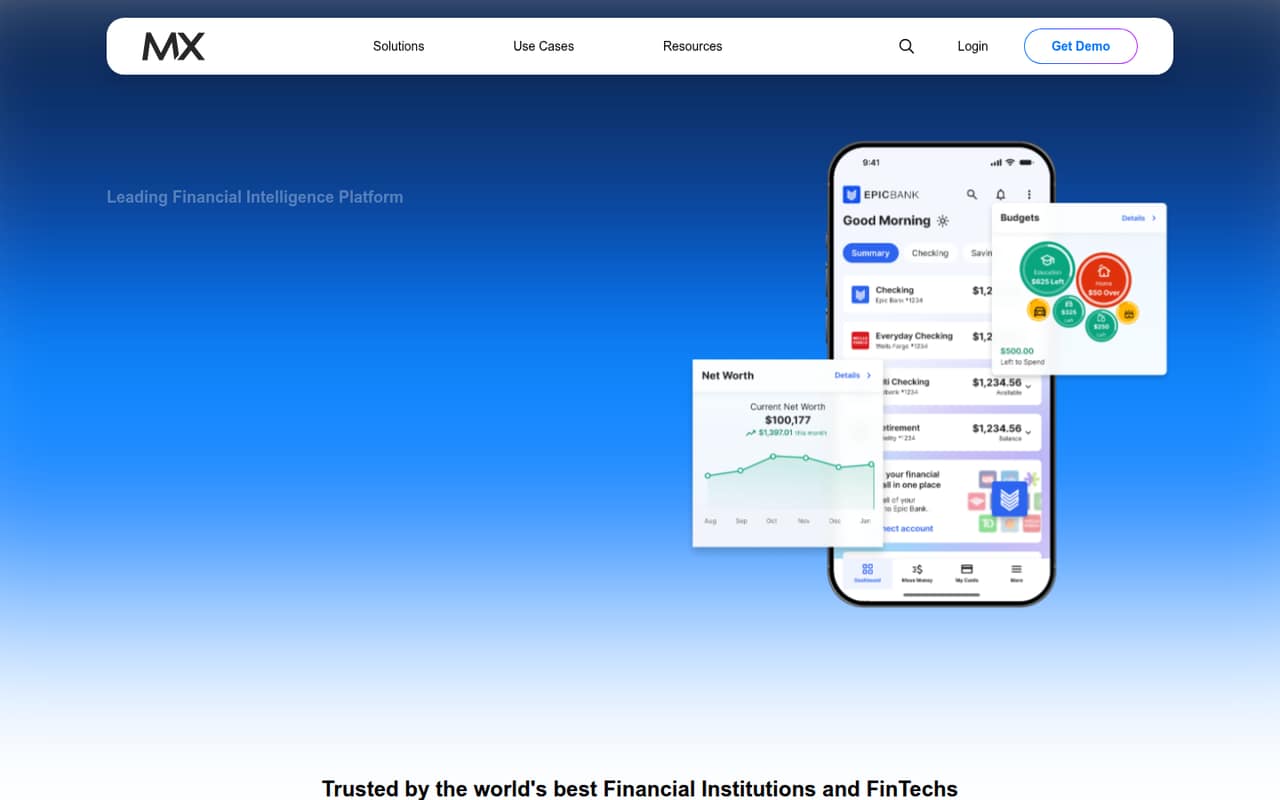
MX is a financial data and analytics platform for financial institutions and fintechs. Its product suite covers account aggregation, consumer-permissioned data access, instant verification, transaction-data enhancement, customer analytics and financial insights.
The product range is relevant to deposit, lending and financial wellness use cases, but public pricing is custom and the homepage provides little technical detail about API implementation. Ask MX for a quote, integration documentation and production limits before committing.
Good fit if
- Financial institutions building digital banking tools
- Fintechs needing permissioned account data
- Teams using transaction data for analytics
Skip it if
- Developers seeking a self-serve free tier
- Teams requiring published usage pricing
- Projects needing a named SDK or language
ScoresHow it rates
What works
- Combines account aggregation and transaction-data enhancement
- Supports consumer-permissioned account connections
- Includes account detail, ownership and balance verification
- Offers customer analytics and personalized financial insights
- Product suite spans connect, analyze, engage and act
What doesn't
- Pricing is custom and not published
- No free plan or trial is listed
- SDK and language support are not named
- Public rate limits and usage caps are not stated
- License, self-hosting and data export terms are not published
01What MX is, technically
MX is a financial data and analytics platform for financial institutions and fintechs. Architecturally, treat it as a managed platform with an open finance API and a suite of connected products, rather than a client-side library or standalone analytics package. Its Connect products handle account access and verification; Analyze products cover customer analytics and data enhancement; Engage includes financial insights and personal financial management; Act covers account opening and deposit switching.
The platform sits between financial data sources and an institution's digital channels or internal workflows. It provides consumer-permissioned account and transaction data, then tools to aggregate, categorize and analyze that information. The intended uses include account opening, lending, deposit growth and financial wellness. MX also offers mobile banking and an AI assistant product called MX Max. The homepage positions these as ways to use financial data in consumer-facing experiences, but buyers should confirm the exact product boundaries and data flows during technical evaluation.
02MX API, SDKs and docs
MX identifies its offering as an open finance API and points developers to product documentation and a service-status page. Its homepage describes secure, consumer-permissioned OAuth connections for account data access, plus products for aggregation, verification, transaction-data enhancement and analytics. That gives teams a clear integration surface to investigate: MX's API and product documentation.
The vendor does not publish SDK or programming-language names on its homepage. Confirm SDK support and the API's specific request and response formats in MX's docs before choosing an implementation. The homepage also does not name a CLI, webhook interface or plugin system, so do not assume those are available. Map the integration against your own systems for consent, account linking, data ingestion and downstream analytics. Ask MX for implementation guidance, supported environments and examples for your target use case; the public product pages alone are not enough to estimate engineering effort.
03MX pricing for developers
MX does not publish plan prices or a starting price. The pricing information lists custom pricing through the sales team, with no free plan and no published free-trial terms. Monthly and annual prices are not published, so a team cannot calculate an initial budget from a public rate card.
The vendor also does not publish a usage formula, request charges, seat pricing, overage rates or add-on prices. That makes it impossible to estimate how a bill changes as connected accounts, data volume or product usage grows. Treat the price as a negotiated quote, not a predictable self-serve API bill. Before signing, ask MX to identify the pricing metric, included products, any minimum commitment, production and sandbox charges, and how additional data volume or connections affect cost. Get overage terms and renewal conditions in writing. Without those figures, MX's value depends on the quote and contract scope rather than a public comparison against other finance APIs.
04MX: open source, self-hosting and lock-in
MX presents a financial intelligence platform and API, not an open-source package. The vendor does not publish a software license or self-hosting option on its homepage, so confirm both directly if they are requirements. The public product positioning is as a managed service; there is no stated deployment path for running MX inside your own infrastructure.
Data portability is a key diligence item. The homepage describes access to and enhancement of financial data, but does not publish export formats or a migration process. Ask what raw and normalized data you can export, whether you can retain it after termination, and how account connections and consumer permissions are handled when moving away. Lock-in risk will depend on your contract, stored data and reliance on MX-specific categorization or analytics. Keep a separate plan for replacing those functions if portability or service continuity matters.
05MX in production
MX's homepage points to documentation and a service-status page, but does not publish API rate limits, availability targets or usage caps. Get those figures from the vendor before designing capacity or committing to a production workload. Confirm how account connection failures, stale data, institution coverage and retries are handled, and how quickly status incidents are communicated.
The platform uses consumer-permissioned OAuth connections and provides financial data used in account and transaction workflows. That makes consent lifecycle, revocation behavior, data freshness and access controls important integration questions. Ask MX for its security and compliance documentation, incident process, data retention terms and support commitments; the homepage does not detail them. Test how your application handles incomplete or inconsistently categorized transactions before making financial decisions or personalizing offers. Build monitoring around connection health and downstream data quality, and agree on escalation paths with MX before relying on the service for account opening or lending.
Questions people ask
What does MX provide?
MX provides financial data access, account aggregation, account verification, transaction-data enhancement, customer analytics and financial insights. Its product suite also includes personal financial management, mobile banking, account opening and deposit switching. The vendor targets financial institutions and fintechs.
Does MX offer an API?
Yes. MX describes its offering as an open finance API and says it supports secure, consumer-permissioned OAuth connections. Its homepage links to product documentation, but buyers should confirm API formats, supported SDKs and implementation details in those docs.
How much does MX cost?
MX pricing is custom through the sales team. The pricing information does not list a starting price, monthly or annual rates, a free plan or free-trial terms. Ask MX for a quote that explains the pricing metric, included products and any overage charges.
Can MX be self-hosted?
MX's public product positioning is a financial intelligence platform and API. The vendor does not publish a self-hosting option or software license on its homepage. If deployment in your own infrastructure or a particular license is a requirement, confirm availability with MX before evaluation.
Does MX provide transaction categorization?
Yes. MX's Data Enhancement product is described as converting transaction details into clean, categorized and consistent data. The vendor also describes using transaction data for analytics and personalized messaging. Confirm supported categories, data coverage and update behavior for your use case.