
We may earn a commission if you buy through links on this page. It never changes a score or a ranking. How we make money
The bottom line
A hosted payment platform with broad coverage, but check integration and migration details before building around it.
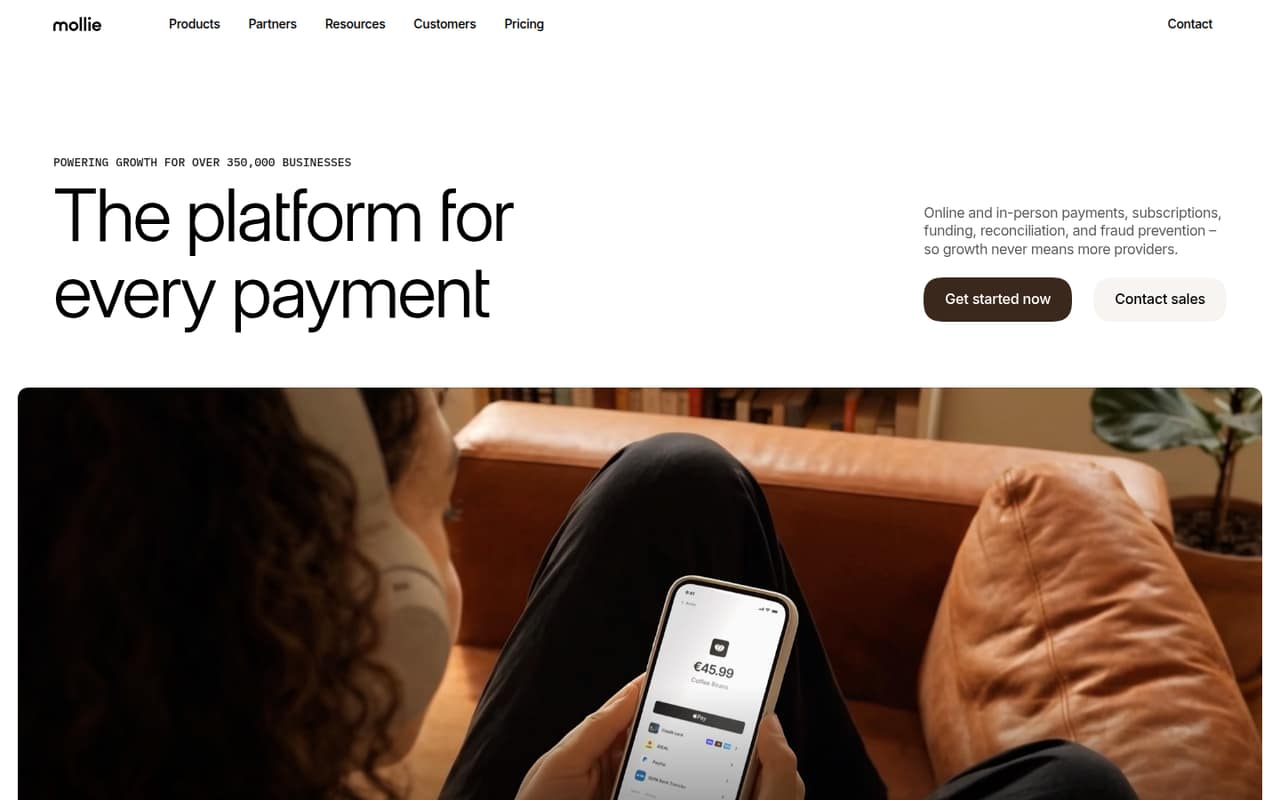
Mollie is a hosted payments and financial platform that combines online and in-person payments, recurring collection, funding, reconciliation and business accounts. Its dashboard also covers refunds, chargebacks and failed payments. The vendor says one integration supports 38 payment methods, but developers should check the docs for the API, SDK and operational details their stack needs.
Standard online pricing has no monthly fee, but successful transactions carry payment-method fees. In-person plans, terminals and business accounts add their own costs. Reddit users describe concerns about verification, support and access to funds, so confirm account review and escalation processes before routing substantial volume through Mollie.
Good fit if
- Businesses combining online and in-person sales
- Merchants needing recurring payment collection
- Teams wanting payments and cash-flow tools
Skip it if
- Teams requiring self-hosted payment infrastructure
- Developers needing documented SDK coverage upfront
- Merchants who cannot tolerate account holds
ScoresHow it rates
What works
- One integration supports 38 payment methods
- Payment Links, Invoicing, Checkout and Recurring are included
- Online and in-person payments share one platform
- Dashboard supports refunds, chargebacks and failed payments
- Standard online pricing has no monthly fee or lock-in
What doesn't
- Transaction fees vary by payment method
- API protocol, SDKs and languages need verification
- Rate limits and uptime commitments are not published
- No self-hosting or open-source option is presented
- Reddit users report verification and funds-access problems
01What Mollie is, technically
Mollie is a vendor-hosted payments and financial platform, not a library, CLI or self-hosted server. It sits between a business’s checkout or point-of-sale flow and payment methods, with a dashboard for managing transactions and related financial work. Mollie says one integration can accept 38 payment methods.
The platform extends beyond payment acceptance: its products include in-person payments, subscriptions, funding, reconciliation, fraud prevention, business accounts, invoicing and payment links. That makes it a potential shared provider for checkout, recurring collection and some back-office payment tasks, rather than a single-purpose card gateway. The dashboard covers refunds, chargebacks and failed payments, and business accounts include IBAN payments and team cards. This breadth may reduce the number of providers a business operates, but it also places more payment and cash-flow operations with one vendor. Before adopting it, map which parts of your existing stack Mollie would replace and which remain separate.
02Mollie API, SDKs and docs
Mollie describes online payments as accepting 38 payment methods “with one integration,” but the homepage does not name an API style, protocol, SDK, programming language, CLI or webhook interface. That leaves important implementation questions for the developer docs: confirm the API protocol, SDK availability for your language, webhook event model, authentication approach, sandbox workflow and payment-method-specific behavior before choosing an integration path.
The product surface includes Checkout, Payment Links, Invoicing and Recurring, alongside in-person payments. For teams building custom checkout or subscription flows, check which operations are available through the integration and which are handled in Mollie’s dashboard. The dashboard also supports refunds, chargeback challenges and failed-payment recovery. Mollie presents team roles for developers, finance, support and admins, with separate logins. That can help separate operational access, but it is not a substitute for verifying API permissions and production credential controls in the vendor’s docs. Confirm supported plugins or commerce integrations with Mollie if your stack depends on them.
03Mollie pricing for developers
Standard online pricing starts at €0 per month, with no minimum costs or lock-in contract. That is not free processing: EEA consumer cards cost 1.80% + €0.25 per successful transaction, and EEA commercial cards cost 2.90% + €0.25. Payment Links, Invoicing, Checkout and Recurring are included; fees vary by payment method, and UK rates are listed in GBP.
For in-person payments, Pay as you go costs €0 per month and lists domestic consumer cards at 1.20%, other consumer cards at 1.80% and commercial cards at 2.90%. Pro costs €20 per month for businesses with monthly volumes over €1,900; one terminal is included, and each additional Pro terminal costs €20 per month. Volume pricing is custom for volumes over €100,000.
Business accounts cost €9 per month after 12 months free, with five accounts and 100 outgoing transfers per month included. Additional transfers cost €0.20 each. Terminals cost €95 or €350 depending on model.
04Mollie: open source, self-hosting and lock-in
Mollie is presented as a hosted payments platform, not as an open-source library or server that you can deploy yourself. The vendor's site does not name an open-source licence or self-hosting option; treat Mollie as vendor-hosted and ask the company about data access, retention and export before signing up.
Moving payment processing can involve more than switching API calls. A commenter on r/PaymentProcessing says token-vault moves can incur a charge, while another points out that migration support and what can be ported are worth checking. That is user-reported experience, not a published Mollie migration policy. Ask Mollie and your current provider which customer records, payment tokens and subscription details can move, what the migration costs, and how long it takes. Confirm that you can export the transaction and customer data your finance and support systems need.
05Mollie in production
Before routing production traffic, ask Mollie for its API rate limits, uptime commitments, incident process and support escalation path. The vendor does not publish rate-limit figures or uptime commitments on its public product page. Confirm how payment failures, delayed notifications, refunds and chargebacks appear in your integration, and test how your application handles retries and reconciliation. Ask what security and compliance responsibilities remain with your team.
Reddit reports are anecdotal, but they raise operational questions worth resolving. One commenter says their account remained in verification for more than 40 days without a support response. A separate r/smallbusiness poster says Mollie closed their business account after an internal review and that a balance remained unpaid; this is the poster’s account, not an independently verified finding. Ask about account reviews, reserve or payout holds, dispute processes and access to undisputed balances before processing material volume. Keep reconciliation records and a contingency plan for switching providers.
From the threadsWhat users say
The Reddit discussion we found here is mostly cautionary, with comments focused on token migration, verification delays and access to funds. These are individual reports rather than a representative measure of Mollie customers.
they do charge for token vault moves (if that is what you mean by data exports)
the migration point is something that sticks out to me
my account has been stuck in verification for over 40 days with 20k$ and no answer from support
Almost €30,000 of our company’s funds are still with Mollie
Questions people ask
What is Mollie used for?
Mollie processes online and in-person payments and offers related tools including subscriptions, payment links, invoicing, funding, reconciliation and fraud prevention. Its business accounts include IBAN payments and team cards. Businesses can use the dashboard to manage refunds, chargebacks and failed payments.
How many payment methods does Mollie support?
Mollie says it supports 38 payment methods through one integration. Fees differ by payment method, and the published pricing information also notes that UK rates are listed in GBP. Check the vendor’s docs for the methods available in your markets and their integration requirements.
Does Mollie support recurring payments?
Yes. Mollie lists Recurring as a product and says its platform supports subscriptions and recurring payment collection. Standard online pricing includes Recurring, though transaction fees still apply. Check the vendor’s docs for the API flow and payment methods supported for your subscription use case.
Can I use Mollie for in-person payments?
Yes. Mollie supports in-store, event and mobile selling. Its pricing lists Pay as you go at €0 per month and Pro at €20 per month for businesses with monthly volumes over €1,900. Hardware terminals have separate listed prices, and transaction fees vary by card type.
Can I move saved payment details to Mollie?
Ask Mollie and your current provider about token portability before planning a migration. A Reddit commenter reports that token-vault moves can involve a charge, but that comment does not establish Mollie’s official migration policy or the cost for your account. Also check what subscription and customer data can be transferred.