
We may earn a commission if you buy through links on this page. It never changes a score or a ranking. How we make money
The bottom line
Mendix covers app building through governance, but production costs and integration details need careful scoping.
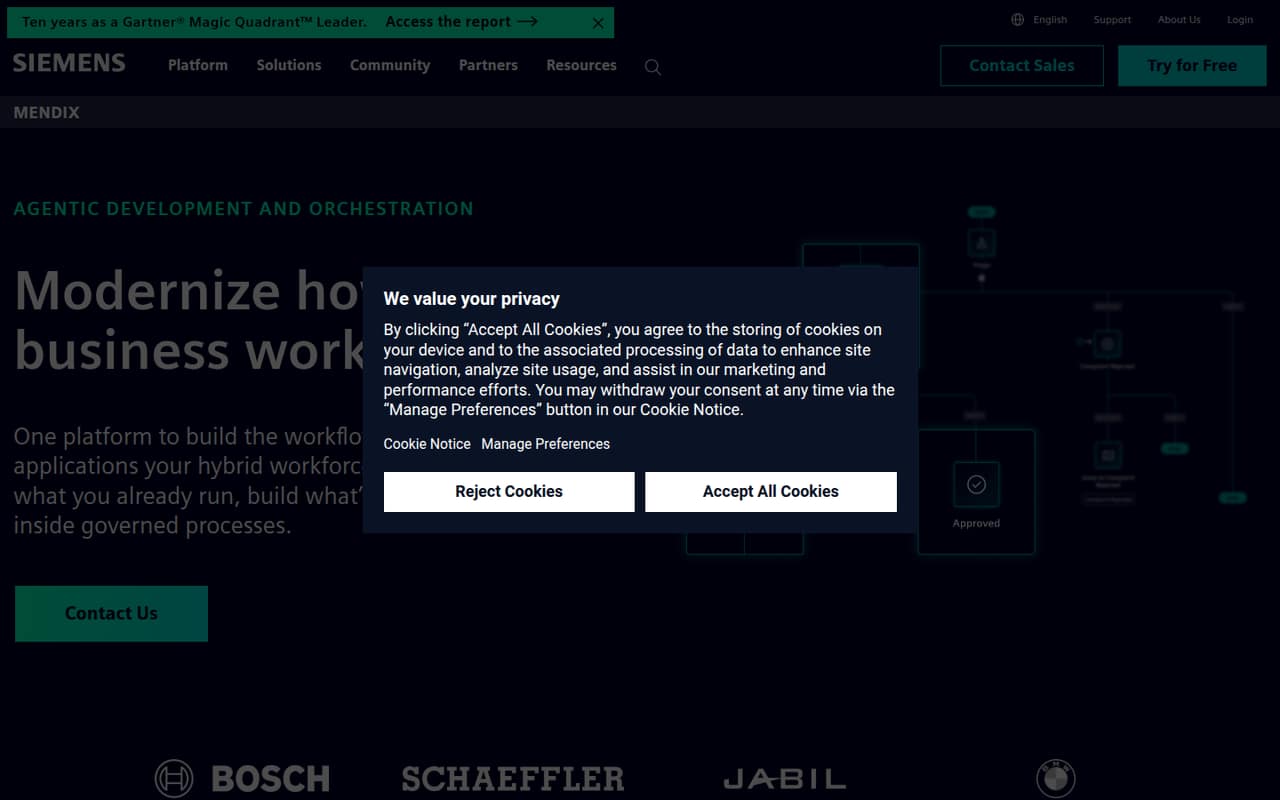
Mendix is a low-code platform for building applications, workflows and AI agents, then coordinating them across people, systems and business processes. It supports visual review of app logic and data, modernization around existing systems, and deployment to public cloud, private cloud or air-gapped environments.
The fit depends on more than the license: Standard and Premium exclude cloud compute, and deployment options cost extra. Standard starts at €918 per month; Premium pricing requires a quote. The platform’s API, SDK and language specifics also need confirmation with Mendix before you plan integrations.
Good fit if
- Teams modernizing existing business systems
- Departments building governed applications
- Enterprises coordinating people and AI agents
Skip it if
- Teams requiring a published SDK matrix
- Projects with fixed infrastructure budgets
- Developers seeking an open-source framework
ScoresHow it rates
What works
- Build apps, workflows and agents in one platform
- Visual review of logic and data
- Governance includes permissions, approvals and audit trails
- Supports public, private and air-gapped deployment
- Standard and Premium list uptime guarantees
What doesn't
- Standard and Premium exclude cloud compute costs
- Deployment options cost extra on paid plans
- Premium pricing requires a quote
- API protocols, SDKs and languages need confirmation
- Open-source licensing and data export details need clarification
01What Mendix Platform is, technically
Mendix is a low-code application development platform for building and coordinating applications, workflows and AI agents. It sits above an organization’s existing systems: teams can connect enterprise data, APIs and operational systems, then add user experiences and processes without replacing the underlying estate. It is not described as a standalone API, library or command-line tool.
The platform combines visual development with AI-assisted generation from prompts, requirements documents or coding agents. Its orchestration layer connects events, people and systems in traceable processes, while governance controls set permissions, policies, approvals and escalation paths. Applications can be deployed to public cloud, private cloud or air-gapped environments. Mendix also supports different AI model choices, including frontier, open-source and private models. For an architecture review, treat it as an application platform with development, orchestration and governance capabilities, and confirm which deployment model fits your operating requirements.
02Mendix Platform API, SDKs and docs
Mendix’s described build surface is visual application development, AI-assisted generation and process orchestration. Teams can start from prompts, requirements documents or coding agents, then review logic and data visually. The platform connects enterprise data, APIs and operational systems, and links business events with people, systems and agents in end-to-end processes.
The vendor does not name a specific API style, SDK, programming language, CLI, webhook protocol or plugin system in its platform overview. That makes it difficult to assess integration effort from the product overview alone. Before choosing Mendix, confirm in the vendor’s docs which APIs and protocols are supported, whether SDKs are available for your languages, and how authentication, versioning and error handling work. Also check how your existing coding agents connect to Mendix and what parts of the generated application can be extended with code. The visual model is central to the described workflow; teams should verify how it fits their source-control and review practices.
03Mendix Platform pricing for developers
Mendix has two free plans at €0 per month: Free (One App) and Free (Unlimited Apps). Both include a free deployment environment for each application, unlimited users and Free Online Academy access, with no credit card or commitment. The free plan’s stated distinction is app count; it does not list a paid-tier uptime guarantee or support.
Standard (One App) costs €918 per month, while Standard (Unlimited Apps) costs €2,295 per month. Both include up to three environments per app, standard support from 9 AM to 5 PM, a 99.5% uptime guarantee and a project dashboard. Premium includes flexible environments, 24/7 support, a 99.95% uptime guarantee, horizontal scalability, HA and fallback, but pricing requires a quote. Prices are monthly in EUR; annual billing and discounts are not published. Cloud compute is excluded from Standard and Premium, and deployment options cost extra. The vendor does not publish those extra prices or overage rates, so scope compute and deployment separately.
04Mendix Platform: open source, self-hosting and lock-in
Mendix supports deployment to public cloud, private cloud or air-gapped environments. That gives teams options beyond a public-cloud-only deployment, but it does not establish who operates the infrastructure or what self-managed responsibilities apply. Confirm those terms with Mendix before treating a private or air-gapped deployment as self-hosting.
The vendor does not publish an open-source license or source availability for the platform, and its pricing does not describe a data-export path. Ask about application-model access, data export formats, exit assistance and any fees before moving production workloads onto the platform. Migration effort may depend on how much of an application uses Mendix’s visual models, governance and orchestration features; plan for a transition review rather than assuming those pieces transfer directly to another stack. The platform can connect existing systems and data, which may help keep some business records outside the application layer, but that is not a substitute for a tested export plan.
05Mendix Platform in production
Standard lists a 99.5% uptime guarantee and up to three environments per app. Premium lists a 99.95% uptime guarantee, flexible environments, horizontal scalability, HA and fallback. Its support is 24/7; Standard support runs from 9 AM to 5 PM. Confirm the service-level terms, support hours that apply to your region and the environments included in your deployment before setting production expectations.
Mendix describes permissions, policies, approvals, escalation paths, audit trails and traceability for actions and decisions. Those controls give teams mechanisms to govern apps, workflows and agents, but they do not establish compliance with a particular regulation or security certification. The platform overview also does not give request limits, rate limits or compute capacity figures. Ask how the limits apply to your chosen deployment and what happens during resource exhaustion. Budget cloud compute separately from Standard or Premium licenses, and include any extra deployment costs in production estimates.
Questions people ask
Who uses Mendix?
Mendix is aimed at product owners, developers, architects and domain experts working together on applications, workflows and AI-enabled solutions. The platform is also positioned for organizations extending core systems and coordinating work across people, systems and agents.
Is Mendix a good fit for building enterprise applications?
It may fit teams that need visual app development, process orchestration and governance in one platform, especially when they want to extend existing systems. Check integration support, deployment responsibilities and total infrastructure costs against your architecture before choosing it.
Can I use Mendix for free?
Yes. Free (One App) and Free (Unlimited Apps) cost €0 per month and include a free deployment environment for each application, unlimited users and Free Online Academy access. The plans do not include the paid-tier support or uptime guarantees listed for Standard and Premium.
Can Mendix run in a private or air-gapped environment?
Mendix states that it can deploy to public cloud, private cloud or air-gapped environments. Confirm the exact deployment architecture, operating responsibilities, supported integrations and additional costs with the vendor for your intended setup.
Can teams choose which AI models Mendix uses?
Mendix says teams can work with frontier, open-source or private AI models and switch as needs change. Confirm which models and configurations are supported for your deployment, along with data handling and governance requirements.