
We may earn a commission if you buy through links on this page. It never changes a score or a ranking. How we make money
The bottom line
Mem0 provides a direct path to persistent agent memory, but production teams should verify controls and costs.
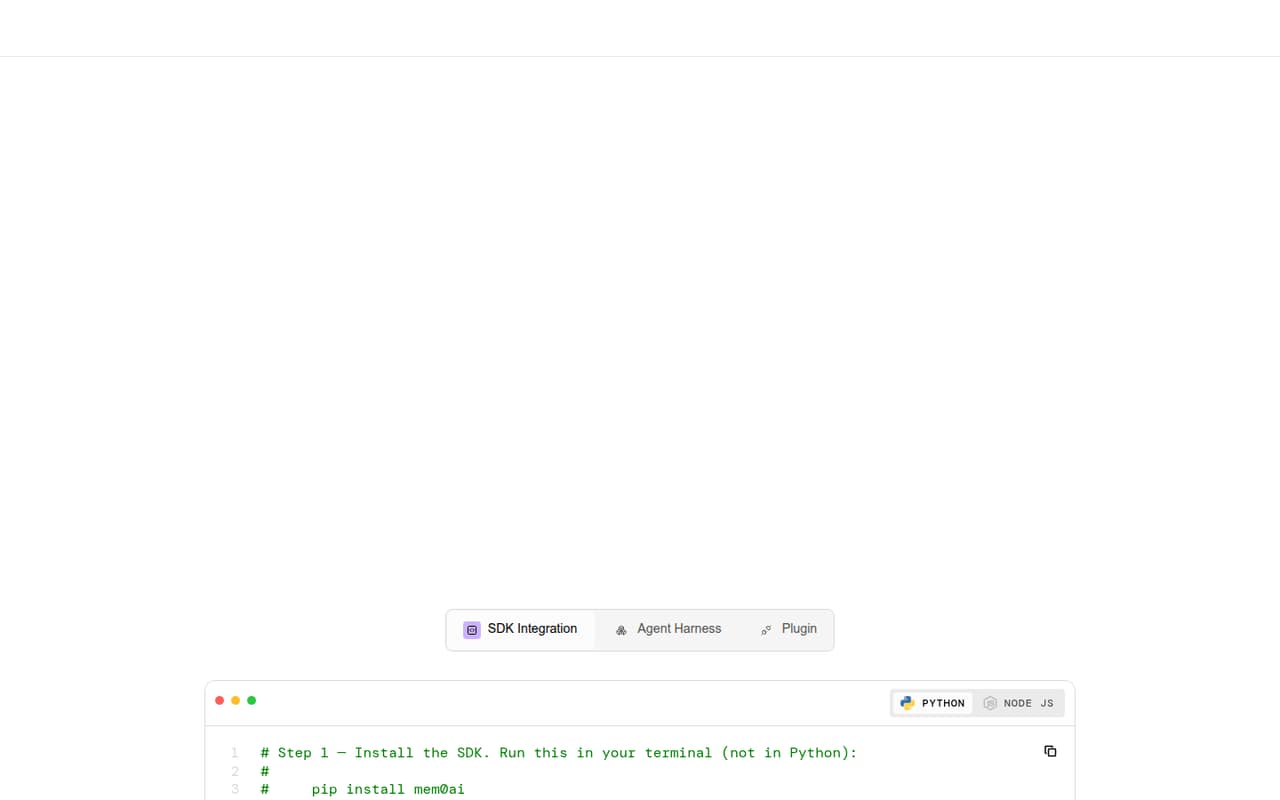
Mem0 is memory infrastructure for AI agents and apps: it extracts, updates and retrieves context across sessions. The Python quickstart uses a MemoryClient with add and search methods; the homepage also lists Node.js, agent harness and plugin integration paths.
The free plan has request limits that change after 30 days when you bring your own LLM key. Mem0 advertises Kubernetes, private cloud and air-gapped deployment, but teams should confirm licensing, data export, rate limits and how it handles stale or conflicting memories before committing.
Good fit if
- Python agent prototypes
- Apps needing cross-session context
- Teams evaluating managed memory
Skip it if
- Workloads needing published rate limits
- Teams requiring clear export terms
- Projects needing verified temporal controls
ScoresHow it rates
What works
- Python quickstart covers adding and searching memories
- Homepage lists Node.js support
- Free tier includes unlimited end users
- Advertises Kubernetes and air-gapped deployment
- Memory extraction and retrieval are core functions
What doesn't
- Free request limits change after 30 days
- Custom plan prices are not published
- Usage-based per-unit rates are not published
- Licence and data-export terms need confirmation
- Reddit users raise stale-memory and trust concerns
01What Mem0 is, technically
Mem0 is persistent memory infrastructure for AI agents and apps. Architecturally, it sits between an application or agent and the model calls that need relevant context: the app submits information, Mem0 extracts and updates memories, and the application retrieves relevant items as users interact. The homepage presents it as a managed service accessed with an API key and SDK, with enterprise deployment options that include Kubernetes, private cloud and air-gapped environments.
That makes Mem0 a memory layer, not a standalone agent framework or a general-purpose model host. Its stated job is to retain selected context across sessions and agents, and to compress chat history into compact memories to reduce tokens and latency. In a codebase, the integration point is the application’s memory-write and memory-retrieval flow. You still need to decide what user or agent identity to associate with each memory and how retrieved context affects downstream prompts. The homepage does not establish that memory writes are automatically safe or correct.
02Mem0 API, SDKs and docs
The homepage’s Python quickstart installs mem0ai with pip install mem0ai, creates a MemoryClient using an API key, then calls client.add(messages, user_id=USER_ID) and client.search(...) with a user filter. It is a compact integration surface for applications that already control their conversation flow; the example uses the same user ID when adding and searching.
The homepage also lists Node.js and presents SDK, Agent Harness and Plugin integration paths. It does not name a CLI or a wire protocol, so teams that need a particular language, REST interface or framework adapter should confirm support in Mem0’s docs before adopting it. The quickstart shows Python code, but it does not settle production questions such as retry behavior, idempotency, timeout configuration or how to handle empty and conflicting results. Treat those as integration checks, not assumptions. The homepage describes the product’s add, learn and retrieve sequence; validate the exact SDK methods and options against the docs for your chosen deployment.
03Mem0 pricing for developers
The pricing page lists Free at $0 per month. It includes 10,000 add requests and 1,000 retrieval requests per month for the first 30 days. With your own LLM key, the listed allowances are 50,000 add requests and 10,000 retrieval requests per month. The plan includes unlimited end users; model calls use Mem0 for 30 days, then your LLM key.
For teams needing tailored volume or agreements, Custom sets add and retrieval volumes, model calls and overage terms in the agreement. Its price and monthly billing terms are not published. Mem0 also lists usage-based billing with a monthly cap you set, but does not publish per-unit rates. That makes request volume and the point at which you switch to your own LLM key central cost inputs. Before production, estimate monthly adds and retrievals, confirm how the Custom agreement handles overages, and ask for a written cost model at expected and peak usage. No per-seat charge is listed; the free plan states unlimited end users.
04Mem0: open source, self-hosting and lock-in
A Reddit poster describes Mem0 as open source, but the vendor doesn't publish a licence in the homepage information available here. Confirm the licence and which components it covers before planning to fork, modify or redistribute the software. Mem0 advertises deployment on Kubernetes, private cloud and air-gapped environments, so it is not limited to the hosted service; ask the vendor which deployment packages and support terms apply to your agreement.
The vendor doesn't publish a data-export path here. Before storing long-lived user or agent memories, establish whether you can export raw records, metadata and embeddings, and in what format. Migration effort will depend on those answers and on how much application logic relies on Mem0’s extraction and retrieval behavior. Keep a stable internal memory interface and retain a source-of-truth record where your application requires an independent exit path.
05Mem0 in production
The vendor doesn't publish request-rate limits or uptime targets. Ask for those alongside retention, deletion, backup and incident-response terms before putting Mem0 on a critical request path. For the free plan, model calls switch from Mem0 to your own LLM key after 30 days; test that transition in the configuration and billing model you expect to use. Enterprise deployment options include Kubernetes, private cloud and air-gapped environments, but confirm security controls and compliance commitments for the specific deployment.
Memory correctness is another production concern. In a Reddit discussion about agent memory, commenters warn that stale facts can look current and that agent-written memory can preserve bad instructions across restarts. These are general risks raised about memory systems, not verified Mem0 defects. Design review and deletion paths for stored memories, and test how your application handles outdated or conflicting results. A Reddit poster says Mem0 “basically work[s]” alongside other tools, while noting a shared MCP concern; the homepage does not list MCP as an integration surface, so verify the claim and relevance for your stack.
From the threadsWhat users say
Reddit discussion is mixed: one poster praises Mem0 as a developer-focused option, while broader agent-memory threads focus on stale facts, trust and memory governance. The comments do not establish Mem0-specific reliability results.
Mem0 is the dev favorite and open source which I respect
Stale facts that look current are the one u/watch_it_burn1 named
The write side is the part nobody prices in when choosing between Mem0, Zep, and files
treat agent written memory like a retrieved document, tagged with what wrote it, since your own notes are the easiest place for a bad instruction to survive a restart
Questions people ask
How does Mem0 integrate with an AI application?
The homepage’s Python quickstart uses the mem0ai package and a MemoryClient created with an API key. The example adds messages for a user ID, then searches memories with that ID as a filter. The homepage also lists Node.js, Agent Harness and Plugin integration paths.
Does Mem0 have a free plan?
Yes. The pricing page lists Free at $0 per month, with 10,000 add requests and 1,000 retrieval requests per month for the first 30 days. With your own LLM key, the listed limits are 50,000 adds and 10,000 retrievals per month.
Can Mem0 be self-hosted?
Mem0 advertises deployment options that include Kubernetes, private cloud and air-gapped environments. Confirm with the vendor which components are available for your deployment, what the licence permits, and what operational or support terms apply.
Does Mem0 support Node.js?
The homepage lists Node.js alongside its SDK integration options. Its displayed quickstart is for Python, so check Mem0’s docs for the current Node.js package, supported methods and setup requirements before choosing it for a production integration.
What should I check before using Mem0 in production?
Confirm rate limits, uptime targets, retention and deletion behavior, security and compliance terms, data export, and the licence for any self-hosted components. Also test how your application handles stale or conflicting memories; Reddit discussions about agent memory raise these as risks for the category.
Sources
- Mem0 homepage
- Mem0 pricing, compiled via web search from mem0.ai, pricingsaas.com
- Reddit: How are you handling long-term memory for your agents? Mem0, Zep, or rolling your own?
- Reddit: Woah. Letta vs Mem0. (For AI memory nerds)
- Reddit: mem0, Zep, Letta, Supermemory etc: why do memory layers keep remembering the wrong things?
- Reddit: I tested 3 memory tools for my agents (Supermemory, Mem0, Vilix AI) and they all share one annoying flaw