
We may earn a commission if you buy through links on this page. It never changes a score or a ranking. How we make money
The bottom line
A hosted email API, campaign service and QA sandbox with useful free tiers and plan-based limits.
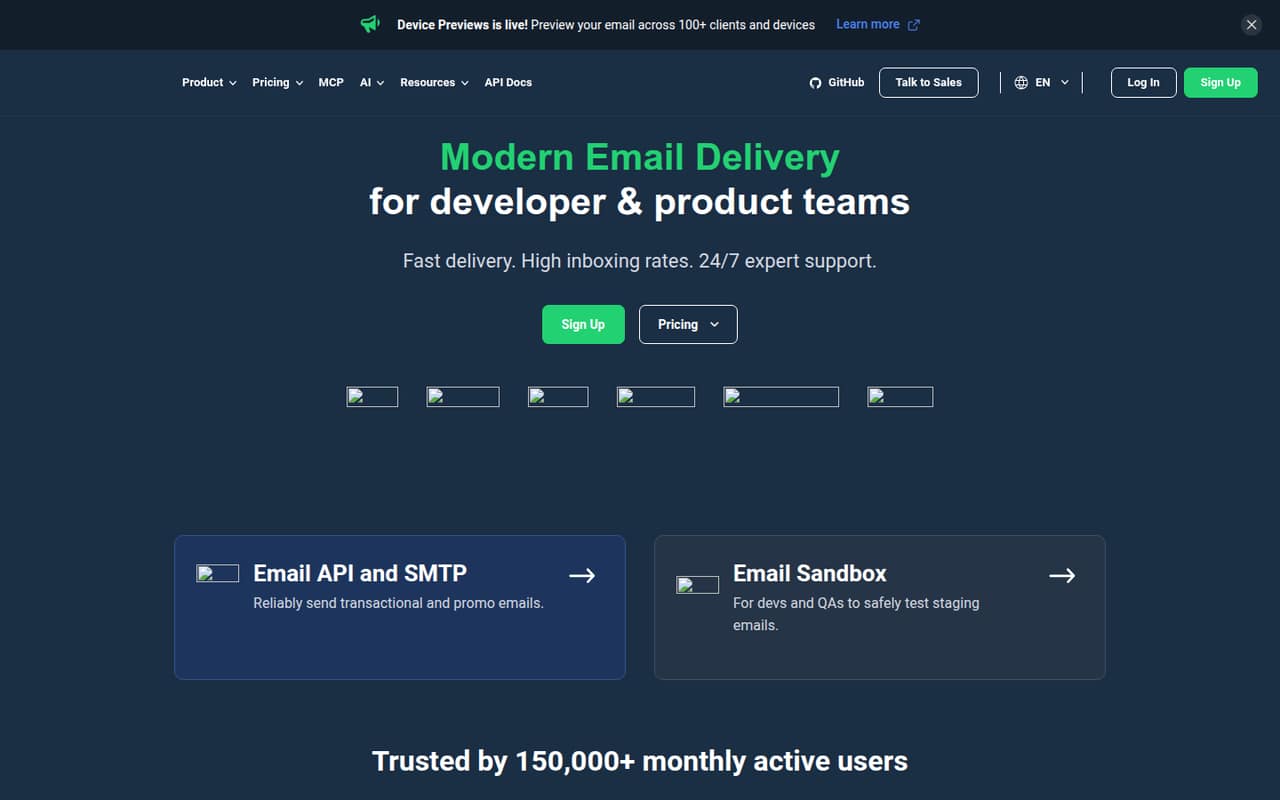
Mailtrap is a hosted email service with a RESTful API and SMTP for transactional and promotional sending, plus a separate Email Sandbox for development and QA. Its Email Marketing product handles campaigns, while dashboards cover delivery metrics and open and click tracking.
The split between real sending and safe test inboxes makes Mailtrap relevant across development and production workflows. Free plans have clear volume limits, and paid plans add capacity, users, domains and log retention. Before adopting it, verify rate limits, service commitments and how you would move templates and reporting elsewhere.
Good fit if
- Teams needing sending and QA in one service
- Developers integrating through REST API or SMTP
- Small teams starting on a free tier
Skip it if
- Teams requiring self-hosted email infrastructure
- Projects needing published rate limits before launch
- Organizations requiring a documented export path
ScoresHow it rates
What works
- RESTful API and SMTP for transactional and promotional mail
- Email Sandbox separates testing from real recipient delivery
- Free plans cover sending, testing and marketing
- Dashboards include delivery metrics, opens and clicks
- Homepage lists 24/7 support from engineers and deliverability experts
What doesn't
- Free API plan caps sending at 4,000 emails monthly
- Email API/SMTP Free has a 150-email daily limit
- Numeric API rate limits and uptime SLA are not published
- No self-hosting option or open-source licence is published
- Data export and migration details need confirmation
01What Mailtrap is, technically
Mailtrap is a hosted email service, not a mail server library or a self-hosted SMTP appliance. Its Email API/SMTP product sits between an application and its recipients: an application sends transactional or promotional email through a RESTful API or SMTP, and Mailtrap handles delivery. Email Sandbox provides a separate hosted inbox for inspecting messages sent from development, staging and QA environments, rather than delivering those test messages to real recipients.
The product also includes Email Marketing for creating, scheduling and sending campaigns. Deliverability dashboards show key metrics for mailbox providers, while open and click tracking and email logs add operational visibility. That makes Mailtrap a broader service than a test-only fake inbox, but it also means teams should treat its products as distinct parts of the stack: production sending, campaign management and test capture have separate plans and quotas. The homepage also lists Email for Agents for inbound email infrastructure, though its details are outside the three core products reviewed here.
02Mailtrap API, SDKs and docs
The primary integration surfaces are a RESTful Email API and SMTP. That gives teams a choice between application-level API calls and the mail transport configuration their framework or service already uses. Mailtrap also provides API documentation, Email Sandbox API docs, and a developer-oriented testing workflow for inspecting messages in staging, development and QA.
The homepage lists native SMTP integration for Supabase and a Vercel integration for sending and testing environments. Claude Code can send email, manage templates and sending domains, and pull stats; Cursor can send email and manage templates. The Mailtrap MCP Server exposes sending, template management and delivery stats to AI clients, and Google Antigravity supports sending and testing email and managing templates. The homepage also has an SDK section, but names no languages in its integration overview. Check the vendor's docs for current SDK support in your language. Confirm framework compatibility and error-handling behavior before committing to an integration.
03Mailtrap pricing for developers
Mailtrap has free plans for Email API/SMTP, Email Sandbox and Email Marketing, but each has a separate quota. Email API/SMTP Free allows 4,000 emails per month, 150 per day, one user, one domain and three days of logs. The API/SMTP Basic plan starts at $15 per month for 10,000 emails; 50,000 emails costs $20 and 100,000 costs $30. Business starts at $85 per month for 100,000 emails and includes a dedicated IP.
Sandbox Free allows 50 test emails per month. Paid Sandbox plans start at $17 monthly or $14 per month with annual billing. Marketing Free allows 500 contacts and 1,500 emails; Essential starts at $15 monthly or $12 per month with annual billing. Email API/SMTP overages are listed at $1, $0.88 or $0.55 per 1,000 emails over the monthly limit, with overages capped. Enterprise email sending starts at $750 per month for 1.5 million emails; unlimited sending has custom pricing. Compare each product's quota separately if your stack uses more than one.
04Mailtrap: open source, self-hosting and lock-in
Mailtrap is a hosted service, not a self-hosted mail server or an open-source library. The vendor doesn't publish an open-source licence, self-hosting option or data-export path. Teams should ask about export and retention before storing workflows, templates or reporting they may need elsewhere.
The sending integration uses REST API or SMTP, so replacing the delivery provider means changing application configuration or API calls and validating the new service's behavior. That is a more portable boundary than relying on a proprietary application framework, but campaign assets, sandbox workflows, logs and analytics may need separate migration work. Mailtrap's hosted dashboards and product-specific features create some operational dependence even if the sending interface is replaceable. Keep message templates and contact data in systems you control where possible, and test a provider change before treating it as a low-risk configuration edit.
05Mailtrap in production
The plans make volume, daily sending, users, domains and log retention explicit, so size against peak traffic rather than monthly totals alone. For example, Email API/SMTP Free has a 150-email daily cap and three days of logs; Business plans include a dedicated IP and 15 days of logs. The homepage advertises up to 30 days of email logs across its analytics feature, while plan entitlements differ. The vendor doesn't publish numeric API rate limits or an uptime SLA on its homepage, so ask about both, along with retry behavior, security controls, data residency and compliance commitments, before making it a critical dependency.
The homepage lists 24/7 expert support from engineers and deliverability specialists, but support availability is not an uptime guarantee. Reddit discussions reflect different uses: some developers use Mailtrap for production sending, while others associate it mainly with testing. One commenter argues that deliverability depends heavily on authentication, list hygiene and sending patterns. Treat provider choice as one part of deliverability operations, not a substitute for them.
From the threadsWhat users say
Reddit discussion is mixed but leans positive about Mailtrap’s usefulness and support. Some commenters view it mainly as a testing tool; others report using its API/SMTP for production, while stressing that deliverability also depends on sender setup.
MailCatcher is an alternative to this which you can run locally on your machine
Right now it's just me on my project, so works just fine
Mailtrap offers API and smtp service, as far as I understand it has been a while
One thing I’ve learned is that deliverability depends way less on the platform itself and way more on how you set things up
Questions people ask
What is Mailtrap used for?
Mailtrap provides production email sending through a RESTful API or SMTP, an Email Sandbox for inspecting test messages in development and QA, and Email Marketing for campaigns. Its dashboards include delivery metrics and open and click tracking.
Can Mailtrap send production email?
Yes. Mailtrap's Email API/SMTP product is for transactional and promotional email sending. The Email Sandbox is for test messages in development, staging and QA, so keep the sandbox workflow separate from production delivery.
Does Mailtrap have a free plan?
Yes. Email API/SMTP Free includes 4,000 emails per month and a 150-email daily cap. Email Sandbox Free includes 50 test emails monthly, and Email Marketing Free includes 500 contacts and 1,500 emails. Each plan has its own limits.
What are Mailtrap's Email API/SMTP Free limits?
The Free plan includes 4,000 emails per month, 150 emails per day, one user, one domain and three days of email logs. If you need more volume, Basic starts at $15 per month for 10,000 emails.
Can Mailtrap be self-hosted?
Mailtrap is a hosted service, and the vendor doesn't publish a self-hosting option. If self-hosting or data portability is a requirement, ask the vendor about export options and plan for a separate provider or infrastructure.