
We may earn a commission if you buy through links on this page. It never changes a score or a ranking. How we make money
The bottom line
A straightforward hosted inbox for automated email checks, with private-domain capacity priced by plan.
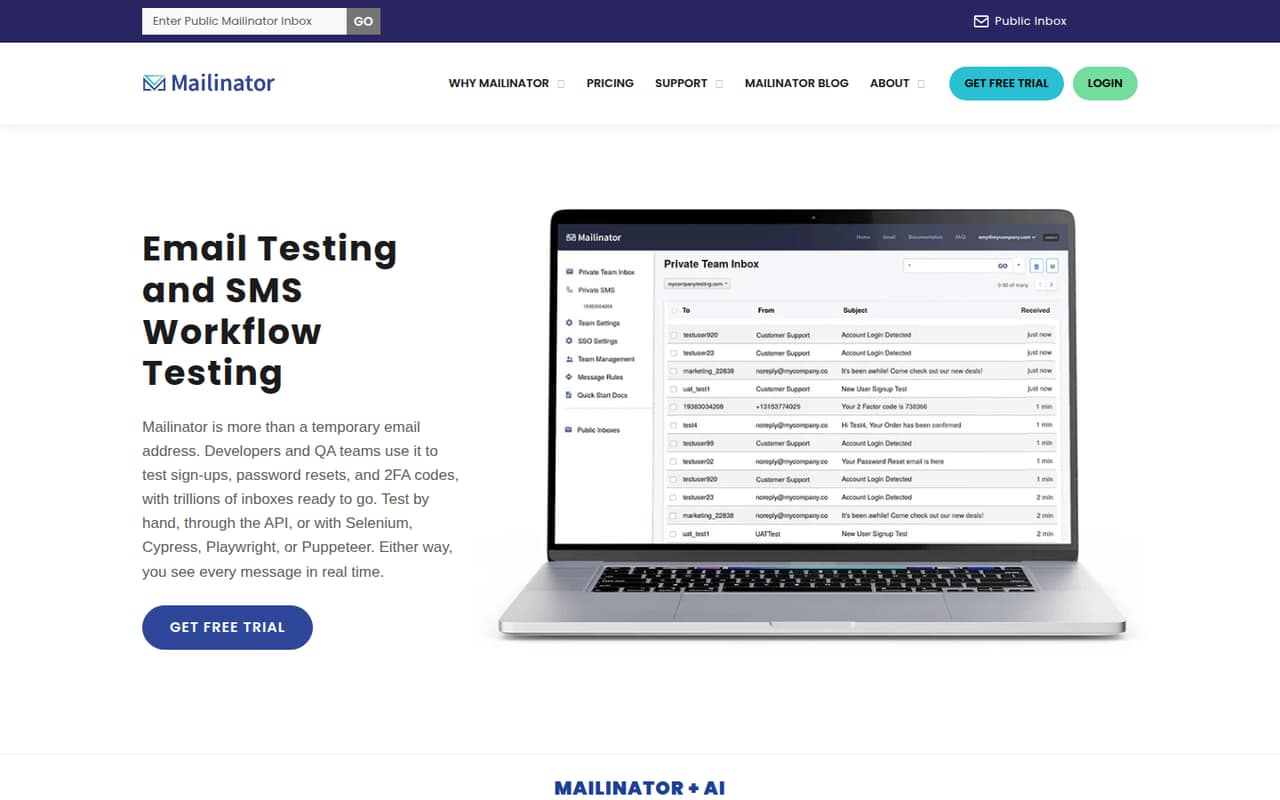
Mailinator is a hosted email and SMS testing service with a web UI, API and automation hooks. It gives QA suites inboxes for checking sign-ups, password resets, OTPs and message delivery without targeting real users.
The free public inboxes are useful for quick checks, but they are public and unsuitable for sensitive test data. The free Verified Pro plan adds a private domain and API access; paid plans raise monthly message limits, seats and sending rates.
Good fit if
- QA teams testing email workflows
- Automated sign-up and reset checks
- Teams needing private test domains
Skip it if
- Sensitive data in public inboxes
- Teams requiring self-hosted infrastructure
- Projects needing published SMS pricing
ScoresHow it rates
What works
- Free public inboxes require no sign-up
- Free Verified Pro includes a private domain and API
- Supports Selenium, Cypress, Playwright and Puppeteer
- Rules can click links or send webhooks
- Paid plans publish email volumes and sending rates
What doesn't
- Public inboxes are unsuitable for sensitive messages
- SMS testing costs extra on eligible plans
- SMS add-on pricing is not published
- Enterprise load testing requires an Enterprise subscription
- License, self-hosting and data-export terms need confirmation
01What Mailinator is, technically
Mailinator is a hosted email and SMS message-routing service, not a library or a server you install in your application. It provides inboxes through a web interface and an API, so an application can send test messages to Mailinator addresses and a test suite can inspect what arrived. The inbox is created when mail is sent; teams do not have to provision each temporary address first.
In a development stack, Mailinator sits between the application’s outbound email or SMS flow and the automated test that checks the result. That makes it useful for sign-up verification, password resets, receipts, OTPs and 2FA journeys. Tests can read messages, extract a link or code and assert on it. Public inboxes support quick manual checks; private domains are intended for controlled team workflows. Mailinator also offers programmable email interactions, including clicking links and sending webhooks to services such as Slack. Its homepage says load testing requires an Enterprise subscription.
02Mailinator API, SDKs and docs
The integration surface is Mailinator’s API, its web UI, email-interaction rules and webhooks. The homepage names Selenium, Cypress, Playwright and Puppeteer as automation tools, and describes tests pulling messages from the API. It does not name an API protocol or authentication scheme, so check the vendor’s documentation for endpoint details, credentials and current limits before wiring a CI job.
Mailinator’s homepage blog lists SDK updates for C# 2.0.0, Python 1.0.9, JavaScript 1.1.2 and Ruby 1.1.1. A separate blog post says Codex used Mailinator’s CLI, but the homepage does not document its commands or supported workflows. Confirm current SDK and CLI support in the vendor’s docs rather than assuming a client covers every endpoint. For other integrations, the stated options are webhooks and rules that can click message links or forward to platforms such as Slack. The vendor also describes running checks in CI on each build.
03Mailinator pricing for developers
Public - Free costs $0 per month and includes unlimited public inboxes, temporary storage, 24/7 uptime monitoring and no sign-up. Verified Pro is also listed at $0 per month for one user, with unlimited private inboxes, one private domain, 10MB permanent storage and 1K emails per month. Its free price does not make it a high-volume tier.
Business is $99 monthly or $79 per month billed annually. It includes five seats, one private domain, 50MB permanent storage, 100K emails per month and up to 20 emails per second. Business Plus is $199 monthly or $159 billed annually, with 10 seats, three private domains, 100MB permanent storage, 300K emails per month and up to 100 emails per second. Enterprise starts at $699 monthly and lists custom seats, 5+ domains, 3MM+ emails per month and up to 500 emails per second.
A two-week Business free trial is listed. SMS testing is available by request for an additional, unpublished charge on Business, Business Plus and Enterprise. Ask about overages and upgrades before launch; the pricing page lists upgrades for Business and Business Plus but no overage rates.
04Mailinator: open source, self-hosting and lock-in
Mailinator is presented as a hosted service accessed through its web UI and API. The vendor doesn't publish its source licence, a self-hosting option or data-export guarantees on the vendor's site available to buyers. Treat it as a hosted dependency unless the vendor confirms otherwise in writing; teams that require source access or control of message storage should ask before adopting it.
Migration risk depends on how much test code is coupled to Mailinator’s API, inbox naming and message format. Keep the inbox-reading layer behind a small internal adapter, and avoid spreading provider-specific calls through application tests. That does not remove the work of moving existing test data or replacing message interactions, but it narrows the code changes if you switch providers. Confirm export formats, retention and account-termination handling with the vendor.
05Mailinator in production
The published plan limits matter when CI runs many parallel workflows: Business lists 100K emails per month and up to 20 emails per second, while Business Plus lists 300K and up to 100 emails per second. Enterprise lists 3MM+ emails per month and up to 500 emails per second. The homepage says Enterprise is required for email load testing. Treat these figures as plan ceilings, not a guarantee of delivery latency or an uptime SLA; the free plan’s 24/7 uptime monitoring is not itself an uptime commitment.
Separate public inboxes from private test domains. Messages in public inboxes are visible to others, so do not send credentials or personal data there. One Reddit thread notes that some sites block Mailinator addresses; that affects using disposable addresses for external sign-ups, though it is less relevant to controlled app tests. Before depending on the service, confirm retention, rate-limit behavior, incident support, security controls and any compliance requirements with the vendor. Add retries and timeouts so a delayed test message does not silently pass or stall CI.
From the threadsWhat users say
Reddit comments describe public Mailinator inboxes as convenient for quick throwaway use, while warning that the inboxes are public and some sites block disposable addresses. The small set of comments is mixed rather than a strong signal about developer use.
This is different from creating a standard email account because you do not need to create the inbox on mailinator.com first
Keep in mind it is public so anything involving sensitive information is best kept out
Some places won't accept mailinator.com addresses for registration emails
I have not had any problems with Mailinator yet (although I've only used it for three sites so far)
Questions people ask
Can I use Mailinator for automated email tests?
Yes. Mailinator says test suites can read messages through its API, and it names Selenium, Cypress, Playwright and Puppeteer as automation tools. Teams can extract links, codes or attachments and assert on them. Check the vendor’s docs for current API endpoints, authentication and SDK details before integrating.
Does Mailinator have a free plan with a private domain?
Yes. Verified Pro is listed at $0 per month for one user and includes unlimited private inboxes, one private domain, 10MB permanent storage and 1K emails per month. The separate Public - Free plan provides unlimited public inboxes with temporary storage, but public messages should not contain sensitive test data.
How much does Mailinator cost for a team?
Business costs $99 monthly or $79 per month billed annually, with five seats and 100K emails per month. Business Plus costs $199 monthly or $159 billed annually, with 10 seats and 300K emails per month. Enterprise starts at $699 monthly. SMS testing costs extra on eligible plans; its charge is not published.
Can Mailinator test SMS and 2FA workflows?
Mailinator describes SMS workflow testing for OTP and 2FA flows. SMS testing is available by request on Business, Business Plus and Enterprise for an additional charge. The vendor does not publish that add-on’s price, so ask for the fee and any message-volume limits before including it in a project budget.
Are Mailinator public inboxes private?
No. Mailinator’s public inboxes are accessible as public inboxes, so they are appropriate only for non-sensitive checks. For team workflows, Verified Pro includes a private domain, while paid plans add private domains and storage. Keep credentials, personal data and production messages out of public inboxes.
Sources
- Mailinator homepage
- Mailinator pricing, compiled via web search from mailinator.com, usebouncer.com
- Reddit: LPT: Need a throwaway email on the spot? Mailinator.com provides a free public inbox for random things that require an email.Use any phrase followed by "@mailinator.com." Example: Potatoes@mailinator.com.
- Reddit: YSK about Mailinator - a temporary, disposable email address that requires no registration
- Reddit: I made a Mailinator clone: Mailnesia.com!