
We may earn a commission if you buy through links on this page. It never changes a score or a ranking. How we make money
The bottom line
Managed OpenSearch, Prometheus and Grafana, starting at $25/month with a 14-day trial.
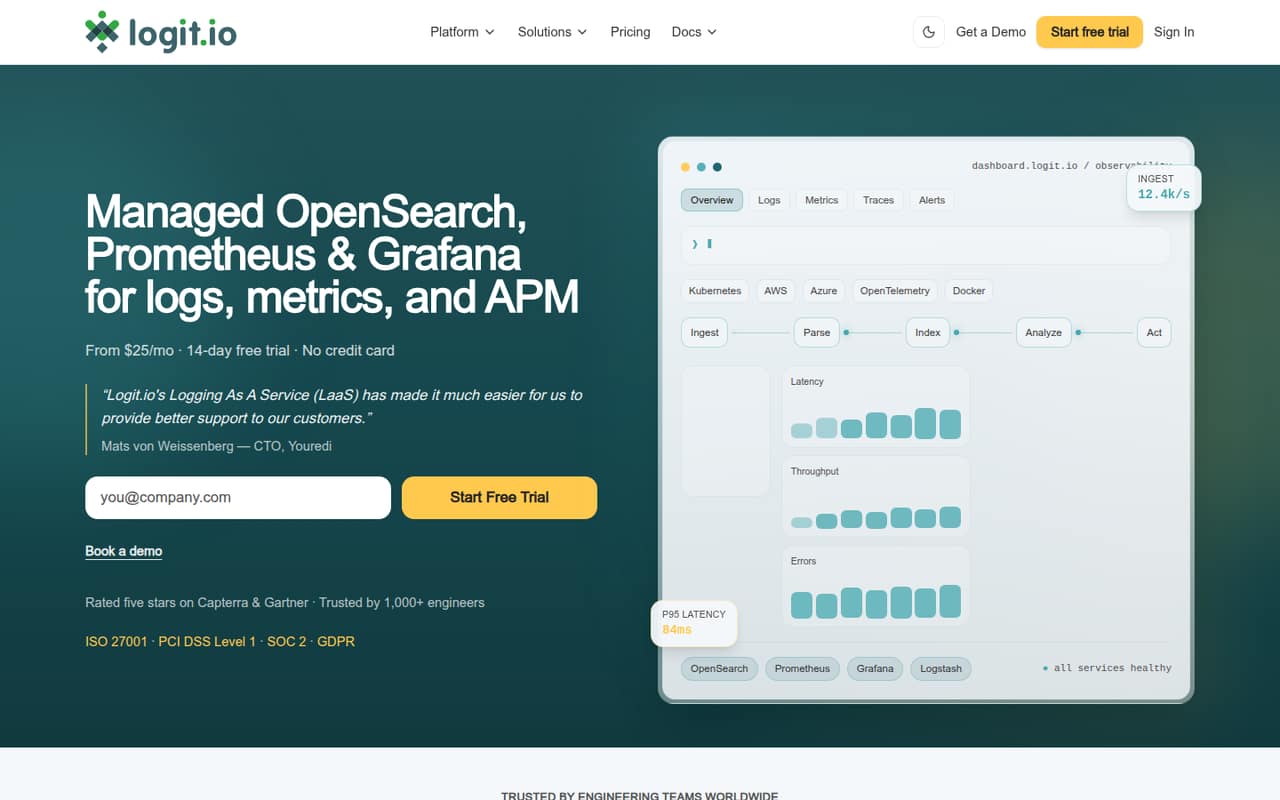
Logit.io is a hosted observability service for logs, metrics and traces, built around managed OpenSearch, ELK, Grafana and Prometheus. Its dashboard provides integration setup, and every plan includes a hosted OTLP/HTTP endpoint for telemetry.
Pricing starts at $25/month with annual billing, or $30 month-to-month, for the Individual plan. There is no free plan, and the published price tiers set daily ingestion and retention allowances, so teams should confirm their expected volume and overage terms before production use.
Good fit if
- Teams avoiding observability cluster operations
- Projects using OpenTelemetry telemetry
- Teams needing hosted log search
Skip it if
- Teams requiring a free permanent tier
- Projects needing published API rate limits
- Teams requiring verified self-hosting terms
ScoresHow it rates
What works
- Managed OpenSearch, ELK, Grafana and Prometheus
- Hosted OTLP/HTTP endpoint included on every plan
- 245+ documented integrations
- Guided setup includes endpoints and credentials
- Annual prices start at $25/month
What doesn't
- No free plan; trial lasts 14 days
- Rate limits are not published
- No add-on or overage prices are listed
- Logit.io source licence is not published
- Data export and migration terms need confirmation
01What Logit.io is, technically
Logit.io is a hosted observability service: a managed SaaS layer for collecting, indexing, searching and monitoring logs, metrics and traces. Its managed services include OpenSearch, ELK, Grafana and Prometheus, so teams can use those systems without setting up and maintaining the clusters themselves.
In a typical stack, applications and infrastructure send telemetry through documented integrations or the hosted OpenTelemetry endpoint. Logit.io then provides the hosted search, dashboards, alerting and analysis surface. The vendor says each plan includes one OTLP/HTTP endpoint per Logs stack for logs, traces and metrics, with no agent required for that endpoint.
The service addresses the operations work around running observability infrastructure, rather than replacing application instrumentation. Its homepage lists 245+ documented integrations and guided setup in the dashboard. Teams still need to choose what to instrument, control the volume sent, and check that the plan’s ingestion and retention allowances fit their workloads.
02Logit.io API, SDKs and docs
The named protocol surface is a hosted OTLP/HTTP endpoint for logs, traces and metrics. The homepage also lists a hosted, read-only OpenSearch MCP endpoint that can query OpenSearch data from Cursor or Claude. These are different integration paths: telemetry ingestion through OTLP/HTTP, and read-only query access through MCP.
Logit.io says it has 245+ documented integrations. Its guided setup provides copy-paste instructions with each stack’s endpoint and credentials, with Linux and Windows tabs. The listed sources and tools include Filebeat, Logstash, Fluentd, Syslog and Winlogbeat, as well as Kubernetes, AWS, Azure and Docker.
The homepage does not name language-specific SDKs or a CLI. Confirm SDK support and any language-specific setup in the vendor’s documentation before choosing an instrumentation path. It also does not publish API rate limits in the published product facts, so ask about request or ingestion limits for your integration. AI-assisted OpenSearch queries are listed as a platform capability.
03Logit.io pricing for developers
Logit.io has no free plan. The homepage offers a 14-day free trial with no credit card. The Individual plan costs $30/month, or $25/month with annual billing, and includes about 2 GB/day at 15-day retention, 30 GB stored per month, one user, automatic parsing and alerting.
Small Team is $100/month month-to-month or $80/month with annual billing. It includes about 3 GB/day at 30-day retention, 90 GB+ stored per month, unlimited users, high availability and peak overage protection. Business costs $200/month or $160/month annually, with about 5 GB/day at 30-day retention, 150 GB+ stored per month, custom GB and days, priority support and long-term archiving. Custom capacity is quote-based.
The published tiers tie the bill to capacity and retention, rather than per-seat charges on Small Team and higher. The pricing page lists no add-on or overage prices, so ask how excess ingestion, storage or retention is billed before deploying. Annual billing lowers the listed monthly rates; the vendor also says data allowances and retention can be customised.
04Logit.io: open source, self-hosting and lock-in
Logit.io describes its offerings as managed, hosted open-source services, including OpenSearch, ELK, Grafana and Prometheus. That describes the underlying tools, not a published source licence for Logit.io’s own service; the vendor does not publish that licence in the published material. The standard product is presented as hosted, while the Custom plan lists flexible deployment options. Ask Logit.io what those options include before assuming you can self-host the service or its control plane.
The homepage does not publish data export formats, export procedures or migration terms. Using familiar tools and OTLP/HTTP may make it easier to keep instrumentation and some data formats portable, but it does not establish that dashboards, alerts, stored data or configuration can be moved without work. Confirm export access, retention after cancellation, and costs for retrieving data. Also check whether your OpenSearch queries and Grafana dashboards use features that depend on Logit.io’s hosted setup.
05Logit.io in production
Published capacity is plan-specific: Individual lists about 2 GB/day and 15-day retention, Small Team about 3 GB/day and 30-day retention, and Business about 5 GB/day and 30-day retention. Higher tiers list larger stored-data allowances, while Custom offers custom capacity and retention. These are planning boundaries, not published request-rate limits; ask the vendor how bursts and ingestion above plan capacity are handled. Small Team includes high availability and peak overage protection.
The vendor lists ISO 27001, PCI DSS Service Provider Level 1 and SOC 2, and says its controls are GDPR-ready. Check the security documentation for the controls, regions and evidence your own compliance review requires. The homepage does not give a service-level uptime figure or publish API rate limits in the published material. Before relying on the service, confirm SLAs, incident support, data export, backup and recovery terms, and how capacity changes affect billing.
Questions people ask
Does Logit.io have a free plan?
No. The pricing information lists no free plan. The homepage offers a 14-day free trial and says no credit card is required. After the trial, the Individual plan starts at $30 per month with monthly billing or $25 per month with annual billing.
What does Logit.io cost per month?
The Individual plan is $30 month-to-month or $25 per month with annual billing. Small Team is $100 monthly or $80 with annual billing, and Business is $200 monthly or $160 with annual billing. Custom pricing is not listed. The vendor also offers customised capacity and retention.
What telemetry can Logit.io ingest?
The homepage says every plan includes one hosted OTLP/HTTP endpoint per Logs stack for logs, traces and metrics, with no agent required for that endpoint. Logit.io also lists 245+ documented integrations, including Filebeat, Logstash, Fluentd, Syslog and Winlogbeat.
Can I self-host Logit.io?
Logit.io presents its standard service as hosted and managed. Its Custom plan lists flexible deployment options, but the homepage does not define those options. Ask the vendor whether a self-hosted deployment is available, which components it covers, and what support and licensing terms apply.
How much data does each Logit.io plan include?
Individual lists about 2 GB/day at 15-day retention and 30 GB stored per month. Small Team lists about 3 GB/day at 30-day retention and 90 GB+ stored per month. Business lists about 5 GB/day at 30-day retention and 150 GB+ stored per month. Custom plans can set capacity and retention.