
We may earn a commission if you buy through links on this page. It never changes a score or a ranking. How we make money
The bottom line
Good entry point for local models; verify Bionic’s API before changing production integrations.
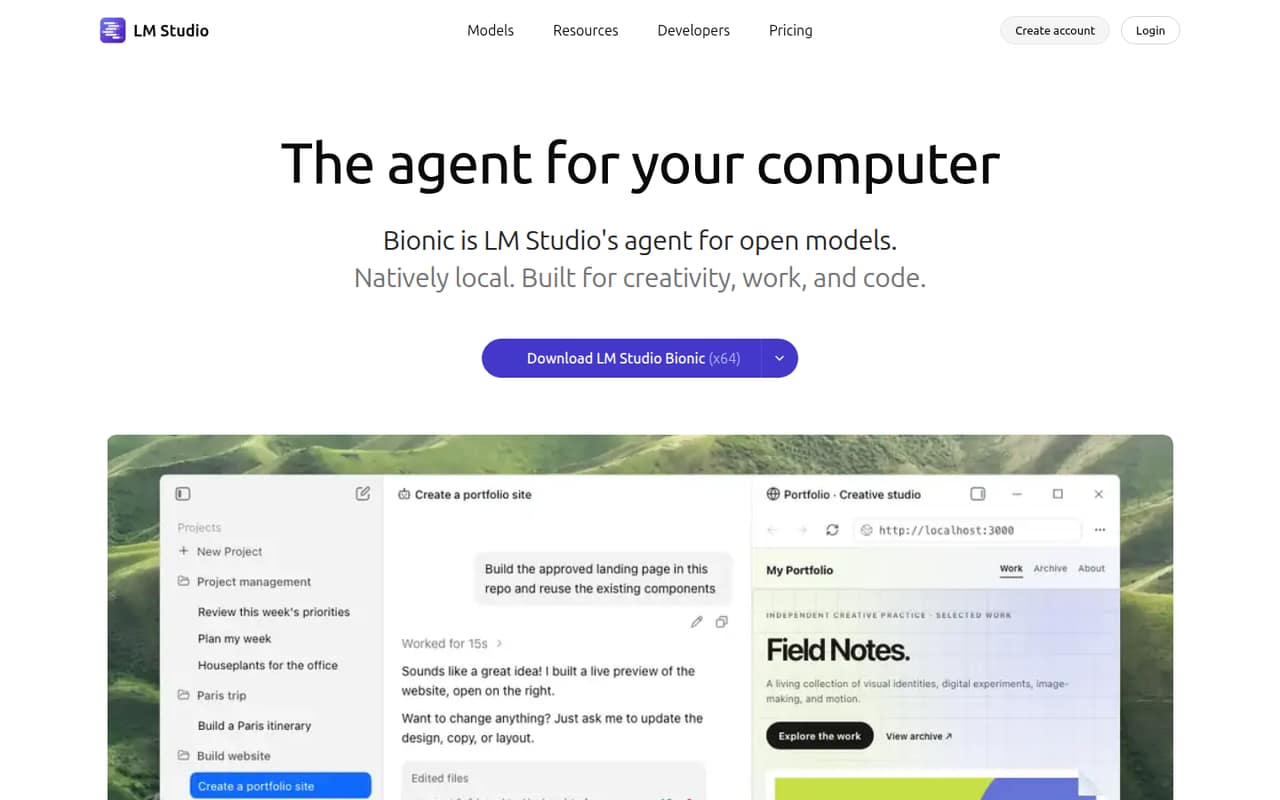
LM Studio combines a desktop app and local runtime for running downloaded LLMs with Bionic, its computer agent for work and code. Local inference and voice transcription are the clearest fit; optional cloud inference adds hosted open models.
The free tier makes it easy to start, but API and SDK details are thin on the homepage. Reddit users report confusion between Bionic and the original app, along with API incompatibilities and update-related breakage. Confirm integration behavior before depending on it in production.
Good fit if
- Developers exploring local LLMs
- Solo users automating desktop tasks
- Teams wanting optional hosted models
Skip it if
- Teams needing a documented API contract
- Production systems requiring published rate limits
- Organizations requiring a clear source license
ScoresHow it rates
What works
- Run downloaded LLMs locally with llama.cpp and MLX
- Free plan includes offline voice transcription
- Bionic auto-saves document changes
- Optional cloud inference uses Zero Data Retention
- Free LM Link supports up to five devices
What doesn't
- Homepage does not establish SDKs or language support
- Bionic API differences may break integrations
- Usage limits and rate limits are not quantified
- Software license and data export terms are unclear
- Reddit users report update and model-loading issues
01What LM Studio is, technically
LM Studio is a desktop application and local model runtime, not just a hosted API. Its current Bionic agent runs on your computer and can work with local LLMs downloaded in the app. The runtime uses MLX and llama.cpp. That places LM Studio at the inference and user-interface layer of a local AI stack: it handles model discovery and execution, while Bionic adds document editing, coding tasks, automation and computer control.
Cloud inference is optional. The site says Bionic can use hosted frontier open models and that LM Studio cloud services use Zero Data Retention. The free plan also lists limited web search, while paid plans add hosted models and other cloud features. This setup suits individual developers who want to start locally and add hosted inference. It is not, on the evidence published on the homepage, a clearly documented backend service for applications that need a stable API contract.
02LM Studio API, SDKs and docs
The integration surface established on the homepage is the desktop app and LM Studio runtime: download models, run them locally, and use them for chats or Bionic agent tasks. The homepage links to Bionic docs, but names no programming-language SDK, CLI, REST API, webhook or plugin interface. Confirm supported SDKs and API behavior in the vendor’s docs before designing an integration around them.
There is a reason to check rather than assume compatibility. A Reddit commenter reports that Bionic’s API is slightly different from LM Studio’s and that the difference caused errors when connecting another application. That is an individual report, not a complete API specification, but it makes migration risk concrete. The homepage does not set out request formats, authentication, versioning or error behavior. For a codebase that depends on LM Studio as an inference endpoint, validate the exact Bionic endpoint and client compatibility before switching. Treat the desktop agent and the older app’s integrations as distinct until the docs confirm otherwise.
03LM Studio pricing for developers
The Free plan costs $0 per month and includes local LLMs with llama.cpp and MLX, LM Link for up to five devices, offline voice transcription and limited web search. Bionic+ is $20 per month and adds US-hosted open-source models, discounted bulk tokens, web search and page extraction. Pro is $100 per month and includes everything in Bionic+ plus 5× usage limits, discounted bulk tokens and early access to new features.
The pricing page lists monthly prices but no annual billing or discounts. It does not quantify the included usage, token allowances, rate limits or overage rates, so we can’t calculate a production bill from plan prices alone. The vendor doesn’t publish those usage figures. Organization plans offer pay-as-you-go pooled credits or team seat-based plans, with prices not published. Ask how usage is measured, what happens at plan limits and how organization credits are billed before committing.
04LM Studio: open source, self-hosting and lock-in
Running models locally is supported: the app downloads LLMs to your computer and uses the LM Studio runtime, with MLX and llama.cpp underneath. That is local inference, not proof that the LM Studio application itself is open source or that its runtime can be deployed as a self-hosted server. The vendor doesn’t publish the application’s software license or a data-export format on the homepage, so check those terms before adopting it for a team.
Local model files and the ability to run open models can reduce dependence on a single hosted inference provider. Bionic’s cloud features still introduce a service dependency, and the homepage does not describe a migration path for agent tasks or saved documents. Reddit discussions show users considering alternatives such as llama.cpp, but switching may require rebuilding integrations and configuration. Keep model files and task data in formats you can move, and verify export options first.
05LM Studio in production
The published limits are narrow: Free LM Link supports up to five devices, Free web search is limited, and Pro advertises 5× usage limits. The pricing page does not publish request-rate limits or define how usage is counted. For local inference, capacity also depends on the computer running the model; the homepage does not give deployment or scaling guidance. Test model loading, recovery and resource use on the hardware you plan to support.
The site says voice and audio are processed locally and never leave the device. It describes cloud services as Zero Data Retention, but teams should still review the service’s security and compliance terms before sending sensitive prompts to hosted models. Reliability reports on Reddit are mixed: some users say updates broke downstream services or models failed to load; another describes confusing Bionic API errors while connecting an app. These are user reports, not measured failure rates. Pin versions where possible, test updates against your integration, and keep a fallback inference path.
From the threadsWhat users say
Reddit sentiment is sharply divided. Some users value LM Studio as an accessible route into local inference, while others object to the Bionic transition and report broken integrations, model-loading problems and update regressions.
LM Studio got a whole generation of people running local models who never would've touched a command line
bionic’s api is only slightly different from lmstudio
I got sick of LM Studio constantly failing to load models for no good reason
This happened like 5 updates in a row
Questions people ask
Do I have to pay to use LM Studio?
No. The Free plan costs $0 per month and includes local LLMs with llama.cpp and MLX, offline voice transcription, limited web search and LM Link for up to five devices. Bionic+ and Pro add hosted open models and higher usage limits for $20 and $100 per month, respectively.
Can I run models without sending prompts to the cloud?
Yes. LM Studio lets you download and run local LLMs, and the site says voice and audio data are processed locally and never leave your device. Cloud inference is optional. Check your settings and model choice if local processing is a requirement.
Does Bionic have an API or SDK?
A Reddit user reports an API difference between Bionic and LM Studio, but the homepage does not document API details or name SDKs and languages. Check the Bionic docs for supported endpoints and client compatibility before connecting it to an application or replacing an existing integration.
Is Bionic the same app as the original LM Studio?
The site presents Bionic as LM Studio’s agent for open models, while Reddit users report confusion between Bionic and the original LM Studio app. Do not assume they are interchangeable: verify which app and API your workflow requires before downloading or updating.
Can I use LM Studio for coding and document work?
Bionic is described as an agent for work and code. The site says it can create and edit documents, help with coding tasks, automate work and control your computer. It also says document changes are automatically saved. Check the Bionic docs for details about supported workflows.
Sources
- LM Studio homepage
- LM Studio pricing page
- Reddit: Is LM Studio abandoning their core product?
- Reddit: Why the hell is LM Studio making LM Studio so difficult to download?
- Reddit: Unsloth Studio VS LM Studio... Which one do you prefer?
- Reddit: Time to finally migrate from LM Studio -> llama.cpp, your experience?