
We may earn a commission if you buy through links on this page. It never changes a score or a ranking. How we make money
The bottom line
LiveKit gives developers control over real-time agents, but production bills span more than session minutes.
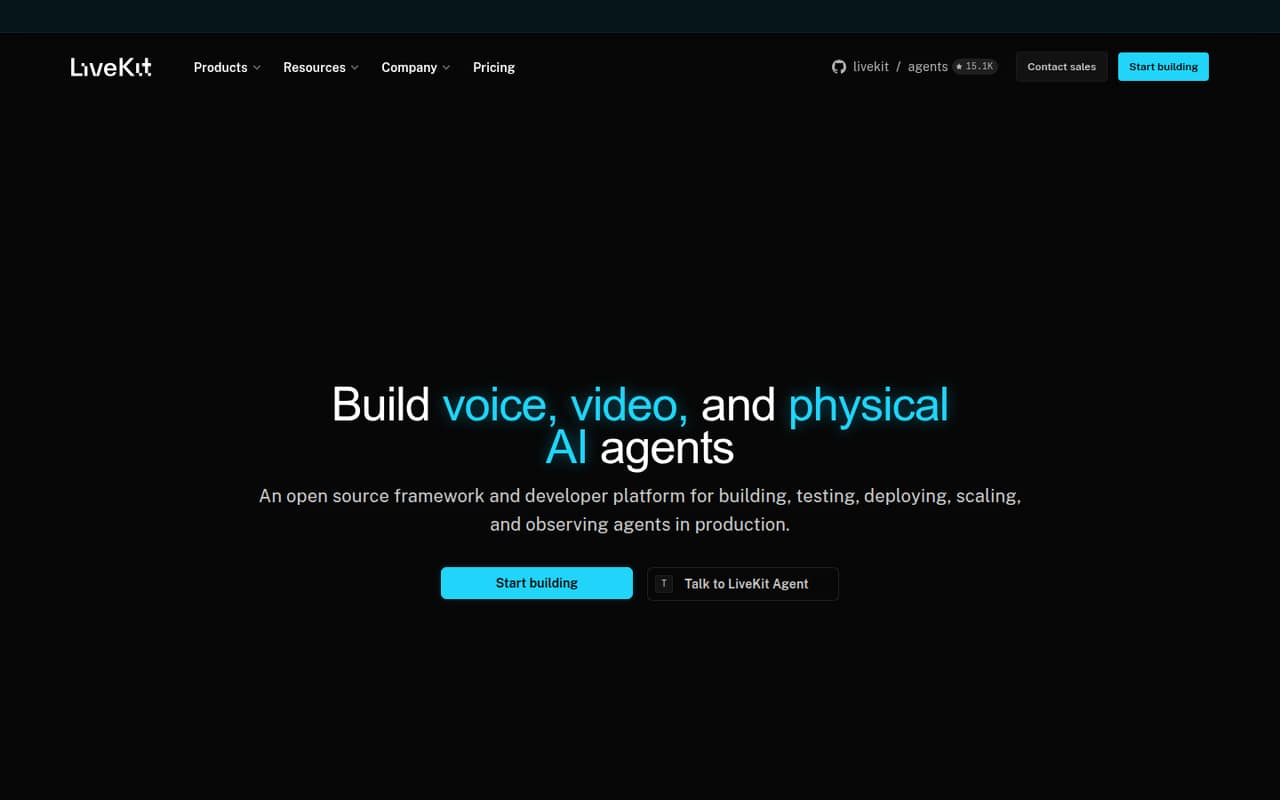
LiveKit is an open-source framework for building AI agents and a hosted cloud platform for real-time voice, video and telephony. It fits between your application logic and the live media infrastructure, with a model gateway, deployment tools and session observability in the same platform.
The free Build plan is useful for prototyping, while production pricing starts at $50 per month on Ship. The framework offers customization and self-hosting options, but teams should verify repository licensing, export requirements and total model and telephony costs before committing.
Good fit if
- Teams building real-time AI agents
- Developers needing voice and telephony
- Projects requiring model flexibility
Skip it if
- Teams seeking a no-code agent builder
- Hobby projects with high usage
- Apps that need fixed, all-in pricing
ScoresHow it rates
What works
- Open-source agent framework with customizable behavior
- Supports voice, video and physical AI agents
- Model gateway covers TTS, LLM and STT
- Cloud deployment includes session observability
- Free Build plan includes 1,000 session minutes
What doesn't
- Production costs can span many usage categories
- Ship includes only 20 concurrent agent sessions
- Model prices vary by model and plan
- Repository license and data-export terms need checking
- Self-hosting requires operating real-time infrastructure
01What LiveKit is, technically
LiveKit is an open-source framework and developer platform for building AI agents, paired with a hosted cloud platform for real-time media. In a typical stack, your application supplies business logic and chooses models; LiveKit handles agent sessions and the real-time voice, video or telephony path between users and agents. Its model gateway connects agents to text-to-speech, language and speech-to-text models, while LiveKit Cloud provides deployment, scaling and session observability.
The framework is not just a hosted voice API: LiveKit presents it as a way to build and test agents, then deploy them on its cloud infrastructure or use the open-source framework. The homepage describes users speaking through an app, browser or phone call, with speech streamed to the agent and responses sent back. Automatic turn detection and interruption handling are listed features. That puts LiveKit in the media and agent-runtime layer of an application, rather than replacing your product's business logic or model selection.
02LiveKit API, SDKs and docs
The homepage calls LiveKit's interfaces “Simple and Powerful APIs” and shows an AgentSession configured with speech-to-text, an LLM, text-to-speech and turn detection. The voice-agent quickstart is for Python or Node.js. LiveKit also points to starter apps for web and mobile, telephony integration, and deployment to LiveKit Cloud. Those are the named build paths; confirm specific SDK support, API methods and client requirements in the vendor's documentation before choosing your application stack.
The documented integration surface includes apps, browsers and phone calls, plus phone numbers and SIP integrations for telephony. A model gateway provides access to TTS, LLM and STT models. The homepage links to documentation and describes full-stack observability for agent sessions. It does not name a CLI, webhook interface or specific protocols beyond SIP, so teams depending on those should verify support in the docs. Reddit developers report finding examples for client integration, while one commenter said they struggled to find frontend integration guidance. Start with the quickstart and examples, then test the handoff into your existing app.
03LiveKit pricing for developers
LiveKit's Build plan costs $0 per month and includes 1,000 agent session minutes, five concurrent sessions, one deployment, $2.50 in inference credits and one free US local number. Ship costs $50 per month and includes 5,000 session minutes, 20 concurrent sessions, two deployments, $5 in inference credits and 5,000 recording minutes. Scale is $500 per month, with 50,000 minutes, up to 600 concurrent sessions, four deployments, $50 in inference credits and 50,000 recording minutes. Enterprise has custom pricing and limits.
On Ship and Scale, session minutes beyond the allowance cost $0.01 per minute. Other usage can add up: recording overages are $0.005 per minute, observability events are $0.00003 per entry, and audio turn detection is $0.50 per 1,000 requests where charged. US local numbers beyond the included number cost $1 per month; inbound minutes and SIP, WebRTC, Twilio and WhatsApp usage have separate rates. Extra inference credits are billed at model prices, which vary. The pricing page lists monthly prices, not annual billing.
04LiveKit: open source, self-hosting and lock-in
LiveKit describes its framework as open source, and developers on Reddit discuss running a self-hosted LiveKit server. The framework can therefore be part of a self-managed deployment, but that shifts infrastructure, networking and scaling work to your team. One Reddit user described setting up a central server and needing command-line knowledge; another noted that a server on a slow connection can still struggle.
The source repository's license should be checked before adoption; LiveKit's homepage description alone does not establish the license terms. Data-export guarantees and a complete migration path are also worth confirming with the vendor. A customer testimonial describes moving to LiveKit Cloud and gaining a unified export interface across web and phone calls, but that is not a general export commitment. Migration effort will depend on how much of your application uses LiveKit-specific agent sessions, telephony and model integrations. Keeping business logic and model configuration separate can reduce coupling.
05LiveKit in production
LiveKit's homepage lists 99.99% uptime, 100ms global latency and 19-plus regions, and says its cloud platform supports millions of concurrent calls. It also lists GDPR, SOC 2 Type 2 and HIPAA. Treat these as vendor claims and check the applicable service terms, region coverage, security documents and SLA before putting regulated or time-sensitive workloads on the platform. Plan concurrency and included minutes matter: Ship includes 20 concurrent sessions and 5,000 minutes before session overages.
Real-time audio also depends on network quality and media capacity. Reddit users report good results with LiveKit for group voice, but self-hosting comments emphasize the need for a well-connected central server and some command-line skill. One user reported difficulty integrating with an existing frontend; another said setup instructions felt oriented toward larger deployments. Those reports point to practical risks: test the client integration, phone path, interruption behavior and degraded-network experience, and model likely peaks rather than budgeting only for average minutes.
From the threadsWhat users say
Reddit sentiment is mostly positive about call quality and the platform's flexibility, with recurring cautions about self-hosting, setup and frontend integration. One thread discusses hobby use and setup; another focuses on building real-time AI agents.
I use livekit and it is way better than the built in AV as I have some players with poorer internet connections
Livekit works great, but you've got to have some command line savvy to get it working, along with a central server on a good connection
I have written some backend code by reading its docs and was also successful in generating tokens. But when I tried integrating It with the application, I was unable to find any proper document to do it
easy to setup, and the free tier has enough for me running 4 sessions a month with 5 players plus myself for about three hours per Session. Works like a charm
Questions people ask
Is LiveKit free?
Yes. The Build plan is $0 per month and includes 1,000 agent session minutes, five concurrent sessions, one deployment, $2.50 in inference credits and one free US local number. Higher usage or additional features can require a paid plan or incur separate usage charges.
How does LiveKit work?
A user speaks through an app, browser or phone call. LiveKit streams speech to an agent, which runs your custom business logic and uses selected models for speech recognition, language processing and speech generation. The agent sends a response back through the real-time session.
Can LiveKit be self-hosted?
LiveKit describes its framework as open source, and developers discuss operating their own LiveKit server. Self-hosting means your team takes responsibility for the server, connectivity and scaling. Check the current repository license and deployment documentation before planning a production setup.
Does ChatGPT use LiveKit?
LiveKit's homepage says OpenAI built ChatGPT’s Advanced Voice on LiveKit Cloud and that the feature is used by millions of users. That is a vendor statement about the service; it does not establish which other OpenAI products or components use LiveKit.
How much does LiveKit Inference cost?
The plans include $2.50 in inference credits on Build, $5 on Ship and $50 on Scale. Beyond those credits, inference is billed at model prices. The pricing page says rates vary by model and plan, and Scale includes discounted model prices.
Sources
- LiveKit homepage
- LiveKit pricing page
- Reddit: Anyone have experience with LiveKit for voice and if it's better than the webRTC?
- Reddit: Livekit : realtime multimodal conversation with AI.
- Reddit: Lost between LiveKit Cloud vs Vapi vs Retell for a voice AI agent (~3,000 min/month) – real costs & recommendations in 2025?
- Reddit: Introducing LiveKit - a WebRTC video conferencing server in Go