
We may earn a commission if you buy through links on this page. It never changes a score or a ranking. How we make money
The bottom line
Lithic covers issuing, ledgers and transfers, but opaque pricing makes costs hard to assess upfront.
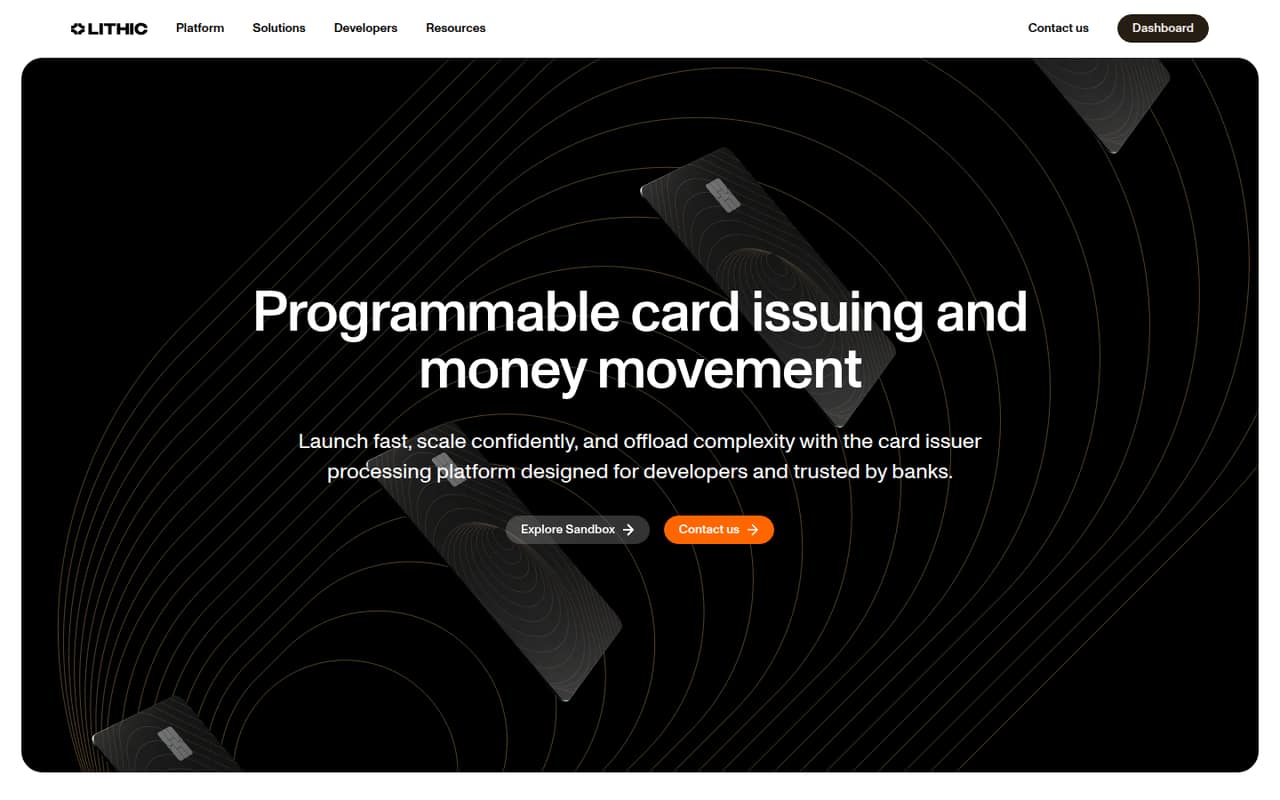
Lithic is a hosted card issuer processing and money movement platform for teams building card programs. Its product set includes card issuing, accounts, ledgers, payments, fraud controls and optional program services such as cardholder support and disputes management.
The platform offers a sandbox, API documentation, libraries and SDKs, and an MCP Server guide. Pricing is negotiated through sales and underwriting; the vendor publishes no starting price or free tier. Get transaction pricing, rate limits, service terms and data-export details before committing.
Good fit if
- Teams launching card programs
- Businesses needing issuing and transfers
- Programs seeking managed operational services
Skip it if
- Developers needing a self-hosted processor
- Teams requiring public usage pricing
- Projects seeking a general-purpose payments API
ScoresHow it rates
What works
- Card issuing for credit, debit and prepaid programs
- Processing, ledgering and payment transfers in one platform
- Fraud controls available through APIs and a dashboard
- Optional program management and cardholder support
- Sandbox, documentation and SDK resources are listed
What doesn't
- Pricing is negotiated rather than published
- No public starting price or free tier
- Rate limits are not published on the vendor's site
- SDK languages and API protocol are not named
- Self-hosting and data-export terms need confirmation
01What Lithic is, technically
Lithic is a hosted card issuer processing and money movement platform, not a library or server that a customer deploys in its own environment. It sits between a card program and the banking, card-network and payment operations the program depends on. Developers use Lithic’s API and dashboard to configure issuing, accounts, payment flows, ledgers and fraud controls.
The platform covers credit, debit and prepaid card programs for individuals and businesses. It also offers virtual and routable accounts, ACH and wire transfers, and debit and credit ledgers for tracking program money movement. Processing uses direct network connections, according to Lithic. For teams that want more than processing infrastructure, optional services include program management, cardholder support, disputes and chargeback handling, and fraud mitigation.
That combination can reduce the number of vendors a program has to coordinate. It also means Lithic becomes part of a financially critical stack: evaluate its bank and network relationships, operational responsibilities and exit terms alongside the API.
02Lithic API, SDKs and docs
Lithic presents an API as the core developer integration surface, supported by a dashboard and documentation. The developer site lists a sandbox, API status page, changelog, libraries and SDKs, and guides for the ledger, ACH, digital wallets and quickstart setup. It also provides guides for generating an API key and using the Lithic MCP Server.
The homepage does not name an API protocol, SDK languages or a CLI. Confirm the API interface, supported languages, SDK maintenance status and any webhook or event delivery options in Lithic’s documentation before choosing an integration design. The sandbox gives teams a place to explore the platform before production, but confirm which flows and edge cases it models.
The integration work is likely to extend beyond calling endpoints: card programs also require decisions about authorization, ledgers, settlement, fraud rules and operational responsibilities. Use the documentation and vendor discussions to map those responsibilities and test failure handling before launch.
03Lithic pricing for developers
Lithic does not publish monthly or annual pricing. The available pricing information lists no plans, add-ons, starting price or free tier, and says terms are negotiated through sales and underwriting. There is no published free-trial detail either. That makes it difficult to estimate cost from a public rate card before sharing program details with the vendor.
The billing model and the way costs change with card volume, transactions, accounts, transfers or support services are not published in the pricing information. Do not assume that a sandbox means free production usage, or that a particular service is included in a processing quote. Ask sales for itemized pricing, minimums, implementation fees, volume bands, dispute costs and any charges for ACH, wires or program services. Also ask how pricing changes as the program scales and what happens if volume falls below a commitment.
Because there is no public starting price, teams should compare a written quote against their expected transaction mix and operational needs before selecting Lithic.
04Lithic: open source, self-hosting and lock-in
Lithic is presented as a hosted processing platform, not as software customers can deploy themselves. The product materials do not present an open-source edition or a source-code licence, so teams should treat the service as closed and hosted unless Lithic confirms otherwise in writing.
The vendor materials here do not establish what data can be exported, in which formats, or how a customer can retrieve it after ending service. Ask for the export process, retention period, fees and timing, along with the portability of ledger history, card and account records, and dispute data.
Migration is likely to involve more than replacing an API client: card programs depend on bank and network arrangements, authorization behavior, ledgers and operational workflows. Confirm which parts of those relationships and records can move, and plan for a parallel-run or transition period if the program cannot switch processors at once.
05Lithic in production
Lithic states that it has 99.99%+ uptime and no scheduled downtime. It also lists SOC 1 Type 1, SOC 2 Type 2, PCI DSS and ISO 27001. Treat these as vendor statements to validate against the current service commitments, audit materials and the specific products in your contract. Ask how availability is measured and what service credits or incident communications apply.
The published materials do not publish API rate limits, request quotas, retry guidance or production overage rules. Confirm those limits, along with authorization latency expectations, maintenance behavior, idempotency support and incident escalation paths. Test how your system handles timeouts, duplicate requests, delayed settlement data and downstream bank or network failures.
Lithic offers direct network connections and ledgering, but your program still needs reconciliation, monitoring and operational ownership. Before launch, verify which party handles disputes, fraud monitoring, cardholder support and compliance tasks; these services vary with the service option you choose.
Questions people ask
What does Lithic do?
Lithic provides hosted card issuer processing and money movement infrastructure. Its platform supports credit, debit and prepaid cards, accounts, ledgers, fraud controls, ACH and wire transfers. Teams can also choose program services such as program management, cardholder support, disputes and fraud mitigation.
How much does Lithic cost?
Lithic does not publish monthly or annual prices, a starting price or a public free tier. Pricing terms are negotiated through sales and underwriting. Ask for an itemized quote that covers processing, transfers, program services, minimums and how costs change with transaction volume.
Does Lithic offer a sandbox?
Yes. Lithic lists a sandbox as a developer resource for exploring the platform. Confirm with the vendor which card, payment and failure scenarios are supported there, and whether sandbox credentials or use have any restrictions before planning your integration.
Which programming languages does Lithic support?
Lithic lists libraries and SDKs, but the product materials here do not name supported languages. Check the current documentation for SDK languages, versions and maintenance status. If your stack is not covered, confirm the API interface and authentication requirements with Lithic before estimating integration work.
Can I self-host Lithic or export my data?
Lithic is presented as a hosted platform, not a self-hosted product. Its product materials do not establish data-export formats or exit procedures. Ask the vendor about exporting ledger history, account and card records, retention, fees and the steps required to transition a program to another processor.