
We may earn a commission if you buy through links on this page. It never changes a score or a ranking. How we make money
The bottom line
A straightforward search API for AI apps, with usage pricing and enterprise deployment options.
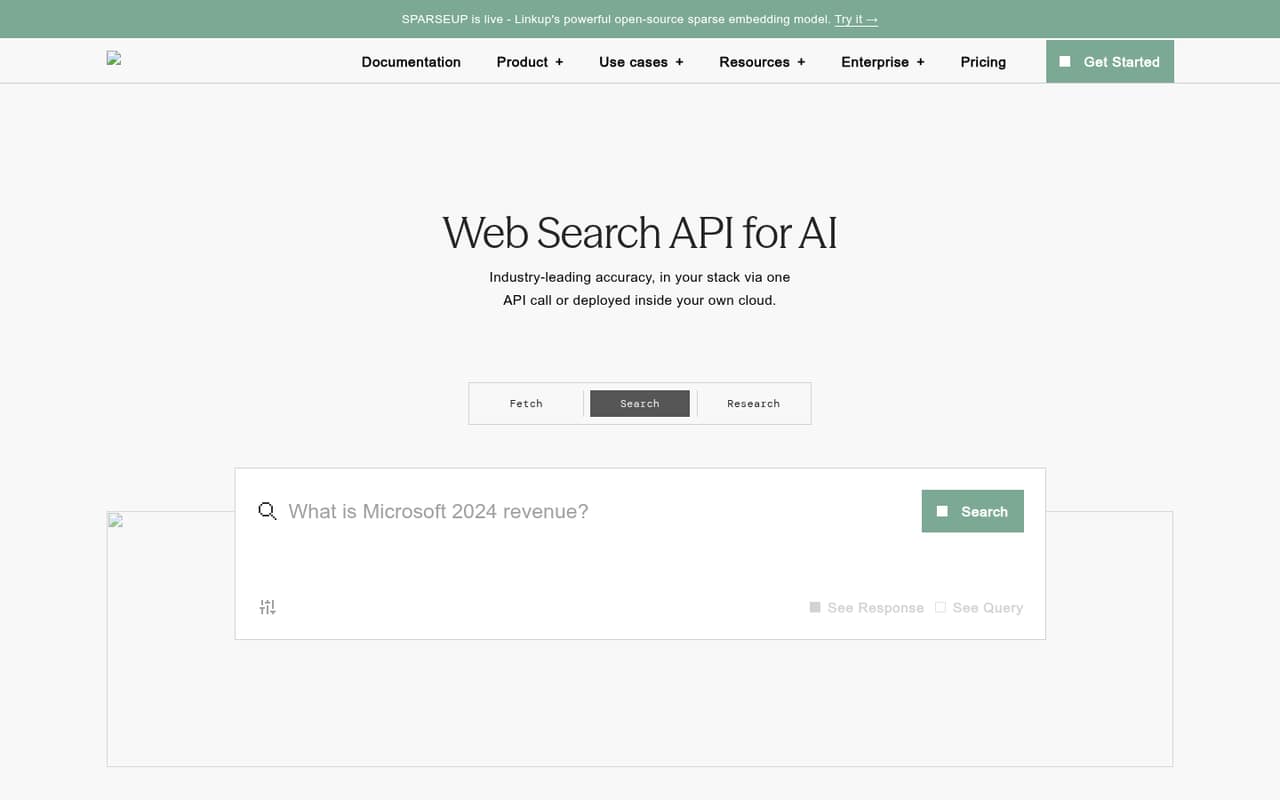
Linkup is a web search API for AI applications, with search, URL extraction and asynchronous research behind one API. Python and Node.js examples, cURL, and integrations for the OpenAI SDK wrapper, LangChain and CrewAI give developers several ways to connect it to an existing stack.
Search starts at $0.005 per request, while research costs more and runs asynchronously. The vendor also offers private indexes and a bring-your-own-cloud indexing option, but teams should confirm request limits, export options and deployment scope before committing.
Good fit if
- AI agents needing cited web context
- Teams researching complex questions
- Enterprises with private data indexes
Skip it if
- Teams needing a self-hosted search server
- Workloads with predictable monthly billing
- Projects requiring published rate limits
ScoresHow it rates
What works
- Search, extraction and research share one API
- Python, Node.js and cURL examples
- OpenAI SDK wrapper, LangChain and CrewAI integrations
- Private indexes for proprietary data
- Pay-as-you-go pricing starts at $0.001 per request
What doesn't
- Free-plan quota and limits are not published
- Research requests cost $0.25–$2.50 each
- Rate limits are not published
- Software licence and source availability are not published
- Data export and migration paths need confirmation
01What Linkup is, technically
Linkup is a hosted web search API for AI applications. Its API covers web search, URL extraction and asynchronous deep research, returning sourced answers and full-text snippets for use in agents, RAG systems and other applications that need current web context. It sits between your application and web data rather than replacing your application’s search or orchestration layer.
The vendor also offers private indexes of proprietary data and a bring-your-own-cloud option. Per the homepage, that option runs the indexing layer inside your infrastructure; it is not a statement that the entire Linkup service can be self-hosted. Teams can tune the index, sources and freshness. For enterprise customers, Linkup lists personalized indexes and a private environment. This makes it relevant to teams that need to combine public web results with controlled data, while leaving the application and its agent logic in their existing stack.
02Linkup API, SDKs and docs
The integration surface is an API, with separate Fetch, Search and Research capabilities. The homepage links to API docs and shows a Python example using LinkupClient; it also names Python, Node.js and cURL. The example sets an API key directly or through the LINKUP_API_KEY environment variable, then calls client.search with a query, depth and output type.
For orchestration, Linkup says it works with the OpenAI SDK wrapper, LangChain, CrewAI and other frameworks, and provides an integrations page. The homepage shows API calls and framework integrations rather than a CLI workflow, so teams that require a command-line tool should confirm current support in the vendor’s docs. The docs should also be the source of truth for request and response schemas, authentication details and error handling. Search responses can provide cited results and snippets; research is asynchronous, so applications need to handle completion rather than assume every call returns immediately.
03Linkup pricing for developers
Linkup charges per request, with no monthly or annual subscription billing listed. The pricing page marks a free plan, but does not publish its included quota or where the free allowance stops. Startups can apply for $5,000 in free credits; this is not an automatic credit grant.
Fetch Standard / Pro costs $0.001–$0.006 per request, with synchronous responses and latency under two seconds. Search Fast / Standard / Deep costs $0.005–$0.006 per request, with synchronous responses and stated latency of one to three seconds. Research costs $0.25–$2.50 per request and runs asynchronously, with stated latency of one to ten minutes. At those rates, 1,000 Search requests cost $5–$6 before any credits or enterprise terms.
Enterprise pricing is custom and includes personalized indexes, a dedicated index refresh rate, a private environment, ZDR, SOC 2 Type II and an SLA. The pricing page does not list request quotas or overage terms, so ask about rate limits and expected volume before budgeting production traffic.
04Linkup: open source, self-hosting and lock-in
Linkup presents a managed API and an option to run its indexing layer inside your own cloud. That is a deployment choice, not evidence that the full service is self-hostable. The vendor doesn't publish its software licence or source availability, so teams requiring open-source components should confirm those terms directly.
The private-index and bring-your-own-cloud options give enterprises more control over proprietary data, but the vendor does not describe a data-export path. Ask what index data and query history can be exported, in which formats, and whether the BYOC deployment changes those terms. If you migrate away, plan to replace Linkup API calls and adapt response handling in the parts of your application that consume its search results, citations, snippets or research output. Keeping that integration behind an internal interface can limit the cost of switching providers.
05Linkup in production
The homepage claims 99.9% uptime with an SLA and describes sub-second latency; the pricing page gives different latency ranges by product: under two seconds for Fetch, one to three seconds for Search, and one to ten minutes for asynchronous Research. Treat those as vendor-stated figures, not guarantees for every workload. Research’s asynchronous behavior also means your application needs a path for pending work and delayed results.
Before launch, confirm rate limits, timeout and retry guidance, index refresh behavior, and what happens when a request fails. Enterprise terms list ZDR, SOC 2 Type II and an SLA; ask what applies to your plan and deployment. The homepage describes BYOC as keeping the indexing layer inside your infrastructure, but teams should verify the data flow for each feature they use.
Reddit feedback is limited and mixed: one thread says Linkup has connections to premium sources, while another commenter preferred a competitor’s retrieval. These are individual opinions, not a broad reliability assessment.
From the threadsWhat users say
The Reddit discussion is mixed and sparse: one poster distinguishes Linkup by its source approach, while commenters favor other tools for retrieval or cost. It offers little direct evidence about Linkup’s production reliability.
Linkup seems to have a slightly different approach, with connections to premium sources
I like Tavily, easy to implement and super accurate retrieval. Others are ok but Tavily is just stronger imo
I would use Brave Search Api - it's on another (better) level of costs
while Exa seems to be a bit faster
Questions people ask
What does Linkup do?
Linkup provides web search, URL extraction and deep research for AI applications through an API. Search returns sourced, cited answers with full-text snippets; Fetch retrieves information from web pages; Research handles complex questions asynchronously. Teams can also create private indexes of proprietary data.
How much does Linkup cost?
Pricing is per request. Fetch costs $0.001–$0.006, Search costs $0.005–$0.006, and asynchronous Research costs $0.25–$2.50. Enterprise pricing is custom. The pricing page marks a free plan and offers startups $5,000 in credits by application, but does not publish the free plan’s quota.
Does Linkup have a free tier?
The pricing page marks a free plan, but does not publish its request allowance or other limits. Startups can apply for $5,000 in free credits. Confirm eligibility, credit terms and the free-plan quota with Linkup before relying on either for a production budget.
Can I run Linkup in my own cloud?
Linkup offers a bring-your-own-cloud option that runs the indexing layer inside your infrastructure. The homepage does not say that the full API can be self-hosted. Ask the vendor which components run in your cloud, what data still reaches its managed service, and which features are available in that setup.
What languages and frameworks does Linkup support?
The homepage names Python, Node.js and cURL, and shows a Python LinkupClient search example. It also lists integrations with the OpenAI SDK wrapper, LangChain and CrewAI. Check the vendor’s current API docs and integrations page for SDK availability, supported versions and the request or response details your application needs.