
We may earn a commission if you buy through links on this page. It never changes a score or a ranking. How we make money
The bottom line
A free, self-hosted AI workspace with broad provider support—and real configuration work.
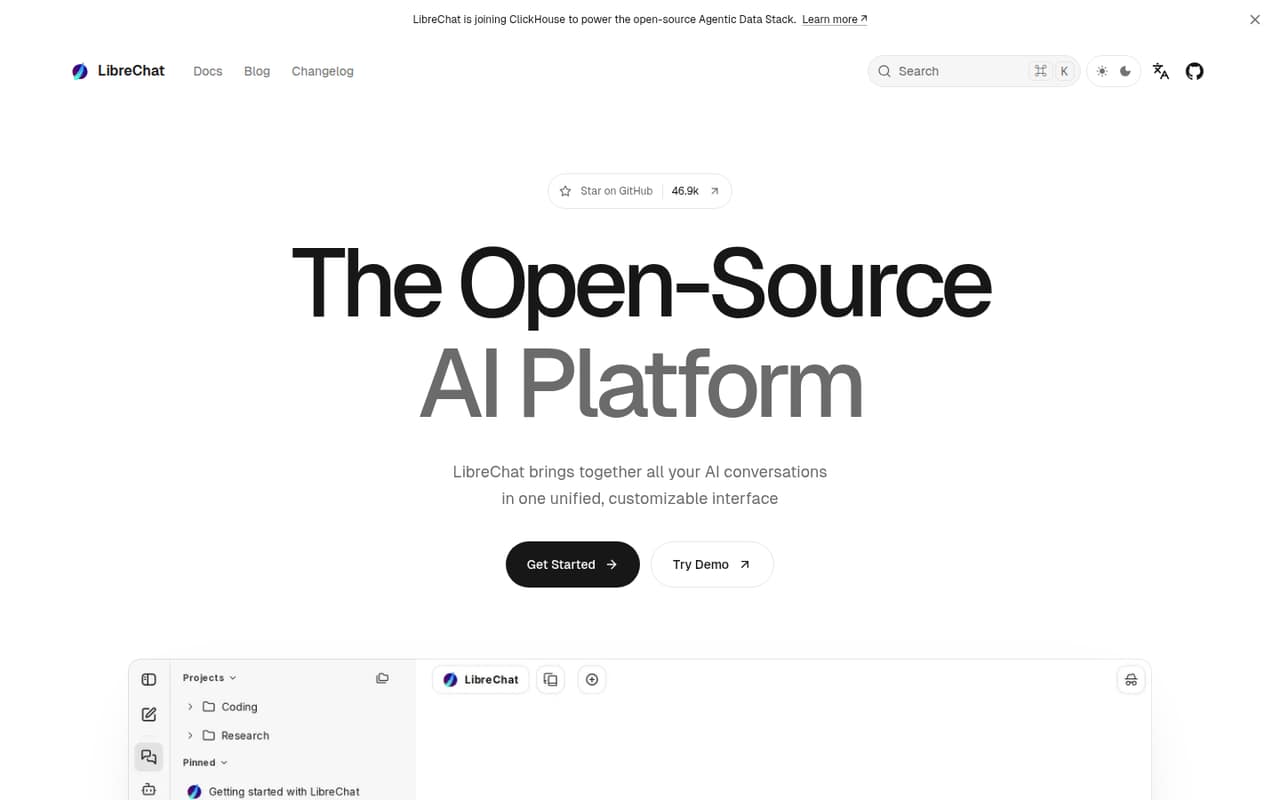
LibreChat is an open-source, MIT-licensed platform you self-host to bring hosted AI providers and local models into one interface. It adds agents, MCP connections, projects, web search and other workspace features without charging per seat for the software.
The trade-off is operational ownership: you pay for hosting and model usage, and developers on Reddit report configuration and reliability problems. Treat it as an application to configure and maintain, not a turnkey hosted service.
Good fit if
- Teams self-hosting an AI workspace
- Projects needing multiple model providers
- MCP-based agent workflows
Skip it if
- Teams wanting a managed hosted service
- Users avoiding configuration and maintenance
- Systems requiring published export guarantees
ScoresHow it rates
What works
- MIT-licensed software with no per-seat charge
- Connects hosted providers and local models
- MCP support for tools and services
- Agents support files, skills and delegated subtasks
- Includes projects, web search and code interpreter
What doesn't
- Infrastructure and model API costs are separate
- Configuration can take substantial troubleshooting
- Reddit users report buggy behavior and outages
- Vendor does not publish a data-export path
- SDK and programming-language support needs confirmation
01What LibreChat is, technically
LibreChat is a self-hosted AI conversation platform, not a hosted API, library or command-line tool. It sits between users and AI providers: teams run the workspace, connect provider accounts or local models, and use a shared interface for conversations and agent workflows. The software is open source under the MIT License, and the pricing data lists no seat limits imposed by the software.
The platform addresses the fragmentation of using different AI providers through separate chat interfaces. Its feature set includes agents with files, tools, reusable skills and delegated subtasks; personal project workspaces; artifacts; web search; and code execution in an isolated environment. It also supports connections to tools and services using Model Context Protocol (MCP). This makes LibreChat an application layer for people and teams, while model inference and hosting remain separate parts of the stack. You need to operate the application and arrange the provider access and infrastructure it depends on.
02LibreChat API, SDKs and docs
LibreChat's homepage describes an application for connecting AI providers and local models, rather than a developer API or SDK. It names providers and platforms including OpenAI, Anthropic, Google, AWS Bedrock, Ollama, Mistral AI, OpenRouter and vLLM. For tools and services, the named integration surface is Model Context Protocol (MCP); agents can use tools, files, skills and delegated subtasks.
The homepage does not identify a programming language, SDK, CLI, webhook interface or API style. Before building a direct integration or automating administration, confirm SDK and API support in LibreChat's documentation. The homepage points to feature documentation but does not establish those programmatic interfaces. It does list enterprise authentication options: OAuth, SAML, LDAP and two-factor authentication. That is useful for fitting the application into an identity stack, but teams should verify the configuration and deployment steps in the vendor's docs before planning a rollout.
03LibreChat pricing for developers
The listed Self-Hosted plan costs $0 per month for the software and is described as open source under the MIT License. The software imposes no seat limits. There are no hosted subscription tiers or monthly and annual billing options listed, and no add-ons are listed.
That $0 price is not the cost of running the service. The pricing data says users pay infrastructure costs directly and pay AI model API usage directly. In practice, your bill therefore depends on the hosting you choose and the providers or local-model setup you operate; LibreChat does not bundle those costs into a subscription. Expect model charges to rise with usage, but the vendor does not publish a common per-request rate or bundled usage allowance. The data lists no overage schedule or free trial. For a budget, estimate hosting and each provider's charges separately, then include the operational cost of maintaining the self-hosted application. There is no listed paid plan that shifts that work to LibreChat.
04LibreChat: open source, self-hosting and lock-in
LibreChat is described as free, open-source software under the MIT License, and its listed plan is self-hosted. You run the application on infrastructure you pay for, and connect AI providers or local models rather than buying a hosted LibreChat subscription. That gives teams control over deployment and provider selection, but also leaves infrastructure and maintenance with the operator.
Using multiple providers can reduce dependence on a single model vendor, but it does not settle how portable conversations or other workspace data are. The vendor does not publish a data-export path in the information available on its site. Before production use, verify how to export conversations, files, agent configuration and user data, and test that process. Switching the chat interface may be simpler than moving its stored data and agent setup; do not assume portability without confirming the relevant export and storage mechanisms.
05LibreChat in production
LibreChat's homepage lists enterprise authentication with OAuth, SAML, LDAP and two-factor authentication, plus an isolated code interpreter and web search. Those features are not a substitute for checking your own security requirements: confirm how credentials, conversation content, files and agent tools are handled in your deployment, and review the applicable provider and infrastructure controls. The vendor does not publish a general rate limit or capacity figure on its homepage, so validate expected concurrency and provider quotas separately.
Reddit reports on reliability and setup are mixed, with several users describing configuration friction, documentation problems, failures and restarts; others prefer LibreChat or cite its MCP support. One project maintainer responding in a Reddit thread attributed some reported problems to configuration and raised instability from development directly on the main branch. These reports are not a service-level guarantee, but they are a reason to test upgrades, backups, authentication and recovery before broad rollout. Self-hosting makes that operational work yours.
From the threadsWhat users say
Reddit sentiment is mixed, with a noticeable thread of frustration about setup, documentation and stability. Supporters value the interface and MCP support, while some users prefer its simpler feel.
At the time I set it up, LibreChat lacked an admin interface and was all config file based which was cumbersome for me to make changes and test
Librechat have more native MCP setup
Librechat has always for some reason bugged out on me
Librechat has less features, which I enjoy as that also means less bloat
Questions people ask
How do I install LibreChat?
LibreChat is a self-hosted application, so you run it on infrastructure you manage rather than signing up for a hosted subscription. Follow the vendor's installation documentation for current deployment steps and configuration. Plan to set up hosting and connect your chosen AI providers or local models; those costs are separate from the free software.
What is LibreChat used for?
LibreChat brings AI conversations with hosted providers and local models into one customizable interface. Its features include agents with files, tools, reusable skills and delegated subtasks, alongside projects, artifacts, web search, code interpretation and MCP connections. It is an application workspace, not a model provider; users arrange infrastructure and model access separately.
How much does LibreChat cost?
The listed Self-Hosted plan costs $0 per month for the software, which is described as MIT-licensed and has no software-imposed seat limits. You pay infrastructure costs and AI model API usage directly. There are no hosted subscription tiers or add-ons listed, so estimate hosting and model charges separately for your expected usage.
How secure is LibreChat?
LibreChat lists OAuth, SAML, LDAP and two-factor authentication. Security also depends on how you deploy and configure the application, and on the providers and infrastructure you connect. Check the vendor's documentation for details relevant to your setup, including credential and data handling, and validate your own access controls, backups and security requirements before rollout.
Can LibreChat connect to local models and tools?
Yes. LibreChat lists local-model support and names providers and platforms including Ollama and vLLM. It also supports Model Context Protocol (MCP) connections to tools and services, and agents can use tools, files, skills and delegated subtasks. Confirm the configuration steps and compatibility for your specific model or MCP service in the vendor's documentation.