
We may earn a commission if you buy through links on this page. It never changes a score or a ranking. How we make money
The bottom line
Langflow gives Python-oriented teams a visual way to build AI flows, but cloud limits and production details need scrutiny.
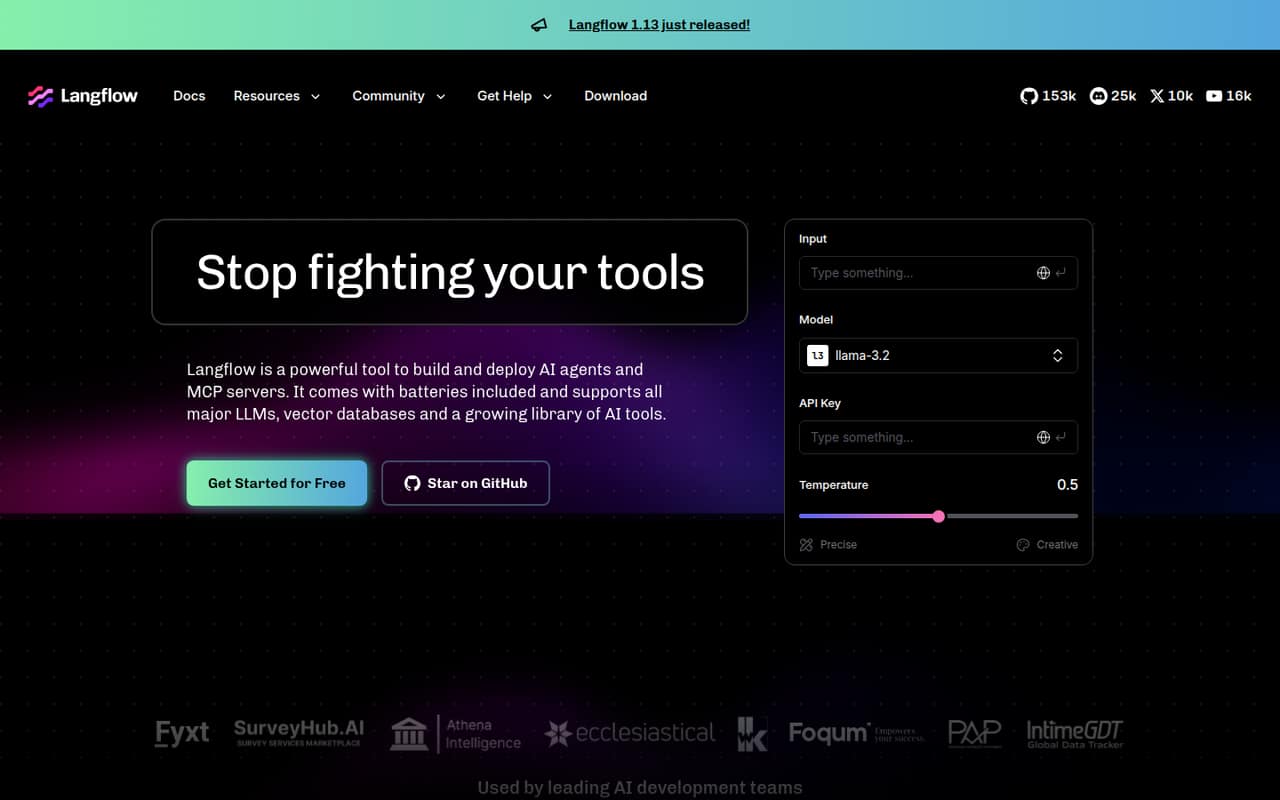
Langflow is a visual platform for building and deploying AI agents and MCP servers. Its mix of drag-and-drop flows, reusable components and Python customization suits teams prototyping LLM applications, RAG workflows and agent tools.
The MIT-licensed self-hosted option has no published software price, and the homepage advertises a free cloud option. But cloud usage limits, rate limits, billing details and several production operating requirements are not published in the pricing information. Treat those as vendor questions before committing a production service.
Good fit if
- Python teams prototyping LLM applications
- RAG and agent workflow builders
- Teams wanting self-hosted flows
Skip it if
- Teams needing published cloud limits
- General-purpose business process automation
- Nontechnical users needing guided tutorials
ScoresHow it rates
What works
- Visual flows support rapid iteration
- Python customization extends components and flows
- Reusable components support sharing across projects
- Can run locally or in Langflow cloud
- MIT-licensed self-hosted option
What doesn't
- Cloud usage and rate limits are unpublished
- Cloud pricing and overages are unpublished
- SDK, CLI and API protocol details need verification
- Production operations need evaluation for each deployment
- A Reddit developer reports friction with larger graphs
01What Langflow is, technically
Langflow is a visual development platform for assembling AI workflows, agents and MCP servers. It sits between application code and the models, vector stores, data sources and tools those applications call. Teams connect components in visual flows, customize components or flows with Python, then deploy flows as APIs through Langflow’s cloud or run Langflow themselves.
That makes it an LLM application builder, not a general-purpose automation service or model host. The homepage says the open-source and cloud versions are the same Langflow, so teams can choose a local or hosted deployment path. The platform supports agent workflows, including a single agent or a fleet with access to components as tools. Its stated integrations include model providers, vector databases and other tools, with examples such as OpenAI, Anthropic, Amazon Bedrock, Pinecone and Weaviate. Langflow is aimed at building and iterating on AI-specific flows; teams still need to decide how their application handles authentication, state, monitoring and other production concerns.
02Langflow API, SDKs and docs
The main integration surface described by Langflow is the flow itself: build a workflow visually, customize it with Python, then deploy it as an API using Langflow’s cloud. The homepage also describes reusable components and pre-built flows, plus connections to models, vector stores, data sources and other tools. It names integrations including Anthropic, Azure, Google Cloud, OpenAI, Amazon Bedrock, Pinecone, Milvus and Weaviate.
The homepage does not name a programming-language SDK, CLI, webhook interface or API protocol. Treat API deployment as the documented integration path, and confirm endpoint formats, authentication, SDK support and versioning in Langflow’s developer documentation before choosing a client architecture. Python is the named customization language, but the homepage does not establish that every part of a deployment is configurable from Python. A Reddit user describes using Langflow alongside n8n by calling a flow API endpoint, and another says reusable custom components are Python-based. Those are user reports, not a substitute for checking the current API reference and deployment documentation.
03Langflow pricing for developers
The Open Source (Self-Hosted) option is listed at $0 per month and is MIT-licensed. Seat and usage limits are not published for that option; self-hosting still means providing and operating the required infrastructure. The homepage also advertises a free cloud account and calls cloud deployment free, but the pricing information does not publish a cloud pricing schedule or monthly and annual billing terms. It also does not publish cloud usage limits, rate limits or overage rates.
The named Enterprise option is IBM Elite Support for Langflow / watsonx integration. Its price is not published; seat and usage limits are also not published. Add-on and overage costs are not published. Before deploying a service, ask Langflow or IBM how cloud usage is measured, what happens at any quota, whether production support is included, and what the total cost is at your expected workload. A free entry point is useful, but it is not enough information to forecast a hosted production bill.
04Langflow: open source, self-hosting and lock-in
The Open Source (Self-Hosted) option is listed as MIT-licensed, and Langflow’s homepage presents the OSS and cloud versions as the same Langflow. That gives teams an option to run it themselves rather than make the hosted service their only deployment path. It also means your team takes on the work of operating the self-hosted deployment and its infrastructure.
Flows use reusable components, and Python customization can help keep some application logic in familiar code. But the vendor does not publish data-export details in the pricing information. Confirm how to export flows, credentials, run history and other stored data, and whether cloud-created projects can be moved to a self-hosted deployment. The MIT licence permits use under its terms, but it does not by itself guarantee that every hosted feature, integration or operational service is available outside the cloud. Treat portability as a design question: keep business logic and data in formats your team can retrieve, and test an exit path before depending on cloud-specific services.
05Langflow in production
Langflow’s homepage describes cloud deployment as enterprise-grade and secure, but gives no specific uptime commitment, scaling limit, rate limit, security certification or compliance scope. The pricing information also leaves cloud usage limits and overages unpublished. Ask the vendor for those details, along with deployment-region options, data retention, authentication controls, incident response and the support terms attached to your plan. For self-hosting, your team must evaluate capacity, updates and access controls in its own environment.
Reddit reports are mixed. One commenter says Langflow is useful for prototyping AI-specific solutions and custom components; another developer who says they have used it in production reports friction when building larger chains and criticizes its LangChain foundation. A separate comparison describes it as strong for fast iteration on RAG, agents and custom components, but weaker on operations when graphs grow. These are individual opinions, not measured reliability data. Test the flow sizes and failure paths your service needs, and verify how deployment, logs, retries and recovery work before relying on it.
From the threadsWhat users say
Reddit sentiment is mixed. Developers praise Langflow for Python-oriented AI prototyping and reusable components, while some raise concerns about production operations, graph complexity and documentation.
Langflow is MUCH simpler to create and share custom components for reusing in various projects
Langflow is okay but not optimized for production
best for fast iteration on RAG, agents, custom components
But I can't find any instructions or tutorials or anything
Questions people ask
Is Langflow free to use?
The Open Source (Self-Hosted) option is listed at $0 per month and is MIT-licensed. The homepage also advertises a free cloud account, but cloud usage limits, pricing terms and overage rates are not published in the pricing information. Check with the vendor before estimating hosted production costs.
Can Langflow deploy flows as APIs?
Yes. Langflow’s homepage says you can deploy flows as APIs using its cloud. It does not name an API protocol or SDK there, so verify endpoint format, authentication and client support in the developer documentation before integrating a flow into an application.
Can I customize Langflow with Python?
Yes. Langflow says Python can be used to customize flows and components. The platform also describes reusable components and pre-built flows. Confirm the supported component interfaces and deployment requirements in the documentation before building a large library of custom components.
Can Langflow run agents and MCP servers?
Langflow describes itself as a platform for building and deploying AI agents and MCP servers. Its homepage says a single agent or a fleet can access components as tools. Check current documentation for deployment, security and scaling details for your intended setup.
Can I self-host Langflow?
Yes. Langflow lists an MIT-licensed Open Source (Self-Hosted) option, and its homepage says the OSS and cloud versions are the same Langflow. You will need to operate the deployment and infrastructure yourself. Confirm how to export projects and data before selecting a deployment path.
Sources
- Langflow homepage
- Langflow pricing, compiled via web search from instapods.com, activepieces.com
- Reddit: I'm a solo dev. I built a fully local, open-source alternative to LangFlow/n8n for AI workflows with drag & drop, debugging, replay, cost tracking, and zero cloud dependency. Here's v0.5.1
- Reddit: LangFlow vs Flowise vs n8n vs Make
- Reddit: Has anyone has any success with LangFlow?
- Reddit: Can anyone compare n8n vs. Langflow vs. Dify vs. SimAI & Flowise?