
We may earn a commission if you buy through links on this page. It never changes a score or a ranking. How we make money
The bottom line
A document extraction API with citations and confidence scores, priced by credits.
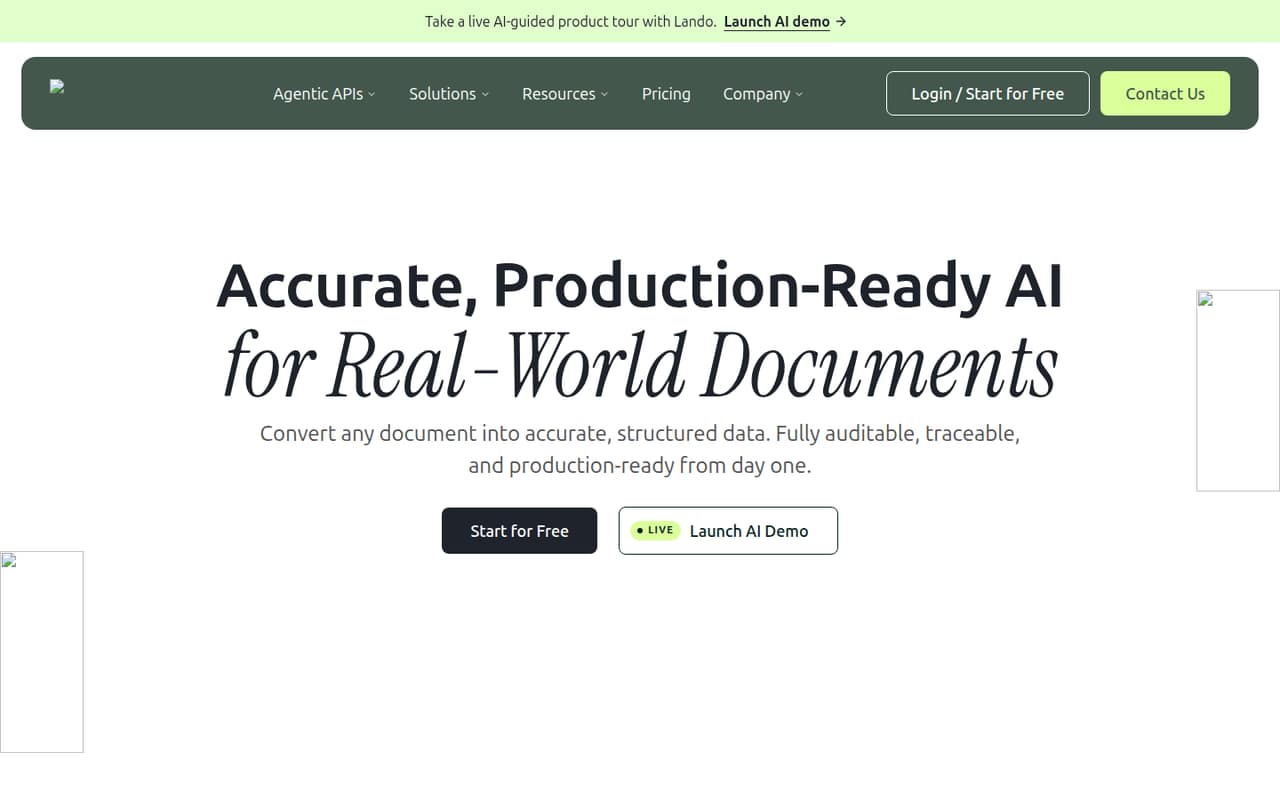
Landing AI Platform is an API-based document processing platform for parsing, splitting and extracting structured data. Its REST APIs and Python or TypeScript libraries produce results with citations and confidence scores, which can support review and audit workflows.
Explore includes 1,000 free credits; paid Team plans start at $250 per month. The credit-to-document cost depends on your workload, so estimate usage against your files before choosing a plan. Cloud, on-premises and virtual private deployment options are available.
Good fit if
- Document-heavy workflow teams
- Auditable extraction pipelines
- Mixed-format document processing
Skip it if
- Projects needing a published per-page price
- Teams requiring open-source software
- Workloads needing guaranteed free unlimited use
ScoresHow it rates
What works
- REST APIs cover parsing, splitting and schema-based extraction
- Python and TypeScript libraries are available
- Citations include page numbers and coordinates
- Confidence scores help flag results for review
- Cloud, on-premises and virtual private deployment options
What doesn't
- Credit costs per document or page are not published
- Explore is limited to one user seat
- Team annual rates are not published
- Enterprise pricing is custom
- Source availability, licence and data export terms need confirmation
01What Landing AI Platform is, technically
Landing AI Platform is an API-based document processing platform, with cloud, on-premises and virtual private deployment options. Its Agentic Document Extraction APIs sit between document sources and applications that need structured data, such as search, analytics, automation or retrieval-augmented generation workflows.
The pipeline is organized around three operations: parse documents into structured content, split mixed files into classified sub-documents, then extract fields against a schema. The platform handles text, tables and figures, and returns citations with page numbers and coordinates, plus confidence scores. Teams can use those references to review results and build audit steps into downstream systems. Extraction supports flat or nested schemas and large tables. It is not just a model endpoint: the modular APIs cover multiple stages of document preparation and extraction. The vendor also offers a live AI-guided product tour, but production integration runs through the APIs and libraries.
02Landing AI Platform API, SDKs and docs
The homepage describes modular REST APIs and Python or TypeScript libraries. Those are the named integration surfaces for building document workflows; the platform also has documentation, a Trust Center and a support resource. The API building blocks are Parse, Split and Extract, with schema-based field extraction and structured output that includes citations and confidence scores.
A typical integration would submit documents for parsing or splitting, then request extraction against the fields your application needs. You can send traceable results into retrieval-augmented generation, automation, search or analytics workflows. The homepage does not name package identifiers, supported language versions, authentication methods or request and response schemas. Confirm those details, as well as error handling and retry guidance, in the vendor’s docs before implementation. The homepage does not advertise a CLI, webhooks or plugins, so plan around the stated REST API and language libraries unless the docs confirm other options.
03Landing AI Platform pricing for developers
Explore is pay-as-you-go and includes 1,000 free credits, one user seat, community support and standard rate limits. The pricing page lists $1 for 100 credits after the free credits. That makes it a practical starting point for prototyping, but the vendor does not publish how credits map to pages, files or extraction complexity. Estimate against representative documents before forecasting production spend.
Team starts at $250 per month. It includes four plan sizes, from 25,000 to 200,000 credits per month, unlimited user seats, email support and zero data retention availability. The pricing page lists no annual billing rate. Enterprise is custom-priced for more than 200,000 credits per month and adds dedicated support, priority rate limits, SLAs and uptime guarantees. The pricing page lists credits at $1 per 100; it lists no separate overage fee. Ask how consumption is measured and what happens when a Team plan reaches its monthly credit allowance.
04Landing AI Platform: open source, self-hosting and lock-in
The vendor does not publish a software licence or source-availability terms on the homepage. It offers cloud, on-premises and virtual private deployment options, so Landing AI is not limited to a public cloud deployment. Confirm with the vendor which components run in each environment, what infrastructure you must provide and whether deployment changes the plan or support terms.
The homepage does not describe a data export feature or migration path. Extraction produces structured content, citations and confidence scores, which you can use in downstream systems; ask whether you can retrieve all inputs and outputs in documented formats and retain them after ending service. Integrations built around REST APIs and schemas can reduce coupling, but workflows may still depend on Landing AI’s extraction behavior and response formats. Test an exit path with representative documents before making it a core dependency.
05Landing AI Platform in production
The pricing page lists standard rate limits for Explore and priority rate limits for Enterprise, but it does not publish numeric limits. Team plan sizes include 25,000 to 200,000 monthly credits; clarify how throughput, concurrency and credit consumption work for your file mix. The homepage claims ADE handles thousands of pages per minute, but does not give a workload or service-level context for that figure. Treat it as a vendor claim and validate your own latency and quality requirements.
The vendor lists SOC 2 Type II certification and says it is GDPR- and HIPAA-compliant by design. Zero data retention is available on Team, and the platform offers cloud, on-premises and virtual private deployment. Confirm the scope of those assurances, retention settings and contractual responsibilities for your deployment. Enterprise includes SLAs and uptime guarantees; ask for the actual terms before relying on them. Use citations and confidence scores to route uncertain results for human review.
Questions people ask
What does Landing AI Platform do?
Landing AI Platform processes documents through APIs for parsing, splitting and schema-based extraction. It can structure text, tables and figures, classify sub-documents in mixed files, and return extracted values with citations and confidence scores. The outputs are designed for downstream workflows such as automation, search, analytics and retrieval-augmented generation.
Does Landing AI Platform have a free tier?
Yes. The Explore pay-as-you-go plan includes 1,000 free credits, one user seat, community support and standard rate limits. After that, the pricing page lists $1 for 100 credits. Confirm how credits are consumed by your document types and workflow before estimating ongoing cost.
How much does Landing AI Platform cost?
Team starts at $250 per month and includes plan sizes from 25,000 to 200,000 monthly credits. Explore is pay-as-you-go, with $1 buying 100 credits after its 1,000 free credits. Enterprise pricing is custom for more than 200,000 credits per month. Annual Team rates are not published.
Which languages and APIs does Landing AI Platform support?
The homepage names modular REST APIs and Python or TypeScript libraries. It describes Parse, Split and Extract API building blocks. Check the vendor’s docs for package names, supported versions, authentication, request formats and rate-limit guidance before choosing an integration approach.
Can Landing AI Platform run on-premises?
The vendor lists cloud, on-premises and virtual private deployment options. Confirm which components run in each environment, what infrastructure is required, and how deployment affects pricing, support, data retention and contractual terms. Enterprise plans also list dedicated support, priority rate limits, SLAs and uptime guarantees.