
We may earn a commission if you buy through links on this page. It never changes a score or a ranking. How we make money
The bottom line
Useful for relational prediction workflows; enterprise pricing and model licensing need clarification.
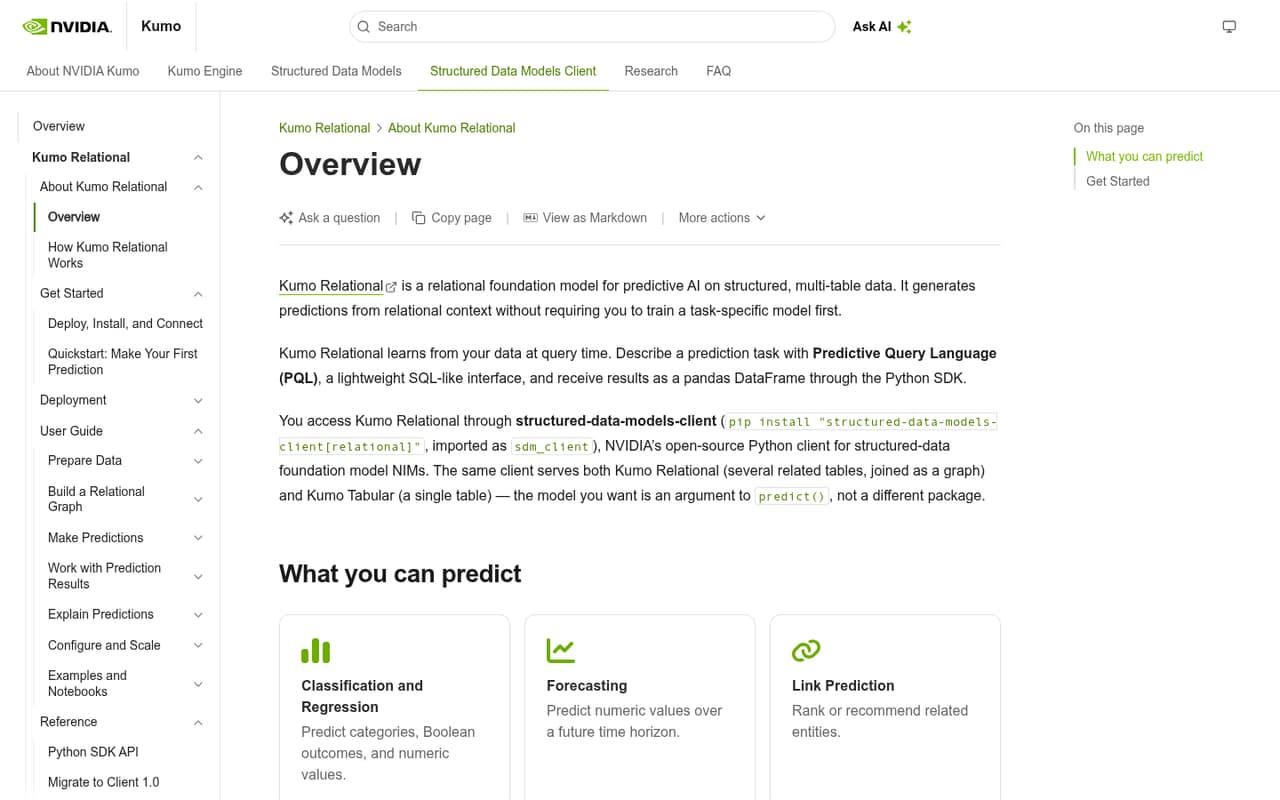
Kumo Relational is a model-serving product for predictions across structured, multi-table data. You describe tasks in PQL and use NVIDIA’s Python client to receive results as a pandas DataFrame, without first training a task-specific model.
The workflow is clearly defined, but Kumo lists only custom enterprise agreements, with no public starting price, free tier, or trial. The Python client is open source; the model’s license, self-hosting rights, and data-export options need confirmation before adoption.
Good fit if
- Teams querying multi-table business data
- Python users building prediction workflows
- Classification, forecasting, and link prediction
Skip it if
- Buyers needing public, predictable pricing
- Teams requiring confirmed model self-hosting
- Projects that need published rate limits
ScoresHow it rates
What works
- Predicts from related tables joined as a graph
- No task-specific model training required first
- PQL offers a SQL-like prediction interface
- Returns results as a pandas DataFrame
- Supports classification, regression, forecasting, and link prediction
What doesn't
- Enterprise pricing is custom and unpublished
- No free plan or trial is listed
- Kumo Relational model license is not published
- Public rate limits and SLA are not listed
- Data export and migration details need confirmation
01What Kumo AI is, technically
Kumo Relational is a relational foundation model served through a NIM, not a general-purpose LLM or a standalone command-line tool. It targets predictions on structured data spread across related tables. The model uses those tables as a graph of relational context, so a prediction can draw on more than one table without requiring a task-specific model to be trained first.
In an application stack, the integration surface is NVIDIA’s structured-data-models-client Python package. You connect the client to a NIM serving kumo-relational, describe the task in Predictive Query Language (PQL), and receive results as a pandas DataFrame. That puts Kumo between a data source and the application or analytical workflow consuming predictions. The documentation navigation includes deployment material and SageMaker, but the deployment options and operating responsibilities depend on the NIM setup. Kumo Tabular is a separate model for single-table data, accessed through the same client.
02Kumo AI API, SDKs and docs
The documented client is structured-data-models-client, installed with pip install "structured-data-models-client[relational]" and imported as sdm_client. It is NVIDIA’s open-source Python client for structured-data foundation model NIMs. The same package serves Kumo Relational and Kumo Tabular; you select the model as an argument to predict() rather than installing a different package.
PQL is the SQL-like interface for describing prediction tasks. The documented result surface is a pandas DataFrame. Kumo’s documentation navigation also lists a Python SDK API reference and a NIM REST API reference. Its integration topics include Snowflake, SQLite, Databricks, DuckDB, PostgreSQL, Databricks Lakebase, and Amazon S3. The homepage does not identify a CLI or additional language SDKs, so teams using other languages should confirm their supported integration path in the vendor’s docs. The docs index is available at /llms.txt; the vendor also says to append /llms.txt to a page URL for its index or .md for a Markdown version.
03Kumo AI pricing for developers
Kumo lists a custom enterprise plan sold through a custom agreement and contact with sales. The pricing page does not publish a monthly or annual price, a starting price, or seat limits. There is no listed free plan or free trial. That makes it difficult to estimate a production bill or compare Kumo with usage-priced prediction services before talking to the vendor.
The available pricing information also does not name a billing unit such as predictions, rows, requests, compute time, or seats. It does not publish overage rates or add-ons, so we cannot model how costs change with prediction volume, batch jobs, or larger deployments from public prices. Ask sales for the full billing basis, minimum commitment, included usage, seat rules, and any fees for deployment or support. The Python client is open source, but that does not establish free access to the Kumo Relational model or NIM. Treat model access and infrastructure costs as separate items to confirm in the agreement.
04Kumo AI: open source, self-hosting and lock-in
The Python client is open source, but the homepage does not state a license for Kumo Relational or say whether its model weights are available. Do not assume that an open-source client makes the model itself open source. Kumo’s documentation describes connecting to a NIM serving kumo-relational and lists deployment material, including SageMaker; confirm with the vendor whether your intended environment is supported and what rights apply to self-hosting.
The homepage does not publish data-export procedures. Results arrive as a pandas DataFrame, which gives your application a familiar output format, but it does not answer how to export inputs, metadata, or other state. PQL and the Kumo prediction interface are also product-specific. Before committing, ask how to retrieve your data and configuration, whether model access continues outside a Kumo agreement, and what work is required to port prediction tasks to another system.
05Kumo AI in production
The docs list material for configuring and scaling, batch prediction, prediction explainability, and NIM REST API use. They also list an FAQ about context-size limits. The homepage does not publish numeric rate limits, throughput targets, an SLA, or security and compliance certifications. Ask for those details, along with supported concurrency, retry behavior, versioning policy, and the exact context limits for your workload, before making the model a production dependency.
Operational ownership depends on how you deploy the NIM: confirm who manages serving infrastructure, monitoring, upgrades, and incident response. Also validate how the model handles missing or changing table relationships and what happens when requests exceed its supported context. The only Reddit item published is a thread headline about NVIDIA acquiring Kumo AI, with zero comments. It provides no developer reports about reliability, support, or production failures, so user sentiment on those issues is unclear.
From the threadsWhat users say
The available Reddit material gives no meaningful read on user sentiment: one thread has a headline about NVIDIA’s acquisition of Kumo AI and zero comments. We therefore treat sentiment as neutral rather than inferring satisfaction or dissatisfaction.
NVIDIA Acquires Kumo AI
for Over $400 Million
to Push Graph AI
Into Enterprise Prediction
Questions people ask
What does Kumo Relational predict?
Kumo Relational supports classification and regression, including categories, Boolean outcomes, and numeric values. It also supports forecasting numeric values over a future time horizon and link prediction to rank or recommend related entities. Its focus is structured data spread across related tables, rather than a single table.
How does Kumo Relational work?
Kumo Relational learns from your data at query time. You describe a prediction task in Predictive Query Language, a lightweight SQL-like interface, and use the Python SDK to receive results as a pandas DataFrame. The product is designed to use relational context without requiring task-specific model training first.
What do I need to integrate Kumo Relational?
The documented Python package is NVIDIA’s structured-data-models-client, installed with its relational extra. You connect it to a NIM serving kumo-relational, prepare the relational schema, and make predictions through the client. Kumo also lists a NIM REST API reference; confirm other language support in the vendor’s docs.
Can I self-host Kumo Relational?
Kumo’s docs describe connecting to a NIM serving kumo-relational and include deployment material, including SageMaker. The homepage does not establish the model’s license, whether weights are downloadable, or the commercial terms for self-hosting. Ask the vendor which deployment environments and operating models your agreement supports.
How much does Kumo AI cost?
Kumo lists custom enterprise agreements and directs buyers to contact sales. Monthly and annual prices, a starting price, seat limits, and usage rates are not published. The listed offer has no free plan or free trial. Ask sales for the billing unit, included usage, minimum commitment, and overage terms.