
We may earn a commission if you buy through links on this page. It never changes a score or a ranking. How we make money
The bottom line
Useful for governed production agents, but unclear API details and unpublished pricing complicate evaluation.
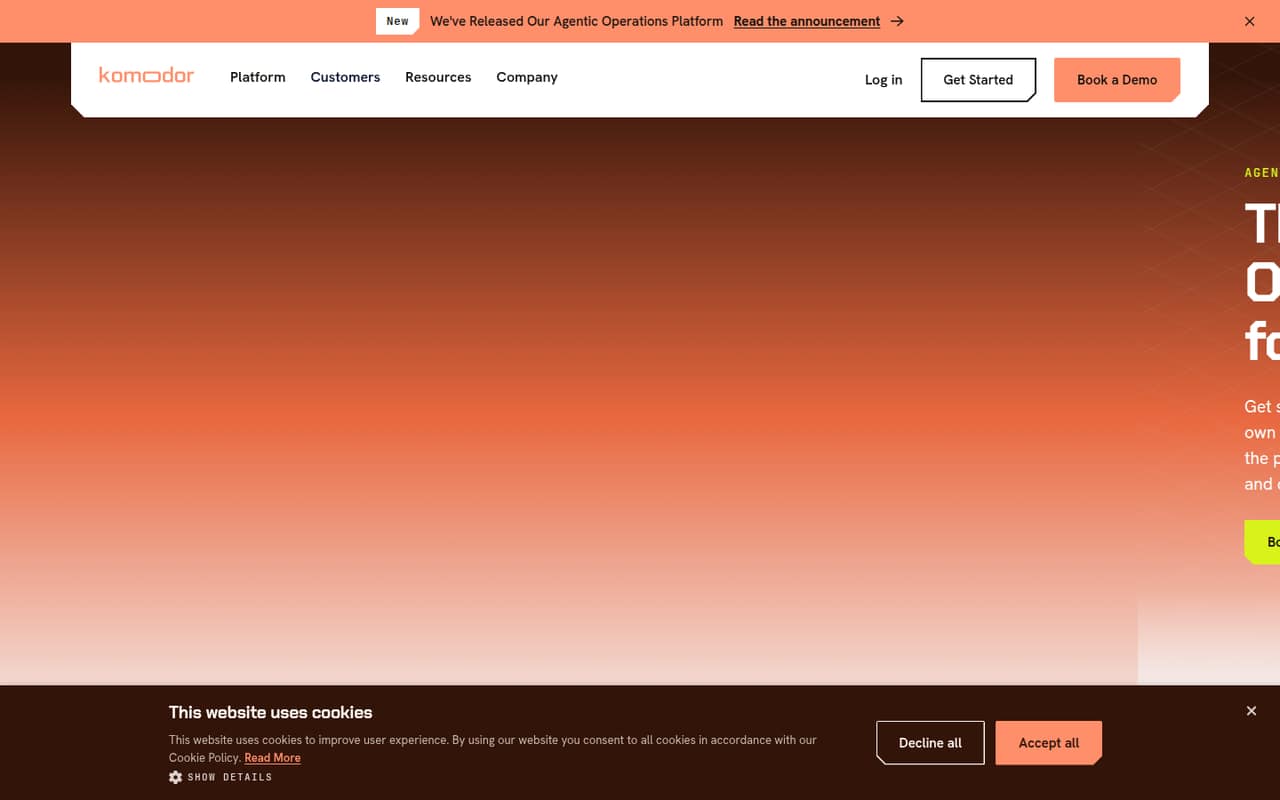
Komodor is an agentic operations platform for production, with workflows for SRE, cost optimization and software operations. Teams can use ready-made workflows, bring agents built with tools such as Claude, Codex or LangChain, or build agents from scratch. Deployment options include a customer's cloud, on-premises and Komodor Cloud.
The platform combines incident troubleshooting and CI/CD health with agent evaluation and governance. Its main buying risks are practical: the vendor does not publish standard plan prices, seat and usage limits, or a platform source licence. Confirm API and SDK support, deployment requirements and expected token costs before putting it in a production stack.
Good fit if
- Teams operating production agent fleets
- SRE teams automating incident workflows
- Organizations needing agent governance
Skip it if
- Teams requiring a published API contract
- Small teams needing a free plan
- Buyers requiring an open-source licence
ScoresHow it rates
What works
- Run ready-made, imported or custom agents
- Supports customer cloud, on-prem and Komodor Cloud
- Includes configurable judges and golden scenarios
- Governance includes permissions, approvals and audit trails
- Targets observability, cloud, Kubernetes and AI costs
What doesn't
- Starter and Enterprise prices are not published
- Seat, usage and invocation limits are not published
- Platform API, SDK and language support need confirmation
- Platform source licence and data export terms are unclear
- Reddit users report the freemium plan was discontinued
01What Komodor is, technically
Komodor is a production operations platform for building, running, governing and optimizing agents. It is not presented as a standalone library or CLI: it provides a shared runtime and governance layer for agent workflows, with deployment on a customer's cloud, on-premises or Komodor Cloud. The platform covers SRE workflows, cost optimization and software operations.
In a stack, Komodor sits above operational signals, agents and existing runbooks. Its troubleshooting workflows correlate signals and generate root-cause analysis from detection through remediation. Other workflows address CI/CD health, production readiness and operational costs. Teams can use ready-made workflows, import agents built with Claude, Codex, LangChain or another harness, or build agents from scratch. Komodor says agents share memory and a living knowledge graph. This makes the product relevant when a team needs to operate and govern multiple production agents, rather than only inspect Kubernetes or telemetry. Deployment architecture, data flows and supported integrations should be checked with the vendor before adopting it.
02Komodor API, SDKs and docs
Komodor's build surface is agent-oriented: the vendor says teams can turn a skill, script or runbook built with Claude, Codex, LangChain or another harness into a production agent, or build one from scratch. Imported and Komodor-built agents use the platform's shared infrastructure and governance. The vendor also describes running agents with any model.
Treat that as the stated integration path, not as evidence of a particular API contract. Before planning an implementation, confirm supported API endpoints and protocols, SDK availability, language support, authentication, versioning and rate limits in Komodor's docs or with its team. Also confirm how existing agents connect to the runtime and what configuration is needed for customer-cloud or on-premises deployment. The vendor describes workflows for incidents, cost optimization and CI/CD health, but the build details that matter to a codebase—such as deployment manifests, CI integration steps and data-ingestion requirements—need validation during technical evaluation. That makes an architecture review more important than assuming a standard SDK-first setup.
03Komodor pricing for developers
The pricing information checked on 2026-11-10 lists two plans, but has low confidence and no published dollar amounts. Starter is described as a platform fee plus actual AI-token usage. The monthly and annual platform prices, included seats, usage limits and trial duration are not published. A free trial is listed; a standard free plan is not.
Enterprise targets organizations running agents at scale. Its listing mentions extended AI tokens and invocations, but does not publish quantities, seat limits, usage limits or a base price. AI SRE, Cost Optimization and AI Software Operations are listed as add-on modules with separate prices not published. The vendor also does not publish overage rates in the available pricing information. For a production estimate, ask for the platform fee, token billing basis, invocation allowances, module costs and any overage charges using your expected workloads. A Reddit thread about the prior freemium offering reports that it was discontinued, so confirm current trial and plan terms directly before budgeting.
04Komodor: open source, self-hosting and lock-in
Komodor's platform source licence is not published, so buyers should not treat the platform as open source. The vendor offers deployment on a customer's cloud, on-premises or Komodor Cloud. Those options address where the platform runs; they do not establish that customers can download, modify or independently operate its source code.
Data export terms are also not published. Ask what can be exported—including agent definitions, workflow configuration, run history, audit records and knowledge-graph data—and in what formats. Migration effort will depend on how much operational logic lives in Komodor workflows, shared memory and governance rules rather than in agents your team owns elsewhere. Reddit commenters describe the previous product as a closed-source SaaS dependency, but that discussion concerns earlier Komodor use and is not a current licence statement. Get the current contract, licence and exit provisions in writing.
05Komodor in production
Komodor's production pitch centers on shared agent runtime, configurable judges, golden scenarios and shadow runs. Its governance features include permissions, guardrails, approval gates, sensitive-data redaction and audit trails. Those controls are relevant for agents that can affect infrastructure or incident response, but teams should verify how policies apply across tools, models and deployment environments.
Before relying on it, ask for documented availability targets, recovery commitments, rate limits, data-retention and export terms, and security and compliance documentation. The pricing information does not publish seat, usage or invocation limits, so confirm how caps and overages behave as workloads scale. Reddit users discussing Komodor's earlier freemium product report that the free offering was discontinued; one commenter framed that change as the risk of relying on a commercial service. That history is a reason to assess plan stability and exit options, not evidence of current platform reliability. The vendor's customer-cloud and on-premises options may suit teams with deployment requirements, subject to confirming what those deployments include.
From the threadsWhat users say
The Reddit material is mixed but leans negative on pricing changes and reliance on a commercial service. The discussions also include criticism of outreach and skepticism about the company.
Komodor has officially lost the plot
you integrated with a freemium SaaS product and now are exposed to their commercial decisions
Regarding the recent changes to our pricing structure, I understand this decision may be disappointing to some of our users
I don't like how you (assuming you are affiliated with this company) send spam to people you find in unaffiliated slack channels
Questions people ask
What is Komodor used for?
Komodor is an agentic operations platform for production. It provides workflows for SRE, cost optimization and software operations, including incident troubleshooting, CI/CD health and agent governance. Teams can run ready-made workflows, import agents built with other harnesses or build agents within the platform.
Where can Komodor run?
The vendor lists three deployment options: a customer's cloud, on-premises or Komodor Cloud. Confirm the architecture, data flows, operational responsibilities and feature availability for the specific deployment option you plan to use before adopting it.
How much does Komodor cost?
Starter is described as a platform fee plus actual AI-token usage, but the vendor does not publish a dollar price. Enterprise pricing and module prices are also unpublished. Seat, usage and invocation limits are not listed, so request a quote based on expected agents, tokens and modules.
Does Komodor offer a free plan?
The current pricing information lists a free trial but no standard free plan; the trial duration is not published. A Reddit thread reports that Komodor's earlier freemium offering was discontinued. Confirm current trial availability and eligibility with the vendor before planning an evaluation.
Can I bring agents built with other tools?
Yes. Komodor says teams can turn skills, scripts or runbooks built with Claude, Codex, LangChain or another harness into production agents. Confirm the supported connection method, language and API requirements with Komodor before estimating implementation work.
Sources
- Komodor homepage
- Komodor pricing, compiled via web search from komodor.com
- Reddit: Komodor Just Pulled the Ultimate Bait-and-Switch Move by Killing Their Freemium Plan
- Reddit: Komodor wants to make every engineer a Kubernetes troubleshooting expert
- Reddit: Komodor, an automated Kubernetes troubleshooting platform, goes Freemium