
We may earn a commission if you buy through links on this page. It never changes a score or a ranking. How we make money
The bottom line
Instana maps application and infrastructure telemetry in real time, with costs tied to MVS usage.
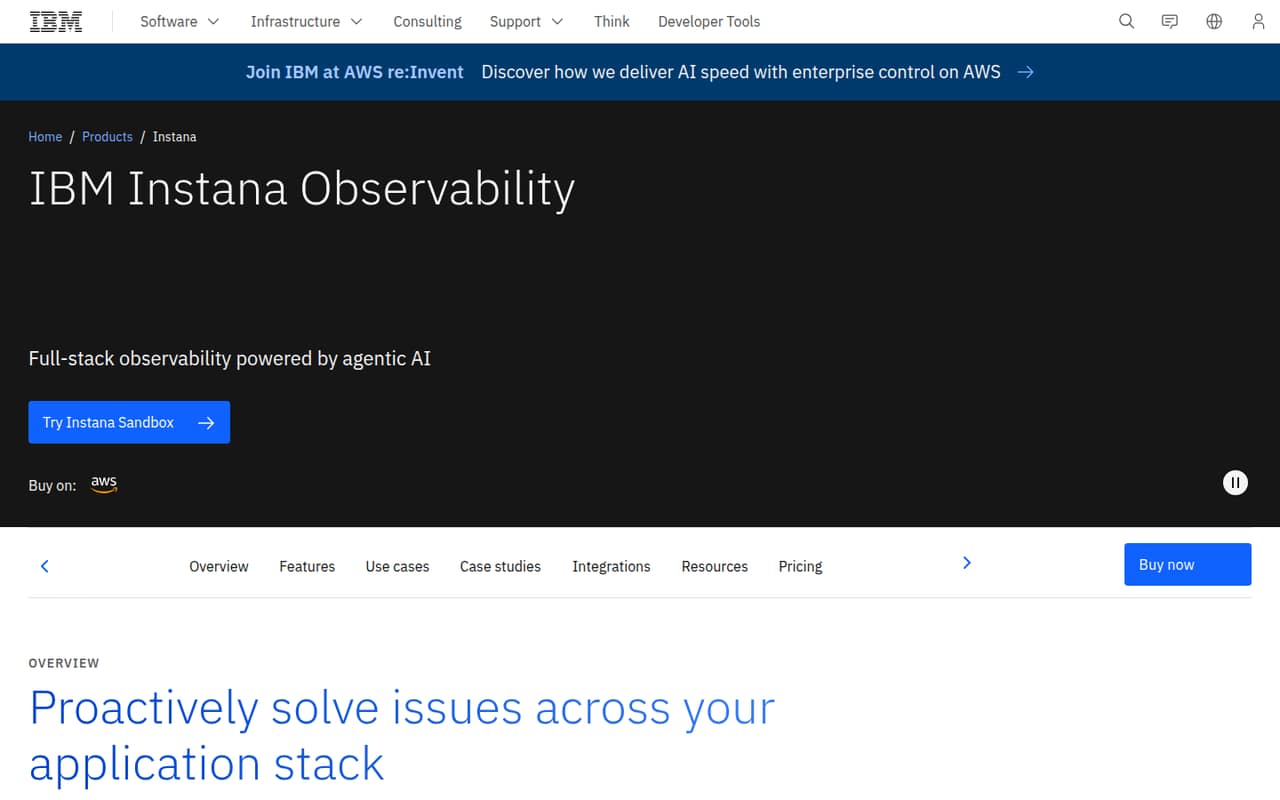
Instana is a full-stack observability platform available as SaaS or self-hosted software. It discovers applications and infrastructure, maps dependencies and provides real-time data, with integrations for more than 300 technologies and the OpenTelemetry Collector.
The trade-offs are commercial and operational: there is no ongoing free plan, prices use MVS-based units, and the homepage gives little detail about developer APIs or SDKs. Confirm integration support, billing units and deployment requirements before rollout.
Good fit if
- Teams monitoring complex application stacks
- Organizations using OpenTelemetry Collector
- Teams needing self-hosted deployment
Skip it if
- Projects requiring a permanent free plan
- Teams needing documented SDK details upfront
- Buyers seeking published add-on prices
ScoresHow it rates
What works
- Real-time data updated every second
- Automatic discovery and dependency mapping
- More than 300 supported technologies
- OpenTelemetry Collector integration
- SaaS and self-hosted deployment options
What doesn't
- No ongoing free plan
- MVS billing unit needs clarification
- SaaS add-on prices are unpublished
- Homepage gives few API implementation details
- Self-hosting adds infrastructure and operations work
01What Instana is, technically
Instana is a commercial observability platform offered as SaaS and in self-hosted plans. It is not a library or a standalone monitoring agent: it sits alongside applications and infrastructure, collecting telemetry and presenting it through a web interface. Instana says it automatically discovers and instruments applications and infrastructure, then maps their dependencies in real time.
The platform is intended to help engineering and DevOps teams trace issues across application and infrastructure layers, investigate incidents and monitor digital experiences. Its data updates every second, and it supports more than 300 technologies. For cloud-native environments, the named integration point is the OpenTelemetry Collector. Instana also maps AI agents and LLM workflows, including prompts, outputs, tokens, latency, cost and errors. Agentic AI supports incident investigation, while IBM Turbonomic is the separate resource-optimization product that Instana works with. This places Instana in the telemetry, diagnosis and monitoring layer of a production stack.
02Instana API, SDKs and docs
The homepage describes an observability platform integrated through automatic discovery, out-of-the-box technology integrations and the OpenTelemetry Collector. It says those integrations need no plug-ins or application restarts. For cloud-native and microservices monitoring, the Collector is the clearest named integration surface.
The homepage does not name a REST API, SDK, programming language or CLI. Before adopting Instana, check the vendor’s developer documentation for the API and instrumentation paths your codebase needs, including supported languages and any SDK version requirements. Do not assume that automatic discovery replaces application-level instrumentation or that every one of the 300-plus integrations covers your deployment’s exact version and configuration.
The product also includes a UI for full-stack visibility, incident investigation and dependency mapping. Ask the vendor how telemetry is configured, queried and exported in your environment, and whether your existing OpenTelemetry pipeline can send the required signals without duplicate collection.
03Instana pricing for developers
Instana has no ongoing free plan. Try Instana for Free provides 14 days of full access, including application, infrastructure, logs and digital experience monitoring. After the trial, the pricing page lists PayPerUse at $0.04 per MVS hour per month. The plan has usage-based pricing, can be canceled anytime and has no add-ons.
SaaS starts at $23.10 per MVS per month, with Essentials or Standard bundles, unlimited users and no limits on hosts or scale. Managed PoPs, Data ingestion and Logs in context are listed as add-ons; their prices are not published. Self-Hosted starts at $385.20 per MVS per year, with Essentials and Standard feature parity and Logs in context included. Self Hosted Old is also listed as an annual subscription, but without a published price.
These rates make the bill depend on MVS consumption or count rather than seats. The pricing page does not define MVS in the published plan details, so confirm the unit, measurement rules and estimated monthly usage with the vendor before budgeting.
04Instana: open source, self-hosting and lock-in
Instana is sold as a commercial product; no open-source licence or source-available edition is listed. The vendor offers self-hosted plans, so deployment does not have to run as SaaS. Self-Hosted includes Essentials and Standard feature parity with SaaS, monthly updates and Logs in context. The Self Hosted Old plan is also described as giving control over data, deployment and upgrade cadence.
Self-hosting gives teams more control over where the observability system runs, but it also means operating the deployment and its infrastructure. The vendor’s plan details do not describe data export formats or a migration path. Ask what telemetry, dashboards, alerts and historical data can be exported, and whether any proprietary data or AI investigation features require Instana to interpret. OpenTelemetry provides a named integration path, but it does not by itself establish that every Instana feature or stored record can be moved to another tool.
05Instana in production
Instana’s automatic discovery, dependency mapping and data updated every second are aimed at systems where changes and cross-service impact need quick visibility. The vendor says it supports more than 300 technologies and integrates with the OpenTelemetry Collector. Check that your languages, runtime versions and infrastructure are covered, and verify how collection behaves during deployments and topology changes.
Before relying on it for production response, confirm ingestion and query limits, retention, alert delivery behavior, service-level commitments, security controls and compliance coverage for your deployment. The plan details list MVS-based prices but do not provide numerical rate or ingestion limits. Ask how MVS usage is measured, how usage changes affect invoices and what happens if telemetry volume rises. For SaaS add-ons, request prices for Managed PoPs, Data ingestion and Logs in context. For self-hosting, account for the infrastructure and operational work needed to run the platform and apply its monthly updates.
Questions people ask
What is Instana used for?
Instana monitors applications, infrastructure and digital experiences. It automatically discovers components and maps their dependencies, giving teams real-time telemetry for tracing issues and investigating incidents. Its AI observability features also map AI agents and LLM workflows, including latency, cost and errors.
How does Instana integrate with OpenTelemetry?
Instana integrates with the OpenTelemetry Collector, which the vendor identifies as an option for cloud-native and microservices monitoring. Confirm the supported configuration and signal coverage in the vendor’s documentation, and check whether your existing Collector pipeline can send telemetry without duplicate collection.
Can Instana be self-hosted?
Yes. Instana lists Self-Hosted and Self Hosted Old plans. Self-Hosted includes Essentials and Standard feature parity with SaaS, monthly updates and Logs in context. The older plan is described as providing control over data, deployment and upgrade cadence.
What is the difference between Instana and Turbonomic?
Instana provides observability: it collects and maps application and infrastructure data and supports incident investigation. IBM Turbonomic focuses on resource optimization. Instana says it works with Turbonomic to optimize application performance and reduce wastage.
When was Instana acquired by IBM?
Instana is presented as IBM Instana Observability, but the vendor's site available for this review does not establish the acquisition date. Check IBM’s corporate announcements or acquisition records for the date before citing it.