
We may earn a commission if you buy through links on this page. It never changes a score or a ranking. How we make money
The bottom line
Global payout infrastructure with branded payee experiences, but custom pricing and integration details need confirmation.
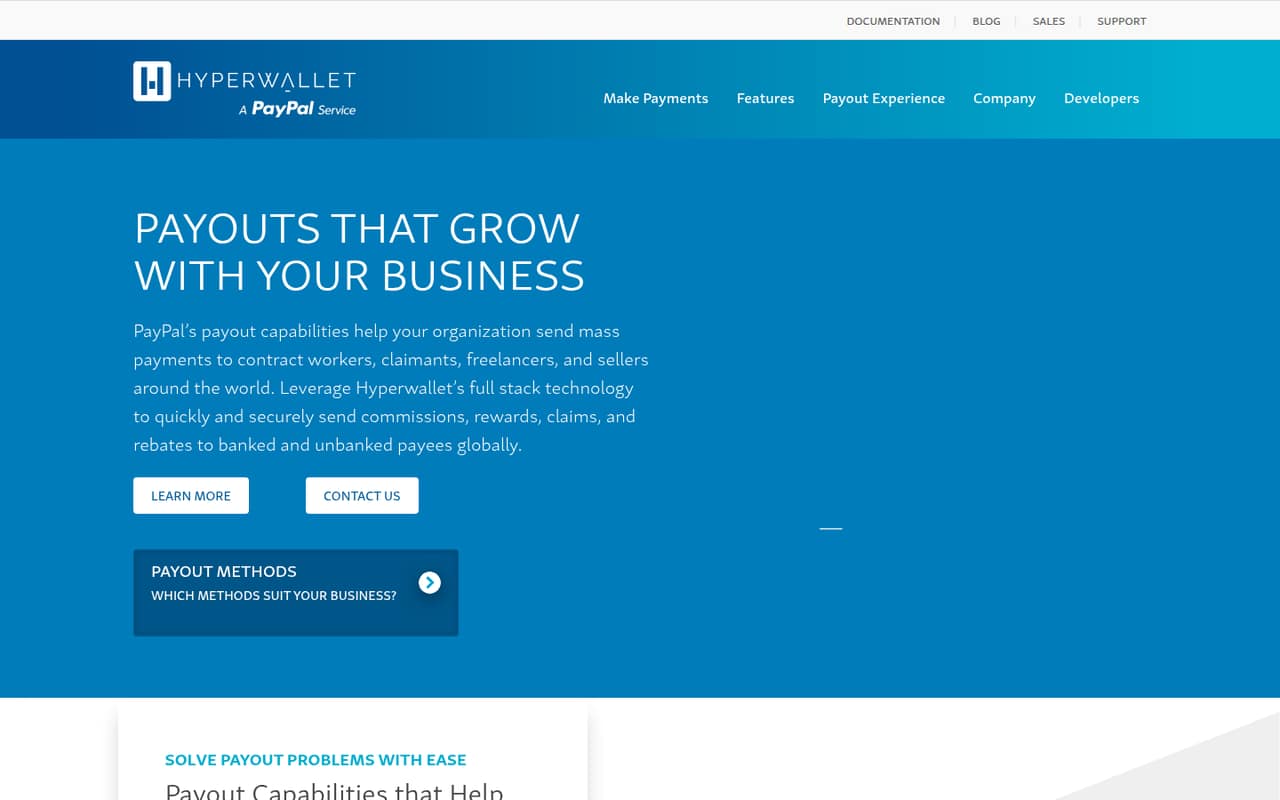
Hyperwallet is PayPal’s hosted payout technology for organizations paying workers, sellers and claimants. Its stated capabilities include mass payments, global payees, branded Pay Portal experiences and embedded payouts.
The public homepage promotes developer documentation and integration tools, but buyers should confirm the API surface, supported SDKs, limits and pricing with PayPal before planning a production integration. Reddit users report account activation and payout-transition friction.
Good fit if
- Marketplaces paying global sellers
- Organizations sending claims or rebates
- Teams needing branded payout portals
Skip it if
- Teams requiring published usage pricing
- Developers needing confirmed SDK details
- Payees who need simple account activation
ScoresHow it rates
What works
- Supports mass payouts to workers, sellers and claimants
- Designed for banked and unbanked payees
- Offers branded Pay Portal experiences
- Supports embedded payout experiences
- Provides developer documentation and integration tools
What doesn't
- Pricing is custom quote; no starting price is listed
- Homepage does not identify API protocols or SDK languages
- Rate limits and service-level terms need confirmation
- No self-hosting option or source licence is documented
- Reddit users report activation and onboarding problems
01What Hyperwallet is, technically
Hyperwallet is a hosted payout service from PayPal, not a library, command-line tool or self-hosted server. It sits between an organization’s payment operations and the people or businesses it pays: contract workers, freelancers, sellers and claimants. The homepage describes payouts for commissions, rewards, claims and rebates, including payments to banked and unbanked payees around the world.
The product combines payout processing with payee-facing experiences. Organizations can use Hyperwallet’s Pay Portal to present a branded interface, or add embedded payout experiences within an enterprise or marketplace. PayPal describes capabilities for small and medium-sized businesses as well as custom-configured marketplace and large-enterprise integrations. That makes Hyperwallet a possible fit when payout workflows are part of a larger product, rather than a standalone payment button. The public material does not establish which services or payment methods are available in every country, so confirm coverage for your payees and use case before designing around it.
02Hyperwallet API, SDKs and docs
PayPal’s homepage points developers to payout documentation and developer tools for integrating payout infrastructure. It also describes embedded payout experiences, which can place payout flows within an enterprise or marketplace product. These are the named integration surfaces in the public homepage material; it does not identify an API protocol, SDK package, programming language, CLI or webhook interface.
Before estimating implementation work, ask PayPal for the current API reference, authentication model, supported SDKs and languages, sandbox access, webhook events, and versioning policy. Confirm how payee onboarding, payout creation, status tracking, reversals and errors are handled, and whether the embedded experience can be customized to your requirements. The homepage says the tools are intended to help stakeholders integrate, but does not publish implementation details or integration timelines. Treat the integration effort as unconfirmed until your team reviews the vendor’s developer documentation and validates the required flows with PayPal.
03Hyperwallet pricing for developers
The available pricing information lists an Enterprise/custom plan with a custom quote. It gives no starting price, monthly or annual price, or published free-tier terms. The pricing record says billing terms and free-plan availability are not published, so do not assume a free production tier or trial when planning a proof of concept.
The public pricing information also gives no per-payout, per-payee, currency-conversion, seat, request or volume rates, and does not describe overages or add-ons. That means we cannot calculate how the bill changes as payout volume grows from the published information. Ask PayPal for a written quote based on your expected payout volume, payee locations, currencies, payout methods and support requirements. Confirm transaction fees, foreign-exchange charges, minimum commitments, implementation costs, account fees and any charges for branded or embedded experiences. Get the quote’s billing terms and any volume tiers before comparing Hyperwallet with other payout providers.
04Hyperwallet: open source, self-hosting and lock-in
Hyperwallet is presented as a hosted payout service. The homepage links to GitHub, but that link alone does not establish that the payout service’s source code is available or identify a licence. The vendor does not publish a self-hosting option in the homepage material. Treat it as a vendor-hosted service unless PayPal confirms otherwise.
The public information also does not describe data export or a migration process. Before committing, ask how your organization can retrieve payee profiles, payout history, reconciliation records and status data, and in what formats. Confirm whether records remain accessible after termination and how long exports take. A migration could involve more than replacing an integration: you may need to move payout workflows and provide payees with a different account or payment experience. Get exit and data-retention terms in writing, especially if Hyperwallet will become the main route for marketplace or worker payments.
05Hyperwallet in production
The homepage describes the service as secure and compliant and says its payout capabilities are designed for organizations of different sizes. Those are vendor claims, not published details about certifications, uptime or operational limits. The available material does not give rate limits, payout throughput, an uptime commitment or incident-response terms. Ask PayPal for those details, along with country and payment-method coverage, before putting critical payouts on the service.
Reddit users report account activation difficulties, delayed activation emails and friction when a platform switches its payees to Hyperwallet. One r/cults3d thread includes a report that support was reachable only after account activation; a separate TELUS-related thread discusses an activation email that had not arrived. These are individual reports, not evidence of a general failure rate, but they point to a production dependency: payee onboarding and support can affect whether people receive payment. Test the full activation and payout journey with your platform, and establish a support escalation path for payees who cannot access their accounts.
From the threadsWhat users say
Reddit sentiment skews negative around platform transitions, account activation and the extra steps required to receive payouts. Some discussion acknowledges broader payout options and tracking, but users also describe onboarding friction and difficulties getting help.
I can’t activate my Hyperwallet account which sucks since their customer service is only reachable if you have an activated Hyperwallet account
First it was way easier; connect your PayPal account, request the payout by the push of a button, and you're done
Invoice for Nov 2025 received, but no Hyperwallet activation email yet. Friend already got theirs
There is no question, so we don't know what to answer except that Hyperwallet represents many interests, even if it is obvious that registration is more complex than simply entering your PayPal email address
Questions people ask
How secure is Hyperwallet?
PayPal describes its payout technology as secure and says its capabilities are designed to support compliant payouts. The homepage does not detail specific security controls or certifications. Ask PayPal for current security documentation, compliance coverage, account-protection measures, incident-response terms and any requirements that apply to your organization and payees.
How do I get a Hyperwallet account?
Hyperwallet is presented as payout technology for organizations, with branded and embedded experiences for their payees. The homepage directs businesses to contact PayPal or sales rather than providing a public self-serve signup flow. If a platform pays you through Hyperwallet, follow that platform’s activation instructions and contact its payment support if an invitation does not arrive.
How do I contact Hyperwallet support?
The homepage links to a Hyperwallet Support Center and lists a corporate sales contact for Canada and the US at 1-855-787-1009, Monday through Thursday, 9am–8pm and Friday, 9am–6pm EST. It also lists an Australia number, 1-800-729-725. Payees should confirm whether their paying platform has a separate support route.
Does Hyperwallet support payouts through Facebook?
The public homepage describes global payouts for organizations and their workers, sellers and claimants, but does not name Facebook as a supported platform. If you are a Facebook payee, check Facebook’s current payment instructions or ask its support team whether it uses Hyperwallet for your specific payout program and region.
How much does Hyperwallet cost?
The available pricing information lists an Enterprise/custom plan with a custom quote and no published starting price. It does not provide public per-payout rates, free-tier terms or monthly and annual billing prices. Ask PayPal for a quote based on your volumes, payee locations, currencies, payout methods and required support.
Sources
- Hyperwallet homepage
- Hyperwallet pricing, compiled via web search from softwareadvice.com, wingspan.app, paypal.com, getapp.com, capterra.com
- Reddit: Anyone else having issues with the new Hyperwallet service?
- Reddit: TELUS invoice received but no Hyperwallet activation email yet – normal?
- Reddit: Screw Hyperwallet
- Reddit: Por qué cults se pasó a Hyperwallet?