
We may earn a commission if you buy through links on this page. It never changes a score or a ranking. How we make money
The bottom line
A broad ML hub and toolkit, with paid compute for teams that need managed hosting.
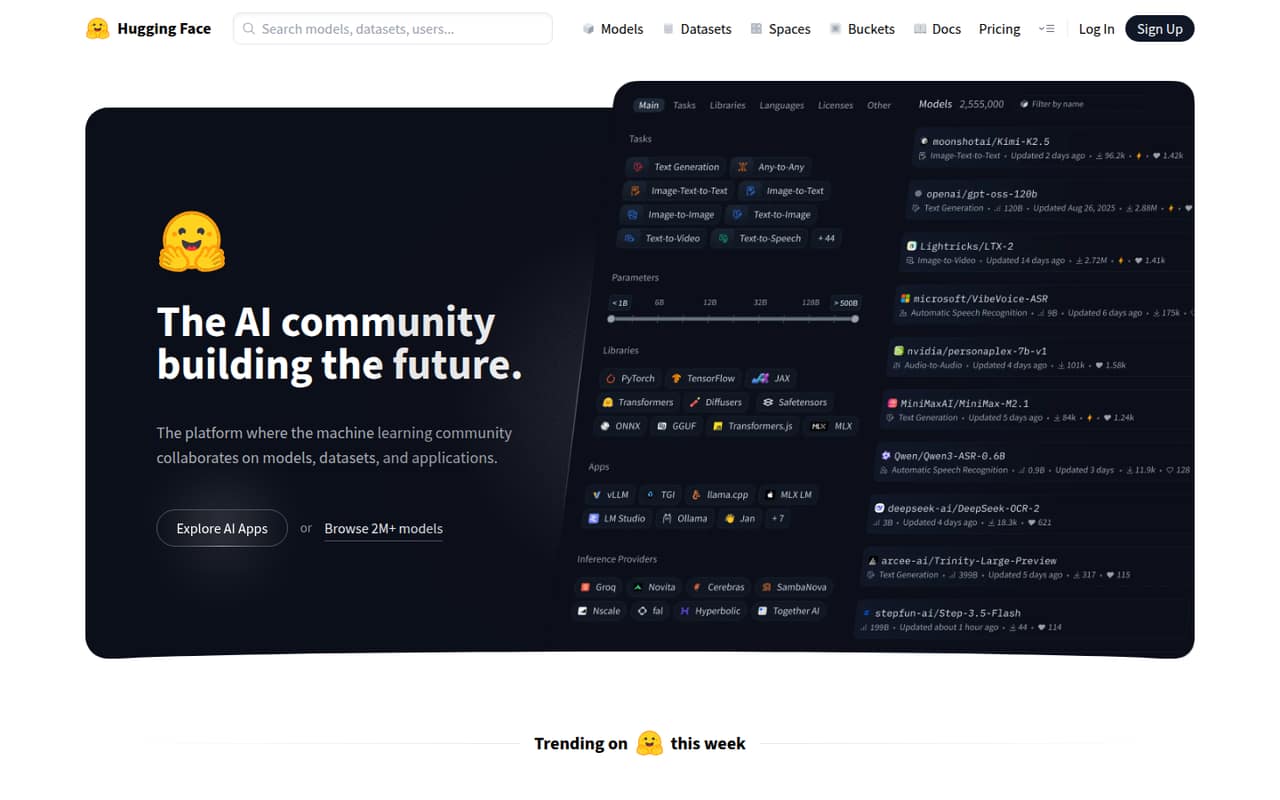
Hugging Face combines a hosted platform for models, datasets and applications with open-source libraries for building and training ML systems. Its Inference Providers API offers access to 45,000+ models, while paid plans add team controls and compute options.
The free offering and public resources make it useful for exploration and prototypes. For production, budget separately for storage and compute, and confirm quotas, reliability commitments and security requirements before depending on hosted services.
Good fit if
- Exploring public models and datasets
- Building with open-source ML libraries
- Teams needing managed ML compute
Skip it if
- Teams requiring published service quotas
- Workloads needing a self-hosted Hub
- Projects needing predictable compute bills
ScoresHow it rates
What works
- Hosts public models, datasets and applications
- Offers a unified API to 45,000+ models
- Includes open-source tools for common ML tasks
- Free CPU Basic and ZeroGPU options are listed
- Paid plans include team and enterprise controls
What doesn't
- Free-tier limits are not stated
- Compute costs vary by hardware and usage
- Rate limits and reliability commitments need confirmation
- Platform self-hosting is not documented
- Repository licenses and export paths need review
01What Hugging Face is, technically
Hugging Face is a hosted machine-learning platform and a collection of open-source libraries, rather than a single SDK or self-hosted server. The hosted Hub is where teams discover and share models, datasets and Spaces applications. Public repositories are available to browse, and the homepage says users can host and collaborate on unlimited public models, datasets and applications.
In a stack, the Hub sits alongside model development and deployment: teams can use its repositories to find assets, use its libraries in their own code, call Inference Providers through a unified API, or deploy Inference Endpoints and GPU-backed Spaces. The open-source stack includes Transformers for PyTorch, Diffusers, Datasets, Accelerate, Tokenizers, Safetensors, PEFT, TRL and other tools. That gives teams multiple integration points, but it also means the operational boundary varies: library use, hosted repository collaboration and managed inference are distinct parts of the platform.
02Hugging Face API, SDKs and docs
The clearest hosted API surface is Inference Providers: Hugging Face says it exposes 45,000+ models through a single, unified API with no service fees. The homepage also lists the Hub Python Library as a Python client for interacting with the Hub, and Transformers.js for running ML directly in a browser. Other named integrations include Transformers and Diffusers for PyTorch, Datasets for accessing and sharing datasets, and Accelerate for PyTorch training across multi-GPU, TPU and mixed-precision setups.
Those tools cover repository access, model use and training, but they are separate libraries rather than one universal client. The homepage does not name an API protocol, CLI, authentication flow or language SDK matrix. Check the vendor’s docs for supported request formats, credentials, model-provider compatibility and current SDK guidance before choosing an integration. The listed tools provide a broad starting point; you still need to validate the exact client and deployment path for your application.
03Hugging Face pricing for developers
A free plan is available, and the platform lists free CPU Basic and ZeroGPU options for Spaces. The homepage also says public models, datasets and applications can be hosted without a stated cap. The vendor doesn’t publish the free plan’s detailed quotas, so check the current account limits before treating it as a production allowance.
Pro costs $9 per month. Team is $20 per user per month and adds single sign-on, regions, priority support, audit logs, resource groups and a private datasets viewer. Enterprise is $50 per user per month, with enterprise-grade security and access controls and dedicated support, alongside several Team controls. Annual billing and discounts are not published.
Usage adds separate bills. Storage starts at $12/TB/month for public repositories and $18/TB/month for private ones; rates fall at higher storage bands. Spaces hardware ranges from $0.03/hour for CPU Upgrade to $23.50/hour for listed GPU options. Inference Endpoint CPU instances start at $0.03/hour, with listed AWS CPU options up to $0.54/hour. More than 500TB requires a sales quote; custom Spaces hardware is on demand.
04Hugging Face: open source, self-hosting and lock-in
Hugging Face publishes an open-source stack of libraries, including Transformers, Diffusers, Datasets, Tokenizers and the Hub Python Library. The homepage does not state the license for each project, so check the individual repository license before adopting a tool or redistributing it. Open-source libraries can reduce dependence on hosted features, but they are not the same as a self-hosted Hub.
The hosted platform includes repositories, Spaces and managed compute. The vendor does not publish a self-hosted Hub option on the vendor's site, so teams that require control of the full service should ask about deployment options directly. Public models and datasets may have different licensing and access conditions, so verify what can be retained or moved. Before relying on private repositories, Spaces or managed endpoints, establish how to export code, data, model artifacts and configuration, and test a migration path to another host or local infrastructure.
05Hugging Face in production
Production suitability depends on which part of Hugging Face you use. A library in your own environment has a different failure profile from a hosted Space, Inference Endpoint or provider-backed API. The pricing page lists hardware rates, but confirm request quotas, rate limits, availability commitments, regional coverage and support response terms for the service and plan you intend to use. For sensitive workloads, review the Team or Enterprise controls and ask about the security and compliance requirements your organization has.
The vendor’s homepage says more than 400,000 organizations use Hugging Face, but that figure is not an uptime commitment. Reddit discussion we found for this review is not evidence about platform reliability: one thread describes a purported AI-agent incident, while commenters dispute its framing and emphasize human oversight. Treat those comments as discussion, not a verified incident report. In production, load-test your own integration, monitor provider errors and latency, and keep a fallback for models or endpoints your application depends on.
From the threadsWhat users say
The Reddit threads we read is mixed and largely focused on a purported AI-agent incident, not routine use of Hugging Face. Some commenters express alarm; others question the account or frame it as a supervision problem.
this incident should have been an immediate global ban on ai development and deployment until better safeguards could be produced
HuggingFace is a website that hosts resources for AI research
I'm more inclined to believe OpenAI is lying and that nothing like this actually happened or it has been exaggerated
these tools were running for much longer than implied with little supervision or proper safeguards
Questions people ask
What is Hugging Face?
Hugging Face is a hosted platform for discovering, hosting and collaborating on machine-learning models, datasets and applications. It also provides open-source libraries for model use, training and deployment, plus paid compute and enterprise plans.
Is Hugging Face a safe website?
Hugging Face hosts content from a large community, so review each repository, model and dataset before using it. Check licenses, provenance, code and dependencies, and apply your usual security controls. Enterprise plans list security and access controls, but teams should confirm that the specific controls meet their requirements.
Why is Hugging Face valuable to developers?
It brings model and dataset discovery, collaboration, open-source ML libraries and hosted compute into one platform. Developers can also access 45,000+ models through the Inference Providers unified API. The value depends on whether those shared tools fit your stack and whether managed compute costs work for your workload.
Is Hugging Face expensive?
The free plan and open-source libraries can cover exploration and some development. Paid subscriptions start at $9 per month for Pro and $20 per user per month for Team. Storage, Spaces hardware and Inference Endpoints cost extra, so production bills depend on the resources you use.
How much does the Hugging Face API cost?
Hugging Face says Inference Providers offers a unified API with no service fees. That statement does not establish that inference itself is free: check the relevant provider’s model pricing and billing terms. Managed Inference Endpoints have separate hardware rates, with listed CPU instances starting at $0.03 per hour.