
We may earn a commission if you buy through links on this page. It never changes a score or a ranking. How we make money
The bottom line
A capable secrets-management server, but operating it well takes ongoing ownership.
HashiCorp Vault is a secrets-management server that sits between applications and sensitive values such as passwords, tokens, certificates, and encryption keys. Teams access it through a UI, CLI, or HTTP API; they can run Vault themselves or use HCP Vault Dedicated.
The feature set covers key-value storage, dynamic database credentials, and transit encryption. The trade-off is operational work for self-managed deployments and usage-based charges for HCP. Reddit users report that maintenance, recovery, and scaling behavior need attention in production.
Good fit if
- Teams centralizing application secrets
- Infrastructure using dynamic database credentials
- Operators comfortable managing security services
Skip it if
- Teams wanting a zero-ops secrets store
- Projects needing published fixed monthly pricing
- Organizations avoiding source-available licensing
ScoresHow it rates
What works
- UI, CLI, and HTTP API access
- Key-value, database, and transit secrets engines
- Dynamically generates database credentials from roles
- Supports self-managed deployments
- HCP Dedicated offers hourly cluster pricing
What doesn't
- HCP client limits are not published
- HCP pricing grows with cluster hours and clients
- Self-managed Vault needs ongoing maintenance
- BSL licensing is source-available, not open source
- Reddit users report restore and scaling issues
01What HashiCorp Vault is, technically
Vault is a secrets-management server, not a secrets file format or a client-side library. It stores sensitive values in configured physical storage and provides controlled access through a UI, CLI, or HTTP API. Applications and infrastructure use it as a central service for passwords, tokens, certificates, encryption keys, and other sensitive data.
In a stack, Vault sits between workloads that need secrets and the systems or operators that manage access to them. Its key-value secrets engine stores arbitrary secrets. The database secrets engine can generate credentials from preconfigured roles, while the transit secrets engine provides encryption as a service. Those capabilities let applications request credentials or encryption operations rather than keeping every secret in application configuration.
You can run Vault yourself or use HCP Vault Dedicated, HashiCorp's hosted service. The self-managed route makes Vault part of your infrastructure to operate; the hosted route shifts cluster operations to the service while billing by cluster hour and Vault client.
02HashiCorp Vault API, SDKs and docs
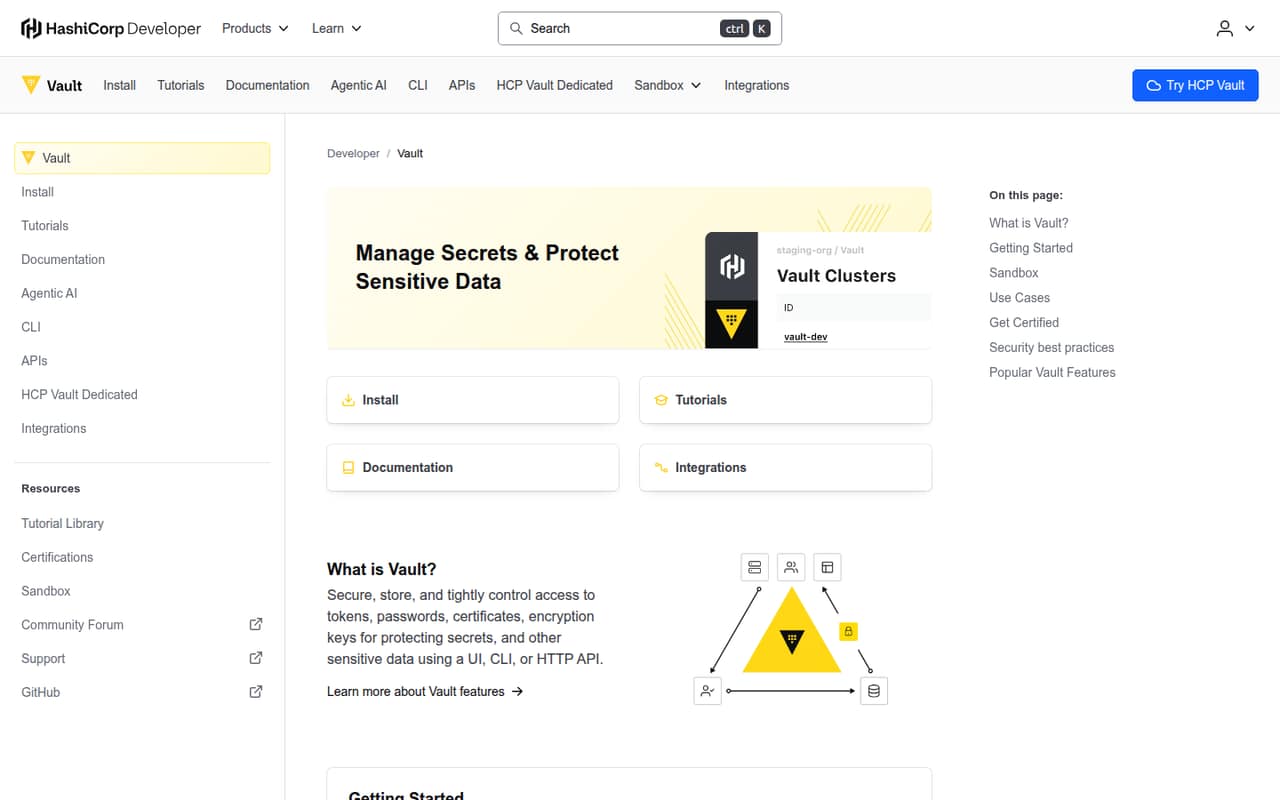
The homepage names three access surfaces: a UI, CLI, and HTTP API. The CLI is useful for operator workflows and scripting; application integrations can use the HTTP API to access Vault. HashiCorp organizes its developer resources around installation, tutorials, documentation, APIs, CLI guidance, and integrations. It also provides a Vault sandbox with preinstalled tools and services for experimentation.
The homepage does not name programming languages or SDKs. Confirm SDK availability and support for your language in HashiCorp's documentation before choosing an integration path; otherwise, plan around the HTTP API and verify the specific endpoints and authentication workflow your application needs. The listed integration resources are a starting point, not a guarantee that every framework has a maintained client.
The docs also cover use cases such as secrets management, database credential management, encryption, and Enterprise disaster-recovery replication. That gives teams a path from basic secret reads to specialized engines, but designing policies, authentication, and application behavior still requires Vault-specific work.
03HashiCorp Vault pricing for developers
Vault has no HCP free plan in the listed pricing. The self-managed community edition is available without an Enterprise subscription, but its source-available BSL license differs from an open-source license. For hosted evaluation, Development (IBM HCP Vault Dedicated) starts at $0.62 per cluster per hour and includes up to 25 clients. Essentials starts at $1.58 per cluster per hour; Standard starts at $1.85. Essentials and Standard also list $73 per Vault client per month, and both include $500 in HCP trial credit.
HCP bills by cluster hour, so the cluster charge accumulates while the service runs; client charges add another usage-based line on Essentials and Standard. Monthly and annual prices are not published for Development, and client limits are not published for Essentials or Standard. Flex and Enterprise Self Managed use custom pricing, with usage limits not published. Ask HashiCorp to confirm expected client counts, billing treatment, and any plan-specific limits before sizing a production deployment.
04HashiCorp Vault: open source, self-hosting and lock-in
Vault can be self-hosted; HashiCorp lists Enterprise Self Managed, and community discussion distinguishes a free self-hosted version from Enterprise. Reddit users describe Vault's current license as BSL, or Business Source License: source-available, but not an OSI-approved open-source license. Check the license terms that apply to the version and use case you intend to deploy.
Vault stores secrets in configured physical storage and exposes access through its HTTP API. That gives teams a service interface for reading and managing secrets, but do not assume that moving data to another product is a one-step export. Plan to map secrets, policies, authentication methods, and engine-specific behavior, then confirm export and restore procedures for your deployment. HashiCorp's homepage does not describe a standard export workflow.
Migration effort will depend on how much of your stack relies on Vault-specific engines and integrations. Keep secrets and policy definitions documented, and test recovery and migration processes before Vault becomes a critical dependency.
05HashiCorp Vault in production
Vault handles sensitive credentials, so production design needs to cover access policy, authentication, storage, backup, recovery, and upgrades. HashiCorp's tutorials include disaster-recovery replication for Vault Enterprise. Reddit commenters report that the open-source version does not support active-active cluster nodes; verify current edition and version behavior with HashiCorp before treating that as a deployment constraint. Ask the vendor about rate limits and applicable HCP client limits when sizing a service, since those details affect application design and cost.
Operational care is a recurring concern in user reports. One Reddit commenter described an aging, unmanaged installation that caused breakage and failed deployments, including problems with a Vault mutating webhook during rapid pod scaling. Another called out restoring the secret store in a new cluster. These are reports about particular deployments, not a guarantee of failure, but they make upgrades, restore drills, and scaling tests important parts of operating Vault. HCP Dedicated reduces self-management work, while introducing hourly cluster and client charges.
From the threadsWhat users say
Reddit discussion treats Vault as a useful production secrets service, but not a tool to install and forget. Users raise licensing, maintenance, recovery, and cost concerns; some report stable use while others describe operational trouble.
Vault costs money outside of their SaaS? Pretty sure I run it for free
the open source version doesn’t support active active cluster nodes
it requires a modicum of care & feeding to keep it updated and clean
Biggest issue has been restoring the secret store in a new cluster
Questions people ask
Does HashiCorp Vault have a free version?
Vault has a self-managed community edition that Reddit users describe as free to run without an Enterprise subscription. It is not the same as a free HCP Vault Dedicated plan: the HCP pricing lists paid hourly cluster rates, with $500 in trial credit for Essentials and Standard.
What is HashiCorp Vault used for?
Vault stores and controls access to secrets such as passwords, tokens, certificates, and encryption keys. Its engines also support arbitrary key-value secrets, dynamically generated database credentials, and encryption as a service through the transit secrets engine.
Can HashiCorp Vault be self-hosted?
Yes. HashiCorp lists an Enterprise Self Managed plan, and Vault also has a self-managed community edition. Self-hosting puts installation, upgrades, storage, backup, recovery, and operational ownership on your team.
Is HashiCorp Vault safe to use?
Vault is designed to store secrets and control access to sensitive data. Whether a deployment is safe depends on configuration and operations, including authentication, access policies, storage protection, updates, and recovery. Review HashiCorp's security guidance and test your own deployment.
Can Vault generate database credentials?
Yes. The database secrets engine can dynamically generate database credentials based on preconfigured roles. Before relying on it, check the engine documentation for your database, configure role and access policies, and test credential rotation and application behavior.
Sources
- HashiCorp Vault homepage
- HashiCorp Vault pricing, compiled via web search from hashicorp.com
- Reddit: Anything on par with HashiCorp Vault
- Reddit: A new open source fork for HashiCorp Vault under the Linux Foundation
- Reddit: Hashicorp Vault - Does anyone use it in prod or its just a hype?
- Reddit: RustyVault: A Hashicorp Vault Replacement in Rust