
We may earn a commission if you buy through links on this page. It never changes a score or a ranking. How we make money
The bottom line
HasData trades scraping infrastructure work for a hosted API, with usage quotas and vendor-managed collection.
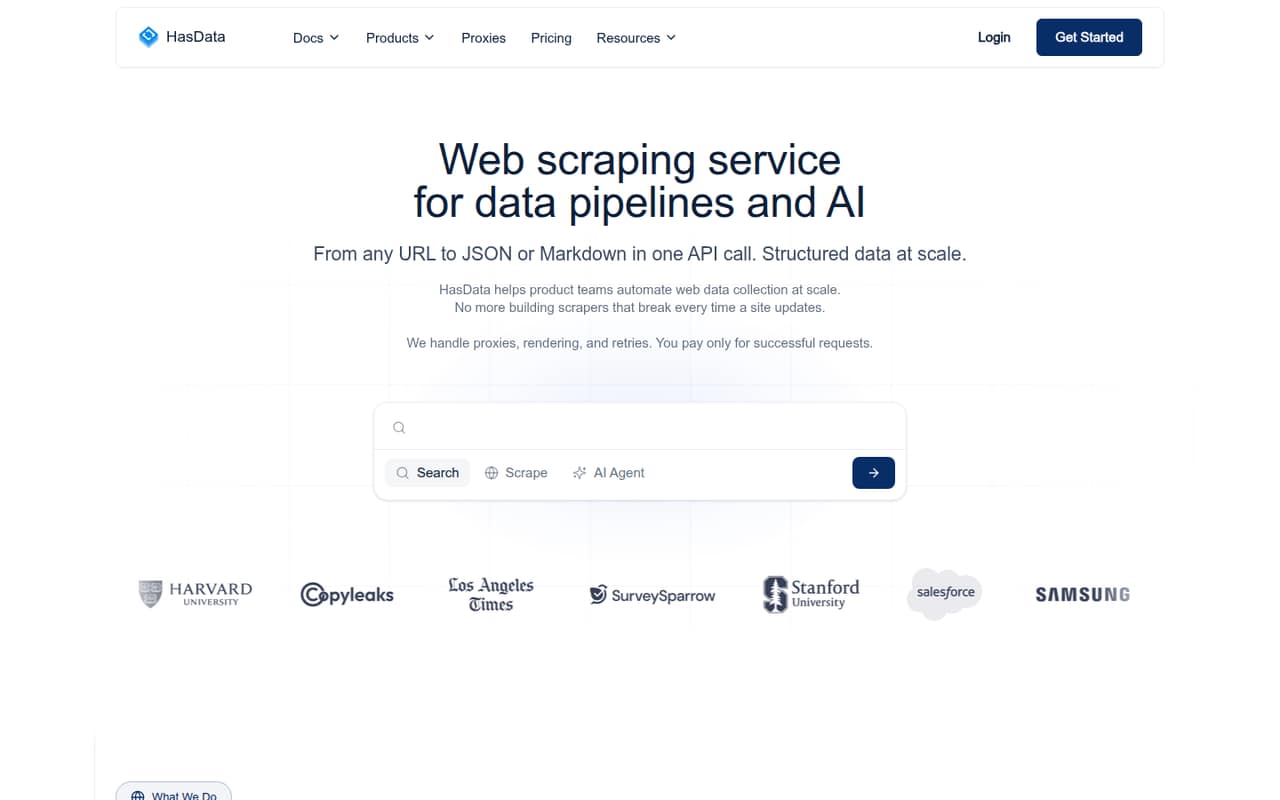
HasData is a managed web-scraping service: send a URL to its API and get JSON or Markdown back. It handles browser rendering, proxy rotation and retries, and also offers 63 API endpoints, 21 no-code scrapers and AI extraction.
A free plan includes 1,000 monthly requests and credits. Paid plans start at $49/month, with higher quotas and concurrency at higher tiers. The main trade-off is reliance on a hosted service and its endpoint-specific pricing and schemas.
Good fit if
- Teams that need structured web data
- Products sourcing Google search or Maps data
- Prototypes that need a free API tier
Skip it if
- Teams requiring self-hosted scraping infrastructure
- Workloads needing published SDK guarantees
- Projects that cannot tolerate vendor-specific schemas
ScoresHow it rates
What works
- 63 API endpoints and 21 no-code scrapers
- Managed rendering, proxies and retries
- JSON and Markdown API responses
- Free plan includes 1,000 monthly requests
- No-code exports include CSV, XLSX and JSON
What doesn't
- Hosted service, with no self-hosting option presented
- No SDK or programming language is named
- Endpoint pricing varies by API and settings
- Self-serve plans cap concurrency at 50
- Overage handling is not published
01What HasData is, technically
HasData is a hosted web-scraping API and SaaS application, not a scraper library or a server you install in your own environment. Your application sends a URL or uses a supported scraper endpoint; HasData runs the collection pipeline and returns structured JSON or Markdown. The service manages headless-browser rendering, proxy rotation and retries.
That puts HasData between your application and the public websites it needs data from. It can replace internal browser automation and proxy-management components when you need data from supported sources. The service advertises 63 API endpoints, 21 no-code scrapers and AI extraction that turns a webpage into JSON using fields you describe. Its no-code interface can schedule scraper runs and export results as CSV, XLSX or JSON. Ready-made datasets are another route if you want recurring data delivery rather than making each request yourself. The API response schemas and endpoint coverage determine how much transformation your own pipeline still needs.
02HasData API, SDKs and docs
The core integration is a hosted API: HasData says you can send a URL and receive JSON or Markdown in one API call. Scraper APIs have documented schemas for supported sources. The homepage does not name a specific API protocol, programming language, SDK or CLI, so confirm SDK support in the vendor's documentation before choosing a client library. Webhooks are listed as an integration option.
The homepage also names Zapier, LangChain, LlamaIndex, Make, n8n, ChatGPT and GitHub among the tools it works with. For non-code workflows, configure one of 21 scrapers visually, schedule runs and export CSV, XLSX or JSON. AI extraction lets you define the fields for structured output. Before integrating, check endpoint-specific schemas, error handling and whether the chosen API's output maps cleanly to your application's data model. The service says it manages retries, but the homepage does not set out retry behavior or delivery guarantees.
03HasData pricing for developers
The Free plan costs $0/month and includes 1,000 credits, 1,000 API requests, 1,000 no-code rows and five concurrent requests. It includes access to every API and no-code scraper. Startup is $49/month for 200,000 of each quota and five concurrent requests; Basic is $99/month for 1 million and 15 concurrent requests; Growth is $208/month for 3 million and 50 concurrent requests. Enterprise pricing is custom past 20 million monthly credits, with concurrency of 2,000+ listed.
The homepage lists endpoint rates from $0.08 per 1,000 requests for its Web Scraping API to $0.83 for Google SERP and Maps, and $1.25 for Google Flights; rates depend on endpoint and settings. It also says only successful requests are billed. Annual billing is advertised as two months free, but its monthly equivalent is not stated. The vendor does not publish overage terms, so ask how requests beyond a plan quota are handled before putting a workload into production.
04HasData: open source, self-hosting and lock-in
HasData is presented as a managed hosted service, not software to run in your own environment. The vendor does not publish an open-source licence for a self-hosted version, so teams that require source access or control over the scraping runtime should confirm those requirements before adopting it.
The API returns JSON or Markdown, and no-code scrapers can export CSV, XLSX or JSON. Those formats make it possible to move collected records into another pipeline, but they do not establish that scraper configurations, schedules or account data can be exported. The vendor does not publish a general migration or account-export process. Lock-in is likely to come from endpoint-specific response schemas, scraper definitions and reliance on HasData's managed proxy and rendering infrastructure. Keep an internal normalized schema and retain any transformation code you own; ask about bulk export and configuration portability before depending on the service.
05HasData in production
Concurrency is a practical capacity limit: the Free and Startup plans allow five concurrent requests, Basic allows 15 and Growth allows 50. Enterprise lists concurrency of 2,000+ and custom pricing past 20 million monthly credits. The homepage says HasData manages retries and bills only successful requests, but does not publish retry rules, uptime commitments or rate-limit behavior. Confirm those details, along with how endpoint-specific credits are counted, before sizing a production queue.
HasData advertises headless-browser rendering for dynamic pages, SPAs and client-side JavaScript, plus geo-targeting and IP rotation through its managed proxy pool. These features reduce infrastructure work but leave collection dependent on a third-party service and on changes to the websites being scraped. Check the terms for your target sites and your own data-handling requirements. The vendor does not publish security certifications or compliance details on the homepage, so ask for the relevant controls and contract terms if you process sensitive data.
Questions people ask
Does HasData have a free plan?
Yes. The Free plan costs $0/month and includes 1,000 credits, 1,000 API requests and 1,000 no-code rows per month, with five concurrent requests. It includes access to every API and no-code scraper. The quota is limited, so check endpoint credit usage before estimating how much data a prototype can collect.
How much does HasData cost?
Paid self-serve plans start with Startup at $49/month for 200,000 monthly credits, requests and no-code rows. Basic costs $99/month for 1 million, and Growth costs $208/month for 3 million. Enterprise pricing is custom for volumes past 20 million monthly credits. Endpoint request rates also vary by API and settings.
What does HasData return from its APIs?
HasData says its APIs return structured JSON for supported sources, and its general web-scraping service can return JSON or Markdown. The documented schemas depend on the scraper endpoint. Its AI extraction feature turns a webpage into structured JSON based on fields you describe.
Does HasData support JavaScript-rendered websites?
Yes. HasData says its headless-browser rendering handles dynamic content, single-page applications and client-side JavaScript. The service manages rendering as part of its hosted pipeline. Check the endpoint documentation and test your target pages against your required fields before relying on a particular site's data in production.
Can I self-host HasData?
HasData is presented as a managed hosted service, not as software for self-hosting. The vendor does not publish an open-source licence for a self-hosted version. You can export no-code scraper results as CSV, XLSX or JSON, but ask the vendor about exporting scraper configurations and other account data.