
We may earn a commission if you buy through links on this page. It never changes a score or a ranking. How we make money
The bottom line
A deployment-flexible AI platform; custom pricing and unclear developer interfaces make evaluation essential.
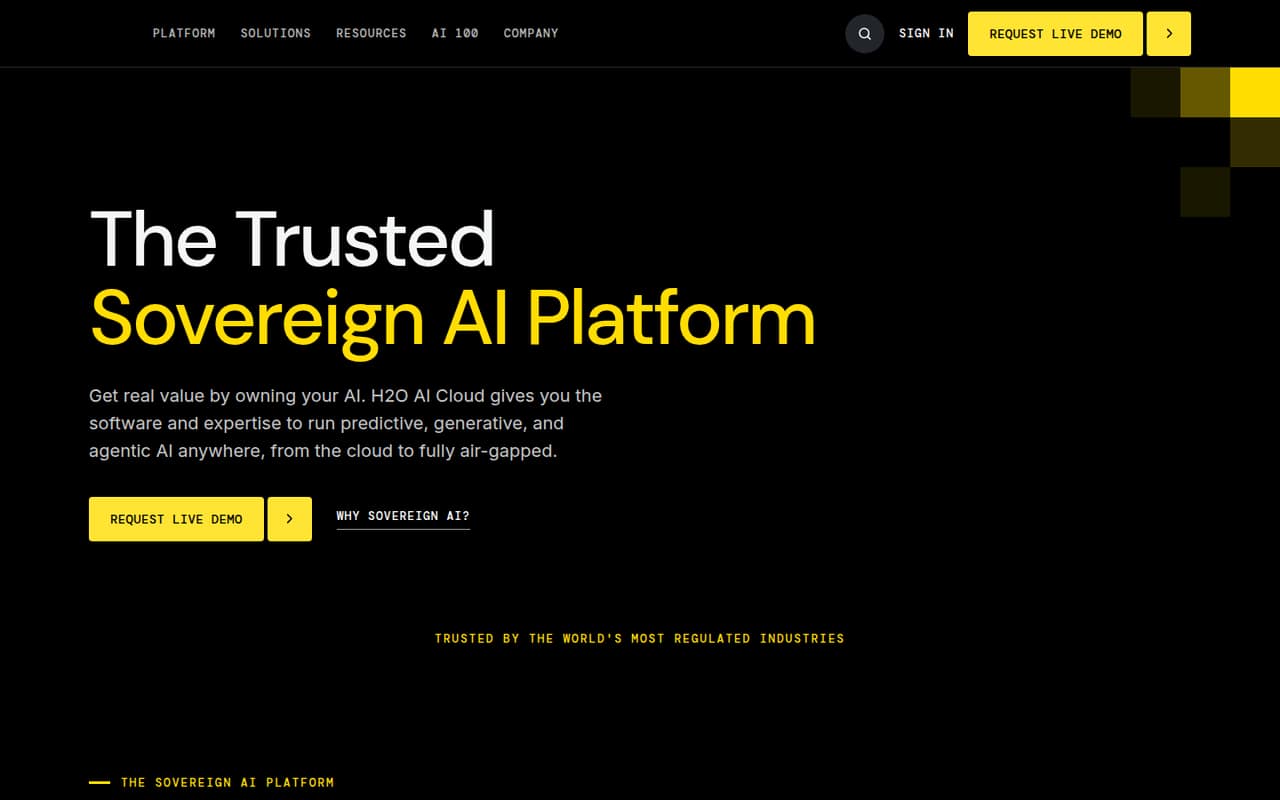
H2O AI Cloud is enterprise software for coordinating predictive, generative and agentic AI with observability. It can run in cloud, private cloud, on-premises or air-gapped environments, with H2O AI Super Agent as its orchestration layer. The fit is strongest where deployment control and governance matter.
For developers, the platform’s workflow and deployment story is clearer than its API surface. The vendor describes a tool and agent builder, but its homepage does not name SDKs, languages or a public API. Commercial plans use custom annual compute-and-memory licensing; H2O-3 Core is the free, Apache 2.0 self-hosted option.
Good fit if
- Regulated teams with deployment constraints
- Enterprises coordinating multiple AI workflows
- Teams evaluating self-hosted H2O-3
Skip it if
- Developers seeking a documented public API
- Small teams needing transparent monthly pricing
- Projects tied to a specific SDK
ScoresHow it rates
What works
- Runs in cloud, private cloud, on-premises or air-gapped environments
- Coordinates predictive, generative and agentic AI with observability
- Includes multi-agent workflows and a tool and agent builder
- H2O-3 Core is free and Apache 2.0 licensed
- Commercial licensing is based on compute and memory, not per-token pricing
What doesn't
- Commercial prices require a custom annual quote
- Seat and usage limits are not published
- Homepage does not name SDKs, languages or API protocols
- Add-on and overage costs are not published
- H2O-3 Core is a separate option, not the full commercial platform
01What H2O AI Cloud is, technically
H2O AI Cloud is enterprise AI platform software, not simply a hosted model API or a developer library. The vendor positions it as a system for predictive, generative and agentic AI, with observability coordinated by H2O AI Super Agent. Its deployment options include cloud, private cloud, on-premises and fully air-gapped environments; managed and hybrid commercial plans cover different hosting arrangements.
In a stack, it sits above infrastructure and models as a platform for building and operating AI workflows. The Super Agent is described as an orchestration core, with multi-agent workflows, deep research, and a tool and agent builder. Predictive AI, generative AI, agentic AI and observability are presented as connected parts of that system rather than separate stacks. This architecture targets organizations that need one governed environment for several AI workloads. The vendor says models and private data can stay inside the customer’s environment, including restricted deployments.
02H2O AI Cloud API, SDKs and docs
The vendor describes platform workflows, Super Agent orchestration, multi-agent workflows, deep research, and a tool and agent builder. Those are the clearest integration surfaces on its homepage. It does not name a public REST API, webhooks, CLI, SDK, programming language or plugin system there, so developers should confirm supported interfaces and SDKs in H2O.ai’s technical documentation before designing an integration.
That matters for codebase fit. A tool-and-agent builder may cover workflow construction, but it does not by itself establish how an application calls those workflows, how credentials are managed, or how deployments are automated. Ask for a working integration path for your language and framework, along with API authentication, versioning, error handling and deployment documentation. The platform’s model-agnostic positioning may give teams choice over models, but it does not answer whether existing services can connect through a supported SDK or protocol. Treat the integration surface as a procurement question, not an assumption.
03H2O AI Cloud pricing for developers
H2O-3 Core is the no-cost option: it is free, self-hosted and licensed under Apache 2.0. The commercial H2O AI Cloud plans are different products and use custom annual licenses based on compute and memory. The pricing material also lists a 90-day free trial; confirm which plan it applies to and what happens when it ends.
H2O AI Managed Cloud covers managed cloud deployment, while H2O AI Hybrid Cloud is for customer cloud, on-premises or air-gapped environments. H2O AI Cloud for Government offers custom enterprise licensing for FedRAMP High environments. Prices are not published, and seat and usage limits are not published. The vendor describes annual licensing rather than per-token pricing, so compute and memory sizing are the stated basis for the bill. Ask how usage changes the quote, what happens at any plan limits, and whether add-ons or overages apply: add-on and overage costs are not published. Monthly commercial rates are not published.
04H2O AI Cloud: open source, self-hosting and lock-in
H2O-3 Core is the open-source, self-hosted option, under the Apache 2.0 license. That gives teams a route to run this core without buying a managed commercial plan, but it should not be treated as proof that every H2O AI Cloud capability is open source or included. Confirm which features and workflows are part of H2O-3 Core before planning a migration from the commercial platform.
For commercial H2O AI Cloud, the vendor offers private cloud, on-premises and air-gapped deployments, as well as managed cloud. It also describes the platform as model- and LLM-agnostic, so teams can choose, swap or fine-tune models. That reduces one form of model lock-in, but does not establish how to export agent configurations, workflow definitions, logs or other platform data. Ask for export formats and migration procedures, and test whether your team can run exported assets outside H2O.ai before signing.
05H2O AI Cloud in production
The vendor says H2O AI Cloud supports cloud, private cloud, on-premises and fully air-gapped deployment. It also cites SOC 2, HIPAA and FedRAMP High, and describes governance, audit trails, explainability and human-in-the-loop controls. H2O AI Cloud for Government is positioned for FedRAMP High environments. Verify which certifications and controls apply to the specific deployment and contract you are evaluating.
The public pricing information does not give seat or usage limits, and the vendor does not publish commercial prices or add-on and overage costs. Before production, get limits and cost behavior in writing, including compute and memory assumptions, capacity scaling, and support expectations. The homepage does not state service-level targets, rate limits, API versioning or recovery guarantees, so ask for those details against your workload. Also validate how observability data is retained and exported, and how the deployment handles model updates in restricted environments. Deployment flexibility is useful, but production readiness depends on the operating terms for your chosen plan.
Questions people ask
Can H2O AI Cloud run on-premises or air-gapped?
Yes. The vendor lists on-premises, private cloud and fully air-gapped deployment, as well as cloud deployment. H2O AI Hybrid Cloud is the commercial option described for customer cloud, on-premises or air-gapped environments. Confirm the specific deployment requirements and support terms with H2O.ai.
Does H2O AI Cloud lock teams to one model?
The vendor describes H2O AI Cloud as model- and LLM-agnostic, with the ability to choose, swap or fine-tune models. That addresses model choice, but does not establish how easily agent definitions, workflow assets or observability data can move to another platform. Ask for export formats and migration guidance.
Does H2O AI Cloud have a public API or SDK?
The vendor’s homepage describes Super Agent orchestration and a tool and agent builder, but does not name an API protocol, SDK, language or CLI. Ask H2O.ai for the supported integration interfaces and documentation for your application stack before committing.
What compliance options does H2O AI Cloud support?
The vendor cites SOC 2, HIPAA and FedRAMP High, and lists a government plan for FedRAMP High environments. Check which certifications, controls and deployment configurations apply to your contract and use case rather than assuming every plan has the same compliance scope.
Is H2O-3 Core the same as H2O AI Cloud?
No. H2O-3 Core is listed as a free, self-hosted product under the Apache 2.0 license. H2O AI Cloud’s commercial plans cover managed, hybrid and government deployments. Confirm which platform features are included in H2O-3 Core before treating it as a substitute.