
We may earn a commission if you buy through links on this page. It never changes a score or a ranking. How we make money
The bottom line
A hosted agent builder with broad connectors and browser automation, but limited published developer details.
Gumloop is a hosted SaaS platform for building and running AI agents across business tools. Its 400+ connectors, browser automation, human handoffs, and workplace messaging support practical workflow automation without requiring a team to build its own agent runtime.
Pro starts at $37 per month and includes 20,000 monthly credits, plus an 8% orchestration fee. There is no free plan, and the vendor does not publish the details developers need to estimate overages, confirm API support, or plan a migration.
Good fit if
- Teams automating business workflows
- Agents that need browser access
- Non-developers building task-specific agents
Skip it if
- Teams requiring self-hosted infrastructure
- Developers needing documented SDKs
- Projects with strict cost predictability
ScoresHow it rates
What works
- 400+ connectors for business apps and services
- Agents can use a real browser
- Human handoffs cover sign-in and approval steps
- Session recordings mask passwords
- Pro includes unlimited agents, seats, and teams
What doesn't
- No free plan, only a 14-day trial
- Pro includes an 8% orchestration fee
- Credit overage pricing is not published
- Concurrency is capped on Pro
- Self-hosting and export options need vendor confirmation
01What Gumloop is, technically
Gumloop is a hosted SaaS application for building, sharing, and running AI agents. It sits above a company’s existing apps and services: teams create agents, connect them to business tools, then run tasks through connectors, browser automation, or workplace messaging. It is an agent and workflow layer, not a general-purpose app builder or a self-hosted automation server.
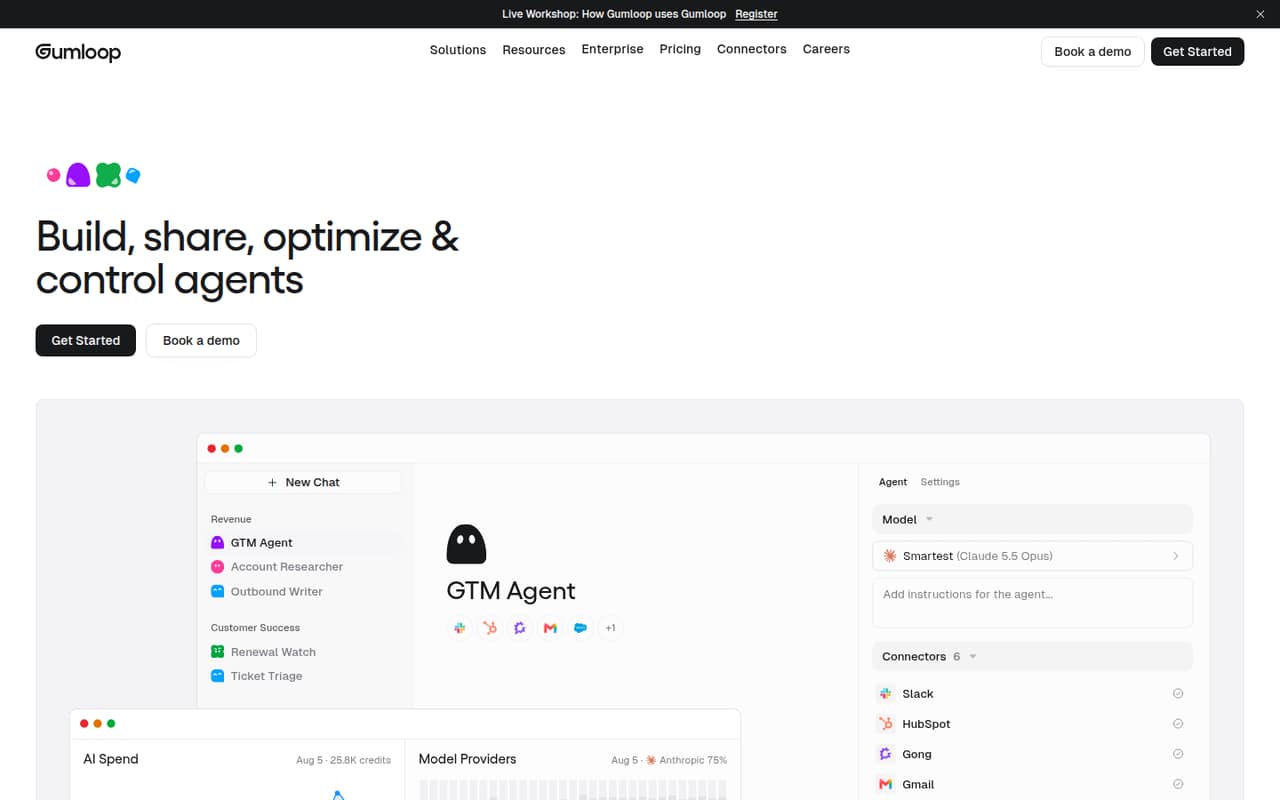
The product targets work that depends on business context and multiple systems, such as account research, ticket triage, and churn monitoring. Its homepage describes agents that can use a real browser to click, type, upload, and retrieve website data, including sites without an API. Agents can also hand a live session to a person when a site requires sign-in or approval.
That makes Gumloop a fit for teams that want to delegate task automation without operating an agent runtime themselves. Developers should assess its integration and data boundaries before treating it as infrastructure for critical workflows.
02Gumloop API, SDKs and docs
Gumloop’s published integration surface is its agent-building application, 400+ connectors, browser automation, and links to its docs. The homepage names connectors including Slack, HubSpot, Gong, Gmail, and Salesforce, and describes app triggers, recurring tasks, and skills. Agents can also work through Slack, Microsoft Teams, email, text message, iMessage, RCS, or SMS.
The vendor does not publish a named API style, programming language SDK, or CLI on its public homepage. We would not assume a REST API, webhook interface, or particular language binding from the connector count; confirm SDK and API support in Gumloop’s docs before designing a code-first integration. The browser path can cover sites without APIs, but it is a different operational dependency from a stable service endpoint.
For teams building agents in the product, Gumloop emphasizes letting people who understand a task create its automation. For custom integrations, ask the vendor about authentication, versioning, retries, and error handling before putting a workflow on a production path.
03Gumloop pricing for developers
Gumloop has no free plan. The vendor lists a 14-day free trial. Pro starts at $37 per month and includes 20,000 credits per month, 35+ models, unlimited agents, seats, and teams, plus an 8% orchestration fee. Pro also lists five concurrent workflow runs and 25 concurrent agent chats. The pricing page does not publish annual billing or discounts.
The included credits and concurrency limits are the main published constraints to model before deployment. The vendor does not publish credit overage rates or explain what the 8% orchestration fee applies to, so confirm both before estimating a production bill. More usage may require a plan or custom terms, but the pricing page does not state the upgrade threshold.
Enterprise uses custom pricing and includes custom included credits and custom concurrency limits. It also lists custom proxy support, organization-wide connector policies, and guardrails. An embedded Gumloop expert and virtual private cloud are Enterprise options; their prices are not published.
04Gumloop: open source, self-hosting and lock-in
Gumloop is presented as a hosted service. The vendor does not publish an open-source license or self-hosting option, so teams that require control of the runtime should treat it as hosted-only unless Gumloop confirms otherwise. Enterprise lists virtual private cloud as an option, but the vendor does not publish its price or deployment details.
The vendor also does not publish data-export or migration details. Before adopting Gumloop, ask how to export agent definitions, run history, connector configuration, and any data stored in workflows. The more an automation depends on Gumloop-specific agents, skills, and browser sessions, the more work may be required to rebuild it elsewhere. Keep business-critical logic and source data accessible outside the platform where possible, and test an exit path before expanding use.
05Gumloop in production
Gumloop lists five concurrent workflow runs and 25 concurrent agent chats on Pro. Enterprise offers custom concurrency limits. The vendor does not publish rate limits, uptime commitments, retry behavior, or credit overage terms on the pricing page, so ask for those details before routing time-sensitive or high-volume work through the service.
The browser features address some operational risks: the product describes saved credentials or a 1Password connection, trusted connections, human handoffs, and session recordings with passwords masked. The vendor also says sessions record logins, takeovers, and handoffs. These controls do not replace a review of data retention, access controls, compliance coverage, and incident handling for your use case.
Reddit feedback is limited and mixed. In one automation discussion, a commenter described Gumloop as easy to build and run but more expensive; another reported “weird quirks” that made it tricky to use. Treat those as individual reports, not reliability evidence. Test failure handling and approval paths with your own workflows.
From the threadsWhat users say
Reddit comments portray Gumloop as approachable for building and running automations, with some users raising cost and usability concerns. The available comments are mixed and do not establish reliability or broad user satisfaction.
Gumloop is more for automations/workflows than full apps
Gumloop : Easy to build, easy to run but little more expensive
little more expensive
Gumloop has some weird quirks that have made it tricky for me to use
Questions people ask
Is Gumloop free?
Gumloop does not have a free plan. The pricing information lists a 14-day free trial. After the trial, Pro starts at $37 per month and includes 20,000 credits per month, subject to the listed 8% orchestration fee and plan concurrency limits.
Does Gumloop have an API or SDK?
Gumloop’s public homepage describes its app, connectors, browser automation, and docs, but does not name a particular API style, SDK, programming language, or CLI. Confirm API and SDK availability with the vendor before planning a code-first integration.
Can Gumloop automate websites without an API?
Yes. Gumloop describes agents using a real browser to click, type, upload, and pull data from websites, with or without an API. It also describes secure handoffs so a person can take over a live browser session for sign-in or approval.
What are Gumloop’s Pro usage limits?
Pro includes 20,000 credits per month, five concurrent workflow runs, and 25 concurrent agent chats. The vendor lists an 8% orchestration fee but does not publish credit overage rates or the fee’s calculation details. Ask Gumloop how those terms apply to your workload.
Can I self-host Gumloop?
Gumloop is presented as a hosted service, and the vendor does not publish a self-hosting option. Enterprise lists a virtual private cloud option, but the vendor does not publish its price or deployment details. Ask Gumloop whether that option meets your infrastructure requirements.