
We may earn a commission if you buy through links on this page. It never changes a score or a ranking. How we make money
The bottom line
Glide makes spreadsheet-based business apps approachable, but it is not a transparent, developer-first platform.
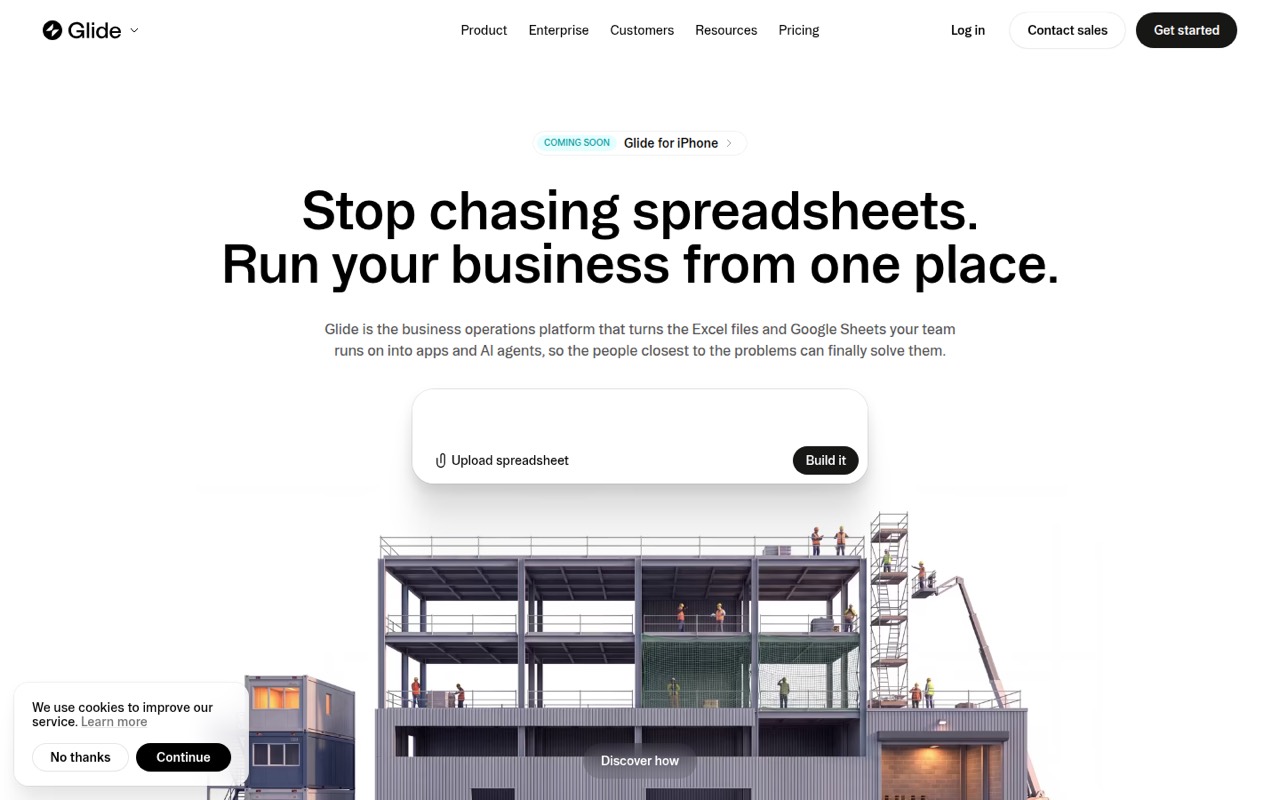
Glide is a hosted business app platform that turns Excel files and Google Sheets into apps and AI agents. Its strongest fit is internal operations: teams can build role-specific views, update shared data and use AI to work with that data.
The trade-off is a platform-shaped stack. The homepage names MCP for connecting Claude, Gemini and ChatGPT, but not a language-specific SDK or API contract. Free is useful for exploring; paid plans add credits, team members, published apps and workflows. Confirm integration, export and production requirements before building around it.
Good fit if
- Internal apps backed by spreadsheets
- Operations teams building workflow tools
- Teams using AI over business data
Skip it if
- Developers needing documented SDKs
- Apps requiring predictable usage costs
- Teams requiring self-hosted software
ScoresHow it rates
What works
- Builds apps from Excel files and Google Sheets
- SheetSense reads sheets, formulas, lookups and notes
- Supports Claude, Gemini and ChatGPT over MCP
- Role-based views limit what each user sees
- Connected apps update when shared records change
What doesn't
- No language-specific SDK or API contract named on the homepage
- Credit top-up prices are not stated
- Free plan has limited credits
- Enterprise pricing is custom
- Self-hosting and data export need confirmation
01What Glide is, technically
Glide is a hosted business operations platform for building apps and AI agents from spreadsheets, prompts or files. It sits between a team’s source data and the people who need to view or update it: bring in Excel files or Google Sheets, build an app around the data, then share role-specific views with employees, managers, customers or partners.
This is a low-code app platform, not a library or a self-hosted server. Its agent can build an app from uploaded data, while SheetSense reads sheets, formulas, lookups and notes to find relevant context. Glide says apps use company data within the permissions set for them, and that record or status changes sync across connected apps.
That makes Glide a candidate for internal tools such as inventory tracking, field inspections and crew scheduling. It is less clearly suited as a general-purpose backend for a custom product: the app, data and permissions live within Glide’s platform model. Treat it as an application layer around operational data, and verify how it fits your existing systems before committing.
02Glide API, SDKs and docs
The named integration surface for AI builders is MCP: Claude, Gemini and ChatGPT connect to Glide over MCP and can build into the same apps, data and permissions as Glide’s agent. Glide also builds from Excel files and Google Sheets, and describes connecting spreadsheets, databases and everyday business tools. Its homepage does not name a language-specific SDK, REST API, CLI or webhook. Confirm SDK support, API contracts and integration details in Glide’s developer docs before treating it as a programmable backend.
The main build path described by Glide is conversational: provide a spreadsheet and a request, let the agent build an app, inspect calculations in plain English, then share it. SheetSense is intended to interpret formulas, lookups and notes as context. Templates offer another starting point, with examples for inventory, inspections and scheduling.
This should lower the barrier for business teams, but it leaves conventional engineering questions to verify: how integrations authenticate, what can be automated outside the builder, and how app changes move between environments. The homepage describes the product flow, not a developer reference or language-specific workflow.
03Glide pricing for developers
Glide has a free plan at $0 per month with limited credits, 2 team members, 10 projects, integrations and the ability to build AI features in apps. It does not include a stated credit allowance, so check the plan before estimating a sustained workload.
Basic costs $25 per month and includes 100 credits, 2 team members, 2 published apps and 1 enabled workflow. Plus is $50 per month for 250 credits, 3 team members, 5 published apps, 20 projects and 5 enabled workflows. Pro starts at $125 per month, with 5 team members, 50 credits per member, unlimited published apps and workflows, 100 projects and premium integrations. Enterprise pricing is custom.
The bill can grow as you need more credits or team capacity. Glide says paid plans can get extra credits; the pricing page lists 1 per month on Basic, 2 on Plus, and unlimited on Pro and Enterprise, but gives no top-up price. Pro credit options rise with team size, from 500 credits for 5 members to 5,250 for 100. Prices are monthly; annual plans are coming soon.
04Glide: open source, self-hosting and lock-in
Glide is presented as a hosted platform. The vendor does not publish an open-source licence or a self-hosted edition, so teams that require source access or deployment in their own infrastructure should ask Glide directly before evaluating it further.
The homepage describes apps built around spreadsheets and connected data, but does not explain a data export path or format. Confirm what can be exported, whether attachments and relationships are included, and what happens to data when an account closes. The underlying spreadsheet may be a useful starting point for migration, but that does not carry over Glide’s app layouts, workflows, permissions or AI behavior. Rebuilding those elsewhere could take more work than moving the records. For a production choice, test the exit path with representative data and document which parts of the application are Glide-specific.
05Glide in production
Glide says apps are private to a company by default, uses encryption, and supports roles down to the row. Its homepage lists CCPA, SOC 2, GDPR and AES 256, and describes enterprise features including single sign-on, an audit log and approved models. Enterprise pricing includes 30-day data backups. Check the scope of those controls, backup recovery process and any uptime commitment against your requirements; Glide’s homepage does not publish an uptime SLA.
The production cost question is also about credits and team size. Model expected usage before choosing a plan, and ask Glide for the price of additional credits and any limits that apply to your workflows or integrations. Confirm how live sync behaves when source data changes or an integration fails.
Reddit feedback is limited, but one r/nocode thread describes a user who liked the app’s look and use yet found monetization difficult, particularly for letting other users bring their own data and sign up. That is a useful warning for customer-facing products: prototype user onboarding, account separation and billing before depending on Glide.
From the threadsWhat users say
The available Reddit discussion is mixed and sparse: one builder liked the app experience but raised friction around monetization and serving users with their own data. Another thread considers Glide among several options for an operations-heavy portal, without a clear verdict.
Even though I love the look and use of the app
Glide doesn’t make it easy for me to monetize it
Maybe with a dedicated signup/login and all that
I’m trying to decide between Bubble.io, Glide, and Softr
Questions people ask
What is Glide used for?
Glide turns spreadsheets, prompts and files into business apps and AI agents. Teams can use it for internal operations such as inventory, field inspections and crew scheduling, then share role-specific views with employees, customers or partners.
Is Glide totally free?
Glide has a free plan at $0 per month. It includes limited credits, 2 team members and 10 projects, as well as integrations and AI features in apps. Paid plans start at $25 per month and add stated credit, app and workflow allowances.
What companies use Glide?
Glide says it is trusted by teams at more than 100,000 businesses. Its homepage includes customer quotes from people at CarboNet, Workplace Options, TTR Sotheby’s International Realty, ITV, RDG and yetipay. The vendor does not provide a complete customer directory on the homepage.
Is Glide a good app builder?
It is a reasonable fit for teams building spreadsheet-backed business tools with little code, especially when role-specific views and AI-assisted building matter. Developers needing a documented SDK, self-hosting or a clearly stated export path should verify those requirements before adopting it.
Can I connect Claude, Gemini or ChatGPT to Glide?
Glide says Claude, Gemini and ChatGPT connect over MCP and can build into the same apps, data and permissions as Glide’s own agent. Check Glide’s docs for the current setup steps and supported capabilities before planning an integration.