
We may earn a commission if you buy through links on this page. It never changes a score or a ranking. How we make money
The bottom line
A straightforward geocoding API and spreadsheet tool, but published plan prices are missing.
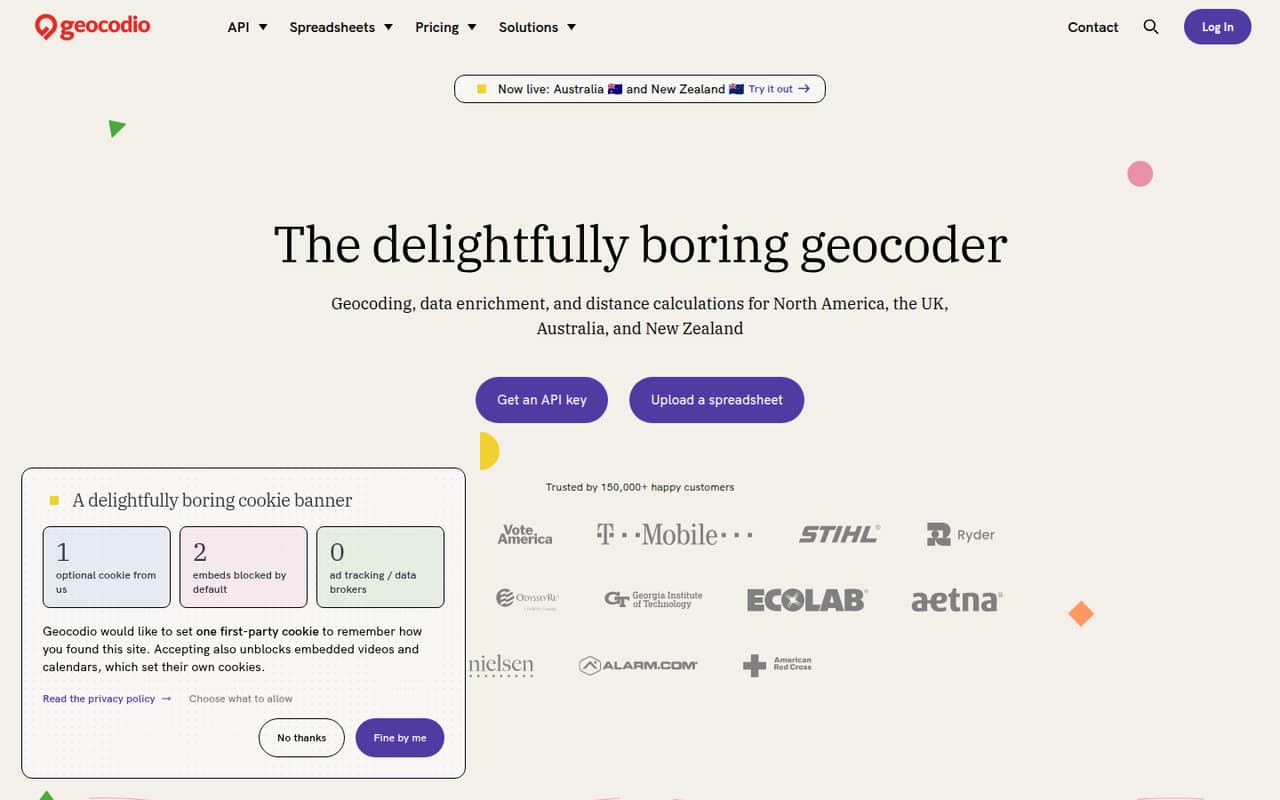
Geocodio is a geocoding API and spreadsheet service for converting addresses to coordinates, reverse geocoding, enriching location records and calculating distances. It covers North America, the UK, Australia and New Zealand, with a no-code workflow for spreadsheet users.
The permanent free allowance is useful for development and small workloads, but the vendor does not publish plan prices or exact Flex credit tiers. Confirm costs, data handling and API integration details before making it a production dependency.
Good fit if
- Address cleanup and enrichment
- Small teams processing spreadsheets
- North American geocoding workloads
Skip it if
- Teams requiring published plan prices
- Projects needing named SDKs
- Workloads outside listed regions
ScoresHow it rates
What works
- 2,500 free lookups per day, forever
- API and no-code spreadsheet workflows
- Handles typos and missing postal codes
- Geocoding, enrichment and distance calculations
- On-premises Docker deployment is available
What doesn't
- Plan prices are not published
- Flex credit amounts are not published
- SDKs and supported languages are not named
- Data export and migration details need confirmation
- Distance API credits cost extra on Unlimited
01What Geocodio is, technically
Geocodio is a geocoding API with a companion web-based spreadsheet workflow. In an application stack, the API handles address-to-coordinate conversion, reverse geocoding, location data enrichment and distance calculations; your application sends location records to Geocodio and uses the returned data downstream. The service covers North America, the UK, Australia and New Zealand.
The spreadsheet tool targets a different integration point: upload a file, choose the data to add, and get an enriched spreadsheet back without writing code. Geocodio says it handles typos, missing postal codes and inconsistent formatting, and accepts large batches. That makes it relevant for cleaning CRM imports, preparing records for analysis or adding geographic fields before a data pipeline loads them.
It is not a geospatial database or a general-purpose mapping platform. Its stated role is to process location data through an API or spreadsheet workflow. The vendor also offers an On-Premises deployment for organizations that need to host it on their own infrastructure.
02Geocodio API, SDKs and docs
The developer integration surface is the Geocodio API, accessed with an API key. The homepage links to API documentation and describes address geocoding, reverse geocoding, data enrichment and distance calculations. It also says the API handles large batches. The vendor does not name a protocol, SDK, programming language, CLI, webhook or plugin on its homepage, so confirm SDK and protocol support in the vendor’s API docs before choosing an implementation.
For a no-code path, the spreadsheet workflow lets users upload a file and select which data to append. That can keep a one-off cleanup job out of an application codebase, but it is a separate workflow from an automated API integration.
Pay-as-you-go and Flex plans list a limit of 1,000 lookups per minute. Geocodio’s homepage calls its documentation clear, but teams should verify request formats, batch behavior, error responses, retry guidance and versioning in the docs. Those details shape how much client-side integration work is needed and how safely a job can resume after failures.
03Geocodio pricing for developers
Geocodio’s Pay-as-you-go plan includes 2,500 free lookups per day, forever, one user and a limit of 1,000 lookups per minute. Credits never expire. The pricing page does not publish the per-lookup rate, so estimate a paid workload only after confirming the current rate. Pre-purchased Pay-as-you-go credits get a listed 5% discount.
Flex 350, Flex 650 and Flex 850 are monthly credit tiers. The exact credit amounts and plan prices are not published. Credits roll over while a plan is active; each plan includes one user, 10 API keys and 1,000 lookups per minute. Flex offers monthly or annual billing. Additional self-serve users cost $250 per month or $750 per year.
Unlimited Geocoding lists unlimited lookups, up to 5 million per day per instance, with one user and unlimited API keys. Distance API credits are separate at $1 per 1,000; enterprise annual plans get a 25% discount. Enterprise Flex is annual-only, with 500,000 credits per year and 400,000 additional credits per user. Plan prices are not published, so production budgets require a vendor quote.
04Geocodio: open source, self-hosting and lock-in
The vendor does not publish an open-source licence or source availability on the vendor's site. Geocodio does offer an On-Premises plan, so it is not limited to a hosted-only deployment: the plan lists Docker deployment, quarterly data and software updates, no external network dependencies and no per-lookup costs. Its annual price is not published.
That deployment option is distinct from open-source self-hosting. Confirm what is included in the Docker package, how updates are delivered and what infrastructure it requires before treating it as a migration path or an offline installation.
The vendor does not publish data-export formats or a migration process. Geocoding inputs and returned location records may be straightforward to retain in your own systems, but confirm export rights, access to previously processed data and output-field definitions in the contract and API docs. If you later switch providers, plan to replace the API integration and validate differences in results and enrichment fields.
05Geocodio in production
The published limits give teams some capacity boundaries: Pay-as-you-go and Flex list 1,000 lookups per minute. Unlimited Geocoding and Enterprise Unlimited Geocoding list up to 5 million lookups per day per instance. These are not interchangeable limits; match the selected plan to both request rate and daily volume, and confirm how batches count as lookups.
The vendor does not publish an uptime SLA, API latency target or detailed retry guidance on the vendor's site. Ask about service commitments, incident communication and handling of partial batch failures before relying on it for a critical pipeline. The homepage includes customer praise about uptime, but that is not a contractual guarantee.
Enterprise Unlimited Geocoding lists HIPAA compliance with a BAA and custom contractual terms. Other plans do not list that compliance feature. The vendor does not publish detailed security, retention or deletion controls here, so review those terms for sensitive location data. On-Premises lists no external network dependencies and quarterly updates; verify update and support arrangements for your deployment.
Questions people ask
What regions does Geocodio support?
Geocodio lists coverage for North America, the UK, Australia and New Zealand. Before building around a particular country or region, confirm the supported data and available enrichment fields in the vendor’s API documentation.
Can Geocodio process a spreadsheet without code?
Yes. Geocodio offers a spreadsheet workflow where you upload a file and select the data to add. The vendor says it returns clean addresses, coordinates and enriched data, and describes the workflow as requiring no code.
What API rate limit should I plan for?
Pay-as-you-go and the Flex plans list 1,000 lookups per minute. Unlimited Geocoding plans list up to 5 million lookups per day per instance. Confirm how batch requests count and whether other endpoint-specific limits apply in the API docs.
Does Geocodio provide SDKs for my language?
The homepage identifies an API and links to API documentation, but does not name SDKs or programming languages. Check the vendor’s current docs for client libraries and supported languages, or plan to integrate against the API directly.
Can I run Geocodio on my own infrastructure?
Geocodio lists an On-Premises plan with Docker deployment, quarterly data and software updates, no external network dependencies and no per-lookup costs. The vendor does not publish its annual price, so request current terms and deployment requirements.