
We may earn a commission if you buy through links on this page. It never changes a score or a ranking. How we make money
The bottom line
A free, lightweight self-hosted forge; server operations and migration checks are on you.
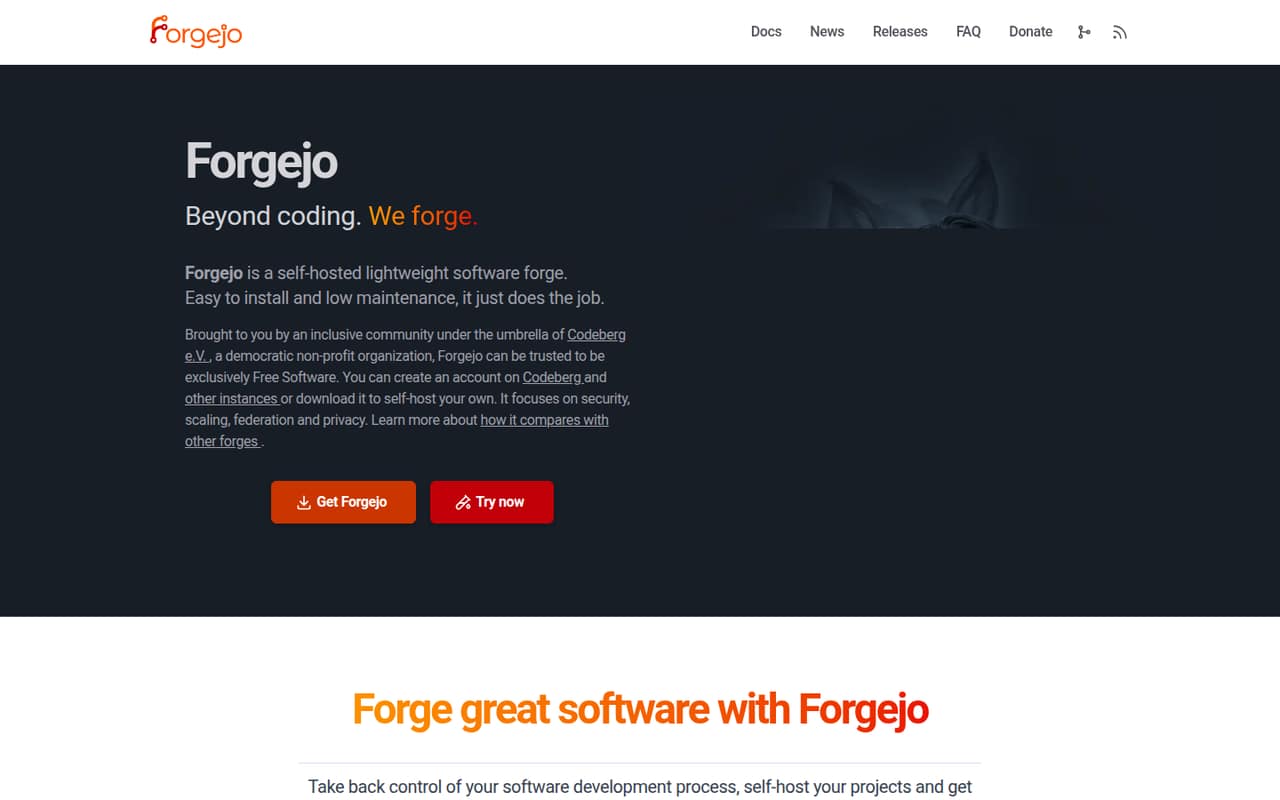
Forgejo is a self-hosted software forge for project management and collaboration. Its homepage emphasizes an easy-to-maintain, low-server-profile service, federation, privacy and Free Software. You can also use Codeberg or other instances, but Forgejo is not presented as a paid SaaS product.
For developers, the trade-off is control against operational responsibility. Reddit users describe it as easy to maintain, while a separate migration discussion reports a version-related problem moving from Gitea. Check migration paths and confirm API and SDK needs before adopting it for a production workflow.
Good fit if
- Teams running their own Git forge
- Small groups prioritizing code privacy
- Free Software and federation advocates
Skip it if
- Teams wanting vendor-managed hosting
- Buyers requiring published API guarantees
- Teams with unverified migration requirements
ScoresHow it rates
What works
- Free Software that can be self-hosted
- Homepage describes a low server profile
- Designed for project collaboration and management
- Codeberg and other instances are options
- Reddit users report easy maintenance
What doesn't
- Self-hosting makes operations your responsibility
- Homepage does not name API or SDK details
- Vendor does not publish commercial plan pricing
- Reddit user reports a Gitea migration cutoff
- Support terms are not published on the homepage
01What Forgejo is, technically
Forgejo is software you run as a self-hosted forge, not a library, CLI tool or hosted API. It sits alongside your development workflow as the place to manage software projects and collaborate. The project also points users to Codeberg and other instances, so self-hosting is an option rather than the only way to access Forgejo.
The problem it targets is the need for a GitHub-like environment that an organization can operate itself. The homepage describes a familiar environment for GitHub users, project management features and collaboration tools, with a focus on security, scaling, federation and privacy. It also describes Forgejo as lightweight and easy to maintain, though those are project claims rather than published deployment benchmarks. In a stack, Forgejo is the project and collaboration service your team operates or selects as an instance; it does not replace your source code or the servers and processes needed to run the service.
02Forgejo API, SDKs and docs
The homepage describes Forgejo in terms of software project management, collaboration and self-hosting. It does not name an API style, SDKs, supported programming languages, CLI, webhooks or plugin system. The practical integration surface established by the product description is the Forgejo instance and its project-collaboration environment; confirm in Forgejo's documentation whether its API, authentication options and integrations meet your workflow before building against them.
That matters if you need automation for repository creation, issue tracking or release workflows: do not assume a particular SDK or endpoint based on the product category. Forgejo supports federation as a project focus, but the homepage does not give protocol details there. The project invites contributions in code, federation, release management, documentation and other areas. For a team evaluating it, start with the official documentation and verify the exact interfaces, supported versions and maintenance expectations your codebase will rely on.
03Forgejo pricing for developers
Forgejo's software is free and the project says it will always be Free and Open Source Software. The pricing page information available for this review lists no monthly or annual plans, commercial tiers, add-ons or starting price. There is no published trial or paid tier to compare, and no usage-based rate, per-seat fee or request allowance is listed.
Free software does not make a self-hosted deployment cost-free to operate. Your organization needs to account for its own server, storage, backups, network and administration, but Forgejo does not publish a hosting calculator or a per-project cost. The homepage describes a low server profile and says Forgejo requires an order of magnitude fewer resources than other forges; it does not provide a workload, configuration or benchmark behind that claim. Codeberg and other instances are alternatives to running your own server, but their pricing and service terms are not specified on Forgejo's homepage. Ask the instance operator about capacity, backups and support before relying on a hosted instance.
04Forgejo: open source, self-hosting and lock-in
Forgejo describes itself as exclusively Free Software and says it will always be Free and Open Source Software. The homepage invites users to download it and self-host their own instance. It does not name a specific license there; a Reddit commenter calls it MIT-licensed, so confirm the current license in the project repository before making a legal or compliance decision.
Self-hosting gives your organization control over where the service runs, but data export and migration procedures are not described on the homepage. Treat migration as a due-diligence item: identify how repositories, issues, users and other project data can be moved, then test the path against your current version. A Reddit user reports a limitation migrating from Gitea after version 1.22. That is a user report, not a universal migration specification, but it makes version compatibility worth checking before switching.
05Forgejo in production
The Forgejo homepage says the project focuses on security, scaling, federation and privacy, and describes the server profile as low. It does not publish specific rate limits, capacity figures, service-level commitments or compliance certifications on the homepage. Before putting a production team on it, verify current release and security practices in the project documentation, decide who owns updates and backups, and test recovery with your own repositories and data.
A Reddit user running Forgejo in a container describes it as easy to maintain; another says installation was easy. Those are individual reports, not operational guarantees. Migration deserves particular attention: a user considering a move from Gitea says Forgejo does not support migrations from Gitea after 1.22. Confirm the relevant version path with the project documentation before planning a cutover. Also check federation behavior, authentication requirements and storage growth against your deployment, since the homepage does not publish production limits for those areas.
From the threadsWhat users say
The Reddit comments lean positive on ease of installation and maintenance, and some users prefer Forgejo's Free Software stance. Sentiment is not uniform: one commenter criticizes the fork's early identity, and a migration report flags a version cutoff that could complicate adoption.
It works well, is easy to maintain
Installed Forgejo and it was really easy, smooth. Now to migrate
The fork felt more like a "fk the establishment" than actual project with its own identity and goals
Forgejo doesn't support migrations from Gitea after 1.22
Questions people ask
Is Forgejo free?
The project says Forgejo will always be Free and Open Source Software. The pricing information available lists no commercial plans, paid tiers or starting price. If you use a hosted instance such as Codeberg or another provider, ask that operator about its terms and any charges.
Can I self-host Forgejo?
Yes. Forgejo describes itself as a self-hosted forge and invites users to download it to run their own instance. You will need to operate the server and plan for updates, backups, storage and access controls. The project describes the software as easy to install and maintain, but your operating costs depend on your deployment.
Does Forgejo have an API or SDKs?
The homepage does not name an API style, SDK, supported language or CLI. Check Forgejo's current documentation for the interfaces and libraries available for your version, and verify that they cover your automation requirements before depending on them in application code.
Can I migrate from Gitea to Forgejo?
Check the documented migration path for the exact versions you run. A Reddit user reports that Forgejo does not support migrations from Gitea after version 1.22. Treat that as a reason to verify compatibility and test a migration with a backup, rather than assuming the same path works across versions.
Is Forgejo suitable for production?
It can serve as a self-hosted project forge, but production suitability depends on your operations and requirements. Forgejo's homepage highlights security, scaling and privacy without publishing specific service guarantees, capacity limits or compliance certifications. Verify those details, backups, update procedures and migration options before relying on it for critical projects.
Sources
- Forgejo homepage
- Forgejo pricing, compiled via web search from forgejo.org, ycombinator.com, fresh.dev
- Reddit: Self-hosted Git: Forgejo vs Gitea vs Gogs?
- Reddit: Appreciation for Forgejo, my best self-hosted tool in 2026
- Reddit: How are the differences between Gitea and Forgejo 4 years later?
- Reddit: I'm stuck with Gitea 1.25 now... should I do the work to migrate to Forgejo?