
We may earn a commission if you buy through links on this page. It never changes a score or a ranking. How we make money
The bottom line
A broad hosted payments platform, but country-level availability and account reviews need careful checking.
Flutterwave combines hosted checkout and commerce tools with payment APIs for transfers, recurring payments, verification and virtual cards. Its Standard plan has no setup or monthly maintenance fee, but payment processing is not free: local NGN transactions cost 2%, capped at ₦2,000, and international transactions cost 4.8%.
The API could suit teams building for supported markets, but the vendor's homepage does not name SDKs, languages or protocol details. Reddit users report account freezes, repeated document requests and payment disruption in Kenya. Confirm current market coverage, compliance requirements and production support before making it a core dependency.
Good fit if
- Businesses accepting payments in supported markets
- Teams needing checkout and payout tools
- Developers building payment flows with APIs
Skip it if
- Teams requiring self-hosted payment infrastructure
- Businesses needing published SDK guarantees
- Merchants who cannot tolerate payout reviews
ScoresHow it rates
What works
- No setup or monthly maintenance fee on Standard
- Checkout, payment links, invoices and a free store
- APIs cover transfers and recurring payments
- Supports more than 30 currencies, per the homepage
- Dashboard supports single and bulk bank transfers
What doesn't
- Local and international transaction fees apply
- Country-specific rates may vary
- SDK languages and API protocol need confirmation
- Open-source licensing and self-hosting are not published
- Reddit users report freezes and payment disruption
01What Flutterwave is, technically
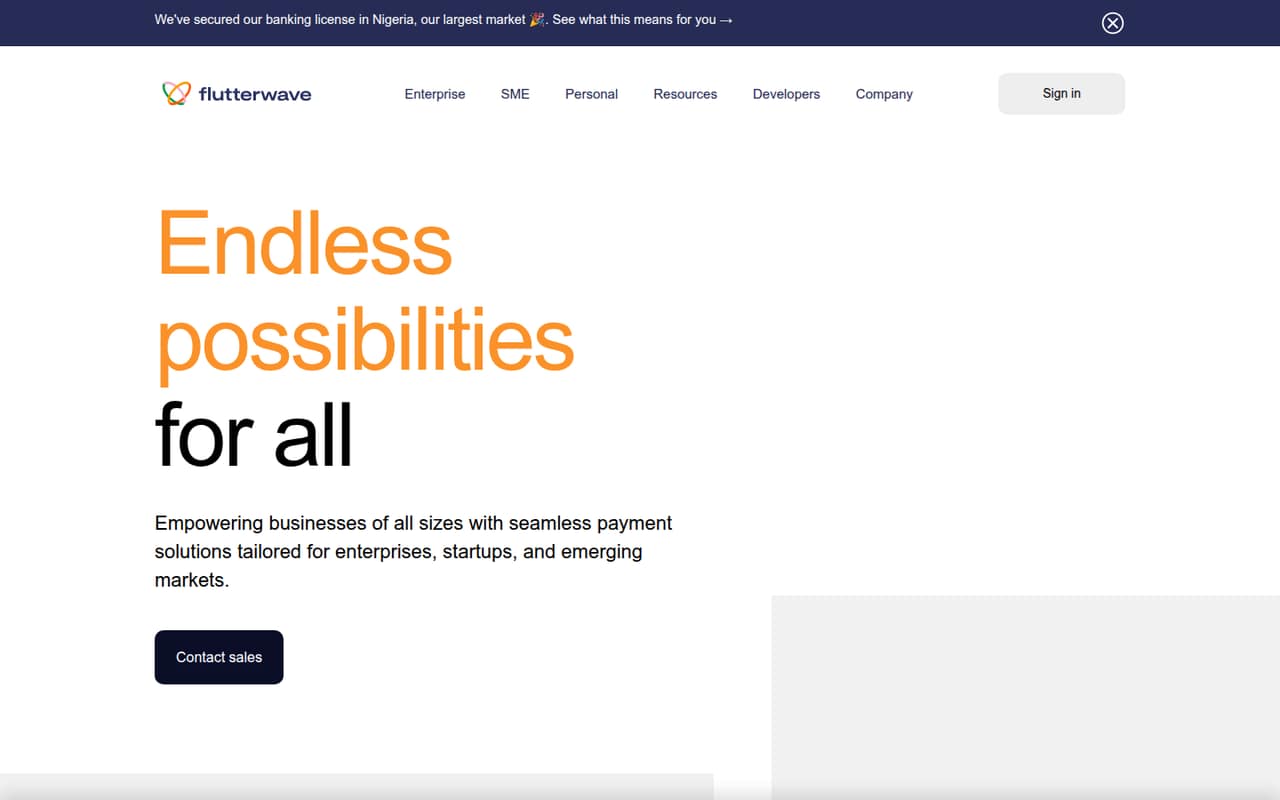
Flutterwave is a hosted payments platform: businesses use its dashboard, online commerce tools and payment APIs rather than deploying a payment server in their own infrastructure. It sits between a business's application or storefront and the payment methods used by its customers. The platform handles payment acceptance and offers transfers, invoices, payment links and a store alongside APIs for developers.
That makes it a combination of a payment processor and commerce service, not a general-purpose banking library or self-hosted gateway. The vendor says businesses can accept payments through more than 15 options, including cards, bank accounts, mobile money, POS, M-Pesa, VISA QR, bank transfer and USSD. Its homepage also lists APIs for transfers, recurring payments, payment verification, customer verification and virtual card creation. For a codebase, the architectural choice is whether to route payment and payout flows through Flutterwave's hosted service, rather than own those integrations and their market-specific operations.
02Flutterwave API, SDKs and docs
The integration surface is Flutterwave's payment APIs and API documentation. The vendor describes the APIs as covering quick transfers, one-time and recurring payments, payment verification, customer verification and instant virtual card creation. Its homepage calls the APIs well documented and says they provide payment integrations and abstractions; that is the vendor's characterization, not a guarantee about a particular integration's complexity.
The homepage does not name an API protocol, SDKs, programming languages, CLI, plugins or webhook features. Confirm supported SDKs, languages, authentication, webhook events, retries and idempotency in the vendor's API docs before choosing an implementation. Do not assume a particular SDK or integration pattern based on the product name alone. The separate dashboard can handle single or bulk transfers, while checkout, payment links, invoices and the store provide hosted commerce options. That may reduce custom work for basic payment collection, but teams building their own flows should validate the API surface against their application and operational requirements.
03Flutterwave pricing for developers
The Standard Pay-As-You-Go plan has no setup fee or monthly maintenance fee. That makes it free to start in the subscription sense, not free to process payments. The listed rate for local NGN transactions is 2%, capped at ₦2,000 per transaction; international transactions are listed at 4.8%. Country-specific rates may vary, so confirm the applicable schedule for each market before forecasting costs.
The bill grows with successful payment volume rather than a published monthly seat, compute or API-call charge. The pricing information does not list an API request fee, transaction minimum, overage rate or add-on price; ask Flutterwave to confirm any charges relevant to your payment mix. Annual billing prices are not published. For high-volume businesses, Enterprise uses custom pricing, with the vendor directing businesses to contact sales. Model fees against transaction size, payment origin and country, and account for the capped NGN fee separately from international and other country-specific rates.
04Flutterwave: open source, self-hosting and lock-in
Flutterwave is presented as a hosted payments service with APIs and a dashboard, not as software to deploy in your own environment. The vendor does not publish an open-source license or a self-hosted edition. If your deployment policy requires source access, private infrastructure or control over payment processing, ask the vendor whether it can meet those requirements before integrating.
The vendor does not publish a data-export policy in its homepage information. Ask what transaction, customer and reconciliation data you can export, in which formats, and for how long it remains available after account closure. Migrating away means replacing payment calls and any checkout or transfer flows built around Flutterwave, then coordinating customer payment-method changes and reconciliation. Keep provider-specific logic behind an internal payment interface where practical, and preserve your own transaction references and records. That will not remove the work of switching providers, but it can limit changes across the rest of your codebase.
05Flutterwave in production
The homepage claims Flutterwave handles more than 20 million API calls per day, peaking at 231 requests per second, and an average of 500,000 payments daily. Those are vendor-reported platform figures, not a published rate limit or a guarantee for an individual account. The vendor does not publish a rate-limit figure on its homepage; ask about account-specific limits, service-level commitments and incident handling before setting production capacity assumptions.
Reddit users report operational issues that merit due diligence. In one Uganda thread, a business owner said Flutterwave froze an account with funds in payouts and repeatedly requested business documents. In a Kenya thread, users complained of payment failures and disruption after the service reportedly exited the market. These posts are individual reports, not confirmation of general policy, but they point to risks around compliance reviews, payout access and market availability. Confirm supported countries and business categories, required documents, dispute handling and escalation paths. Also ask how to reconcile or recover from delayed payouts and interrupted payment flows.
From the threadsWhat users say
Reddit sentiment is strongly negative in the Reddit threads we read, focused on frozen funds, repeated verification and reported disruption in Kenya. These are user reports, not proof that every account or market faces the same issues.
Recently Flutterwave froze the account with about UGX 370k stuck in payouts
This keeps happening almost every three months, and it’s honestly exhausting repeating the same verification cycle
I wasn't able to buy food from Uber Eats using my card. A few times
So these cocksuckers decided to exit the Kenyan market without telling anyone
Flutterwave in the news
Questions people ask
What is Flutterwave?
Flutterwave is a hosted payments platform for businesses, individuals and developers. Businesses can use its dashboard and commerce tools for checkout, transfers, invoices, payment links and an online store. Developers can integrate payment APIs for transfers, recurring payments, verification and virtual cards.
How much does Flutterwave charge?
The Standard Pay-As-You-Go plan has no setup or monthly maintenance fee. Listed fees are 2% for local NGN transactions, capped at ₦2,000, and 4.8% for international transactions. Country-specific rates may vary. High-volume businesses can contact sales for custom Enterprise pricing.
What can developers build with Flutterwave's APIs?
The vendor lists APIs for quick transfers, one-time and recurring payments, payment verification, customer verification and instant virtual card creation. Its homepage does not name SDKs, programming languages or an API protocol, so confirm those details in the API docs before selecting an integration.
Which currencies and payment methods does Flutterwave support?
Flutterwave's homepage says it accepts payments in more than 30 currencies and lists more than 15 payment options. Examples include debit and credit cards, bank accounts, mobile money, POS, M-Pesa, VISA QR, bank transfer and USSD. Confirm the current options for each country you plan to serve.
Can Flutterwave freeze funds or stop working in a market?
Reddit users have reported frozen payouts and repeated requests for business documents, as well as payment disruption associated with a reported exit from Kenya. These are individual accounts, not a statement of Flutterwave policy. Ask the vendor about your business category, document requirements, payout reviews and current country availability.
Sources
- Flutterwave homepage
- Flutterwave pricing, compiled via web search from pricingsaas.com, igamingpaymentsolutions.com, tofali.dev, flutterwave.com, merchantmachine.co.uk
- Reddit: Need a good payment gateway to collect ugx
- Reddit: Fuck Flutterwave
- Reddit: Flutterwave Selects Polygon as Its Default Blockchain for Cross-Border Payments