
We may earn a commission if you buy through links on this page. It never changes a score or a ranking. How we make money
The bottom line
Flowise makes agent workflows visual, but its sunset notice complicates any long-term commitment.
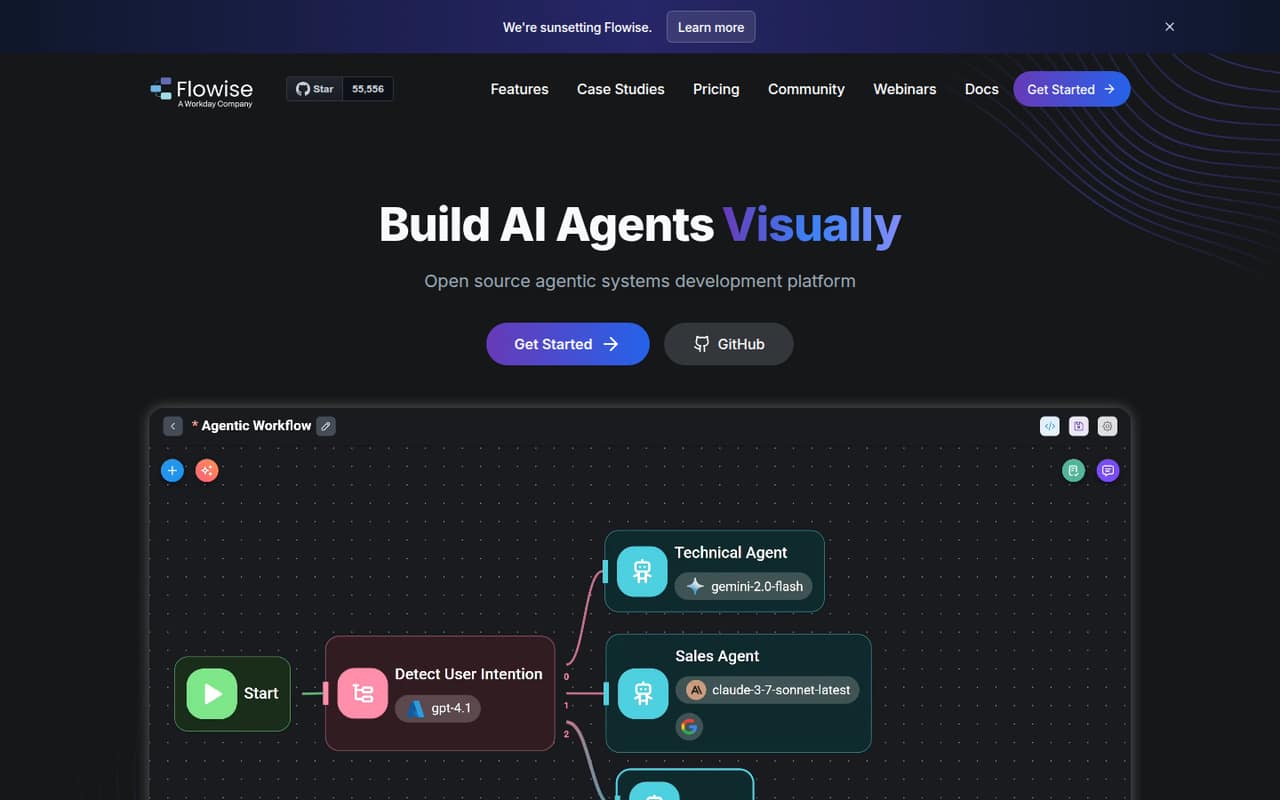
Flowise is an open-source visual platform for building chat assistants, agent workflows and AI applications. It provides an HTTP prediction API, TypeScript and Python SDKs, embedded chat, and cloud or on-premises deployment options.
The main concern is the homepage notice that Flowise is being sunset. That changes the decision: it may suit experiments or existing deployments, but teams should confirm support and migration plans before building a new production dependency.
Good fit if
- Prototyping agent workflows visually
- Teams already running Flowise
- Self-hosters with operations capacity
Skip it if
- New systems needing long-term support
- Teams requiring published service limits
- Developers needing extensive documentation
ScoresHow it rates
What works
- Visual building blocks for agents and chat assistants
- HTTP prediction API at /api/v1/prediction/:id
- TypeScript and Python SDKs plus embedded chat
- Apache 2.0 self-hosted option
- Prometheus and OpenTelemetry observability support
What doesn't
- Homepage says Flowise is being sunset
- A Reddit user describes the docs as lacking detail
- Vendor does not publish API rate limits
- Vendor does not publish a data export policy
- Self-hosting makes infrastructure and scaling your responsibility
01What Flowise is, technically
Flowise is an open-source visual platform for assembling AI applications, not just a hosted API or a model. It sits between your application and the models, embeddings, vector databases and tools that power chat assistants and agent workflows. Its canvas lets developers compose single-agent chatbots, retrieval-augmented generation (RAG) flows and coordinated multi-agent systems.
You can run it as a self-hosted server: the homepage gives npm install -g flowise and npx flowise start as the installation and startup commands. Flowise also offers cloud deployment, while its homepage describes on-premises deployment and horizontal scaling with message queues and workers. Applications can call its prediction API or use embedded chat. The architecture can therefore fit as an AI workflow service behind an application or internal tool. The key caveat is the homepage notice: “We're sunsetting Flowise.” Teams evaluating it should establish what that means for their deployment and support needs before adopting it.
02Flowise API, SDKs and docs
The homepage shows an HTTP prediction endpoint at /api/v1/prediction/:id and a Python example that sends a POST request with a question payload. It also lists APIs, an embedded chat widget, and TypeScript and Python SDKs. That gives application developers more than a canvas-only integration: a flow can be called from a backend, or exposed through embedded chat.
For local installation, the homepage documents npm install -g flowise followed by npx flowise start. It also lists support for 100+ LLMs, embeddings and vector databases, though teams should verify compatibility for each component they plan to use. Execution traces can connect to Prometheus, OpenTelemetry and other observability tools.
Documentation depth deserves a check before committing. In one Reddit thread, a Flowise user says the docs are “lacking in detail” and recommends LangChain documentation as a supplement. Check the vendor docs for endpoint authentication, SDK versions and deployment-specific guidance; the homepage does not describe those implementation details.
03Flowise pricing for developers
The hosted Free plan costs $0 per month and includes two flows and assistants, 100 predictions per month and 5MB of storage. Starter costs $35 per month, with unlimited flows and assistants, 10,000 predictions and 1GB of storage; the first month is free. Pro costs $65 per month and includes 50,000 predictions, 10GB of storage, unlimited workspaces and five users. Additional Pro users cost $15 per user per month. Enterprise pricing is custom.
The Self-Hosted (Open Source) option is free under the Apache 2.0 license, with unlimited seats and usage subject to your infrastructure. That removes a per-prediction plan cap, but shifts compute, storage and operations costs to your team. The vendor lists monthly prices; annual billing prices are not published. The vendor does not publish overage rates or API rate limits, so ask how a hosted project behaves after its prediction allowance is reached. The homepage also says Flowise is being sunset, so confirm that hosted plans remain available and supported before budgeting for them.
04Flowise: open source, self-hosting and lock-in
Flowise describes itself as open source, and its Self-Hosted (Open Source) plan is listed as free under the Apache 2.0 license. The homepage gives npm installation commands and says deployments can run on-premises or in the cloud. It also describes horizontal scaling with message queues and workers, which puts infrastructure planning and operations in your hands.
Self-hosting reduces dependence on Flowise’s hosted service, but it does not by itself settle migration risk. Your application can call a documented HTTP prediction endpoint, while the flows themselves are built inside Flowise. The vendor does not publish a data export policy; confirm how to export flow definitions, credentials and other project data before relying on them. The sunset notice makes that question especially important. Keep model calls, prompts and application logic documented outside the visual canvas where practical, and test a migration path before making Flowise a critical dependency.
05Flowise in production
Flowise lists execution traces, Prometheus and OpenTelemetry support, on-premises deployment, and horizontal scaling with message queues and workers. Those are useful pieces for an operational deployment, but they do not replace checks for authentication, access controls, data handling, backups and recovery. Confirm the controls and compliance terms that your application requires with the vendor before sending production data.
The hosted plans have prediction and storage allowances, but the vendor does not publish rate limits or overage behavior. For self-hosting, estimate capacity and monitor the infrastructure you operate. The sunset notice is the largest reliability concern: teams should ask about maintenance, security fixes and service continuity, then document an exit route.
Developer feedback is mixed. One Reddit commenter says Flowise is “more conceptually digestible” but “an underpowered system.” Another reports that Flowise documentation lacks detail. These are individual views, not service guarantees, but they point to two practical checks: prototype the full workflow and validate documentation against your production requirements.
From the threadsWhat users say
Reddit comments show mixed sentiment: some developers find Flowise approachable for AI-specific workflows, while others question its capability and documentation. The homepage sunset notice adds a separate reason to assess support and continuity before adopting it.
Flowise is a more conceptually digestible
Flowise is a more conceptually digestible but an underpowered system
There is on the Flowise docs but like I mentioned before they’re lacking in detail
since Flowise is using the Langchain framework, the Langchain documentation can be super helpful for this
Questions people ask
Is Flowise free?
Yes. The hosted Free plan is $0 per month and includes two flows and assistants, 100 predictions per month and 5MB of storage. The Self-Hosted (Open Source) option is also listed as free under the Apache 2.0 license, with usage subject to your infrastructure.
How do I install Flowise?
The homepage documents a global npm install followed by the startup command: npm install -g flowise and npx flowise start. For a production deployment, check the vendor docs for current installation, configuration and upgrade guidance, especially given the homepage sunset notice.
Does Flowise have a Python SDK?
Yes. The homepage lists both TypeScript and Python SDKs, and shows a Python example that sends a POST request to /api/v1/prediction/:id. Check the vendor docs for current SDK versions, authentication requirements and request details before integrating.
Why is Flowise shutting down?
Flowise’s homepage says it is being sunset, but does not give a reason in that notice. Teams should contact the vendor to ask about timing, support, security updates and the status of hosted plans before starting a new deployment.
Can I use Flowise in production?
Flowise lists execution traces, Prometheus and OpenTelemetry support, and cloud or on-premises deployment with horizontal scaling. Those capabilities do not establish that it meets your security or reliability requirements. Test your workloads, confirm operational controls, and resolve the sunset and support questions before making it a critical dependency.
Sources
- Flowise homepage
- Flowise pricing, compiled via web search from lindy.ai, rfp.wiki, agentbenchmarks.io, flowiseai.com, saasworthy.com, saaspricehub.io, checkthat.ai
- Reddit: Flowise help for beginners
- Reddit: LangFlow vs Flowise vs n8n vs Make
- Reddit: Flowise
- Reddit: Buildship vs Relevance AI vs Stack AI vs Flowise