
We may earn a commission if you buy through links on this page. It never changes a score or a ranking. How we make money
The bottom line
Facets lets agents ship contract-checked infrastructure changes, but the $799/month entry price sets a high bar.
Facets is a platform control plane for AI agents to request and ship infrastructure changes under rules set by a platform team. It coordinates provisioning, configuration, deployment, routing, monitoring and alerts in a release, with human approval available for actions that require it.
SaaS starts at $799/month for 20 Resource Instances, and Enterprise offers self-hosting in your VPC at custom annual pricing. Facets could suit teams standardizing agent-driven releases, but confirm API and SDK support, operational limits, and data export before committing.
Good fit if
- Platform teams governing AI agents
- Teams standardizing infrastructure contracts
- Organizations automating release handoffs
Skip it if
- Teams seeking a free IaC tool
- Projects needing published API limits
- Teams requiring a published open-source license
ScoresHow it rates
What works
- Checks agent requests against reusable contracts
- Supports human approval for selected actions
- Coordinates infrastructure through monitoring in one release
- Offers Enterprise self-hosting in your VPC
- Uses plain Terraform saved in Git
What doesn't
- SaaS starts at $799/month
- No free plan; trial lasts 14 days
- Additional Resource Instances add monthly costs
- Public API, SDK and language details need confirmation
- License and data-export terms need vendor confirmation
01What Facets is, technically
Facets is a platform control plane for infrastructure changes requested by AI agents and developers. Its SaaS plan includes a Facets-hosted control plane; Enterprise can run self-hosted in your VPC. It sits between developer or agent requests and the cloud resources those requests change, rather than acting as a code editor or a conventional pipeline runner.
A platform team defines reusable contracts describing permitted choices and rules that agents cannot change. Facets checks each request against the contract, then runs ordered steps such as creating a resource, storing credentials, connecting services and releasing to staging or production. Some actions can wait for human approval. The release can include code, infrastructure, configuration, deployment, routing, monitoring and alerts. The homepage positions Facets alongside existing tools: CI continues building and testing code, and Backstage can remain the developer portal through a Facets plugin. Its stated goal is to reduce pipeline work and ops handoffs, not to replace the cloud account or the team's platform rules.
02Facets API, SDKs and docs
The integration surface described by Facets is contract-based: contracts use plain Terraform and are saved in Git as a facets.yaml file. Developers can request approved resources in plain language or choose from a menu; the homepage shows Claude Code as an agent interface. It also says Backstage stays in place with a Facets plugin, while CI keeps building and testing code.
Those details give platform teams a visible starting point, but they do not establish how a custom application calls Facets. The homepage does not name an API protocol, SDK, supported programming language or CLI. We would confirm API and SDK support, authentication, versioning, documentation, and any webhook or command-line interfaces in the vendor's docs before planning a custom integration. The vendor describes contracts as AI-drafted and tested before team review, but implementation details for those steps are not stated. Confirm how contract changes are reviewed and promoted across environments, and whether Git is the only supported contract workflow.
03Facets pricing for developers
The pricing page lists SaaS at $799 per month, with 20 Resource Instances (RIs), a Facets-hosted control plane, an isolated customer copy, standard support and a 14-day free trial. There is no free plan. The pricing lists no annual SaaS price. Enterprise has unlimited RIs, self-hosting in your VPC, custom SLA guarantees, a dedicated success manager and 24/7 priority support; its fixed annual price is custom and not published.
SaaS add-ons are $10 per month for each additional RI through 250 additional RIs, then $8 per month each from 251 to 500. Above 500 additional RIs, pricing is custom. That makes the bill grow with provisioned Resource Instances rather than a published request, seat or compute meter. The pricing details do not list API request quotas, overage charges beyond RI add-ons, or separate fees for environments. Before production, ask how Facets counts an RI, whether inactive resources count, and what Enterprise pricing includes for your deployment size.
04Facets: open source, self-hosting and lock-in
Facets describes plain Terraform inside its contracts, with contract files saved in your Git. That gives teams a familiar format for infrastructure definitions, but it does not establish that the Facets platform itself is open source. The vendor does not publish a license or source-availability detail on the vendor's site; ask for the license terms and any source access before adopting it.
Self-hosting is available on Enterprise, which is listed as running in your VPC. SaaS uses a Facets-hosted control plane. The vendor does not publish data-export details here, so ask how to export contract definitions, release history, credentials metadata and monitoring configuration, and what remains usable after termination. Terraform in Git may make some infrastructure definitions easier to carry forward, but the Facets release workflow, contract behavior and connections may need replacement. Request a documented exit path and identify which state and operational records remain in your cloud account.
05Facets in production
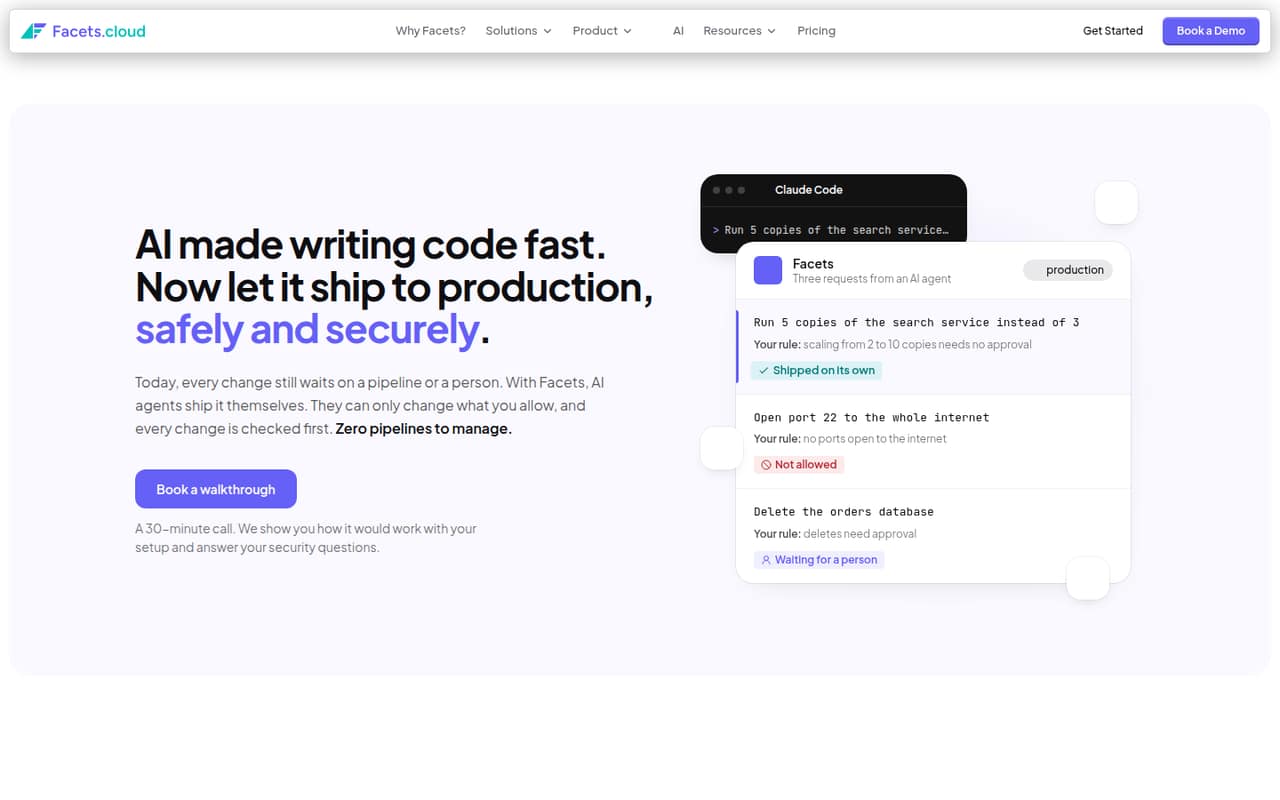
Facets' production value depends on contracts being correct and on the platform handling releases in the right order. Its homepage says requests are checked before execution, rules can prohibit actions such as public ports, and selected actions such as deletes can wait for a person. Confirm how approvals are configured, audited and recovered if a release stalls. Also validate how secrets are stored and what access the control plane needs in your cloud account.
The pricing details do not publish API rate limits, release-volume limits, availability targets for SaaS, recovery objectives or deployment concurrency. Ask the vendor for those limits, incident procedures, backup and restore behavior, and the Enterprise SLA terms before relying on it for critical services. The Enterprise plan lists custom SLA guarantees and 24/7 priority support; SaaS lists standard support. Test your own failure paths, including partial provisioning, rollback, credential rotation and a control-plane outage. The homepage describes cloud migrations, new regions, multi-cloud moves and new environments as use cases, but teams should confirm supported providers and migration procedures with the vendor.
Questions people ask
What is Facets used for?
Facets lets developers and AI agents request infrastructure changes under rules defined by a platform team. It checks requests against contracts, then coordinates steps such as provisioning resources, connecting services, deploying changes, and setting up monitoring and alerts.
How does Facets control AI agent changes?
Platform teams define contracts with permitted options and rules that agents cannot change. Facets checks a request against the applicable contract before execution. Actions can be blocked or held for human approval, depending on the rules the team sets.
Does Facets replace CI or Backstage?
No. Facets says CI continues building and testing code, while Facets deploys each build. Backstage can remain the developer portal through a Facets plugin. Facets coordinates infrastructure, configuration, deployment, routing, monitoring and alerts as part of a release.
How much does Facets cost?
SaaS is listed at $799 per month for 20 Resource Instances, with a 14-day free trial and no free plan. Additional SaaS instances cost $10 per month each through 250 additional instances and $8 each from 251 to 500. Enterprise pricing is custom.
Can Facets be self-hosted?
Yes. The Enterprise plan lists self-hosting in your VPC, unlimited Resource Instances, custom SLA guarantees, a dedicated success manager and 24/7 priority support. SaaS uses a Facets-hosted control plane. Ask the vendor about deployment requirements and data export before choosing a plan.