
We may earn a commission if you buy through links on this page. It never changes a score or a ranking. How we make money
The bottom line
Exa gives AI agents search, content and research APIs, but usage costs and hosted-service dependence need attention.
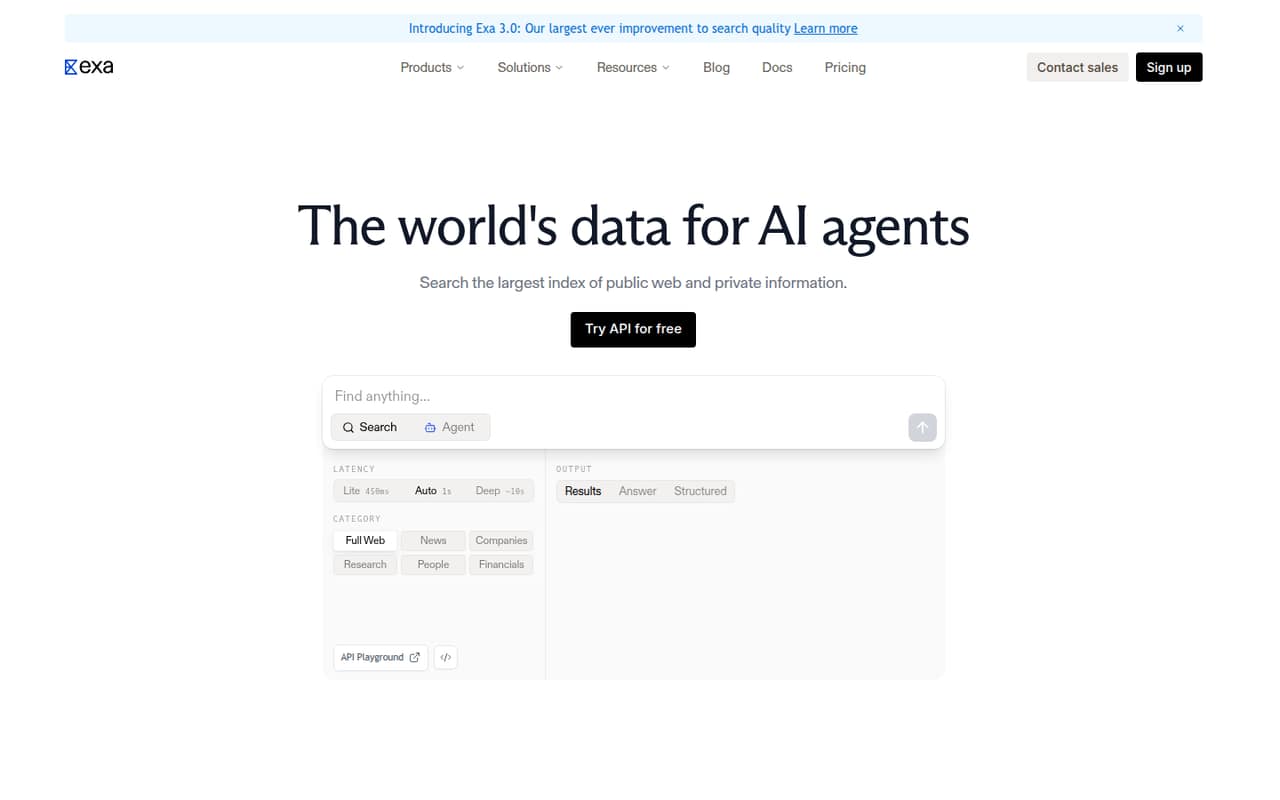
Exa is a hosted set of search APIs and web-crawling tools for AI agents. Search, Contents, Agent and Monitors cover retrieval, relevant page excerpts, cited research and recurring searches; structured company enrichment is another use case.
The free plan includes $10 in monthly credits, but it also has a 10 Search QPS limit. Pay-as-you-go pricing is usage-based, and the bill can grow with search mode, result counts, agent effort and enrichment. Treat Exa as a hosted dependency: confirm limits, retention terms and SDK support before production.
Good fit if
- Agents that need web search
- Research workflows requiring citations
- Apps that need recurring web monitoring
Skip it if
- Teams requiring self-hosted search
- Projects needing predictable flat-rate costs
- Workloads that exceed published rate limits
ScoresHow it rates
What works
- Separate APIs cover search, content, research and monitoring
- Search supports web, news, companies, research, people and financials
- Contents returns relevant excerpts and webpage text
- Agent supports structured outputs and grounded citations
- Free plan includes $10 monthly credits
What doesn't
- Free plan is limited to 10 Search QPS
- Usage costs vary by search mode and agent effort
- Pay-as-you-go base rates are not listed as a flat subscription
- Self-hosting and source licensing are not published
- SDK and language support should be confirmed in the docs
01What Exa is, technically
Exa is a hosted search and web-crawling service exposed through APIs, not a search library or self-hosted server. It sits between an AI agent and web or private-information retrieval: the application sends a query, then uses results, page content or structured research in its own context and workflow.
The Search API offers configurable latency and coverage across web, news, companies, research, people and financials. The Contents API returns webpage text and relevance-selected highlights. Agent supports research runs with structured outputs and grounded citations, while Monitors runs searches on a cadence and can send updates through webhooks. Exa also offers structured company enrichment across 70M+ companies.
That makes Exa a retrieval layer rather than a complete agent runtime. Your application still owns orchestration, user-facing behavior and handling returned data. Exa says its index searches public web and private information; teams using private sources should confirm how those sources are connected and governed before relying on that capability.
02Exa API, SDKs and docs
Build around Exa’s Search, Contents, Agent and Monitors APIs. Search is configurable for latency and coverage; Contents can return relevant excerpts instead of requiring an application to pass full pages into a model. Agent is for deeper research with structured outputs and citations. Monitors supports recurring searches and webhook updates. Exa Connect is another listed integration surface.
The homepage points developers to Docs and an API Playground, and lists 50+ integrations on the Free plan. The vendor does not name SDK languages or a CLI on its homepage, so confirm current SDK support and API request conventions in the docs before choosing an implementation. A Reddit developer describes using Exa through an MCP server, but that is a community integration, not a substitute for checking Exa’s supported interfaces.
Keep the integration boundary narrow: normalize Exa responses in your application and preserve the citations or URLs your product needs. For long-running research and monitoring, also design for asynchronous completion and webhook delivery behavior; confirm those operational details in the docs.
03Exa pricing for developers
The Free plan costs $0 and includes $10 in monthly credits plus a $10 onboarding bonus, 10 Search QPS and 50 Agent concurrency. Pay as you go is usage-based, supports up to 25 Search QPS and includes 50 Agent concurrency. Custom lists 25 Search QPS, custom Search QPS and Agent concurrency, and up to 1,000 results per search. The pricing page lists no annual subscription rates for Pay as you go.
Search add-ons cost $4 per 1,000 Lite requests, $7 for Auto, $12 for Deep and $5 for Answer. Contents costs $1 per 1,000 pages; Monitors costs $2 per 1,000 requests. For Lite, Auto, Deep and Monitors, additional results above 10 cost $1 per 1,000 requests. AI page summaries are $1 per 1,000 pages.
Agent effort ranges from $0.012 per Minimal request to $1.00 per X-high request; Ultra is usage-based. Agent usage also lists $0.10 per ACU, $0.005 per search, $0.02 per email enrichment and $0.07 per phone enrichment. Exa Connect provider usage is billed separately. Custom zero-data-retention terms list a $12,000 annual commitment in API credits.
04Exa: open source, self-hosting and lock-in
Exa is presented as a hosted API service. The vendor does not publish a source licence or self-hosted deployment option on its product homepage, so treat Exa as hosted-only unless the vendor confirms otherwise for your contract. That makes the service quick to add as a retrieval dependency, but it also ties your application to Exa’s API behavior, pricing and availability.
The vendor says Custom includes a zero-data-retention option; the pricing page lists a $12,000 annual commitment in API credits for the enterprise option. That is a retention control, not a data-export guarantee. The vendor does not describe a general export path for queries or results. Keep needed source URLs, citations and normalized outputs in your own storage, and ask about data deletion, export and contract-end handling before sending sensitive workloads.
Migration means replacing search, content retrieval and any agent or monitoring workflows that depend on Exa-specific outputs. A small adapter layer can reduce that work.
05Exa in production
The pricing page sets the Free plan at 10 Search QPS and Pay as you go at up to 25 Search QPS; Custom lists 25 Search QPS plus custom capacity. Agent concurrency is 50 on Free and Pay as you go, with custom concurrency available on Custom. Confirm whether these limits fit peak traffic and what happens when a request exceeds them. The vendor’s homepage does not publish an uptime commitment, so ask about service-level terms, retries and support response times.
Exa lists SOC 2 Type II, GDPR, CCPA and HIPAA safeguards, with a BAA available. Zero data retention is an enterprise option, not a general Free-plan promise. Verify the exact retention and processing terms for your account.
Reddit reports are mixed and anecdotal. One OpenCode user said search queries had started failing, then edited the post to say the issue was resolved. A Pi developer describes a community MCP integration with 1,000 requests per month and no API key; a commenter warns that multiple search agents can use up quota quickly. Budget from your own request pattern, not a headline quota.
From the threadsWhat users say
The small set of Reddit comments is mixed. Developers appreciate access through integrations, while one user reported failing queries and another cautioned that agent tool calls can consume quota quickly.
My exa search queries started to fail mostly
using tool calls with a couple search agents will eat up the quota surprisingly fast
1000 requests/month, no API key needed
cheaper options often hand back stale or empty content and you'd never know from the result list alone
Questions people ask
Is Exa free to use?
Yes. Exa’s Free plan costs $0 and includes $10 in monthly credits plus a $10 onboarding bonus, 10 Search QPS and 50 Agent concurrency. Usage beyond the available credits may require a paid plan or additional credits; check the pricing page for the current billing terms.
How does Exa charge for API usage?
Pay as you go is usage-based. Listed prices vary by API operation: Lite Search is $4 per 1,000 requests, Auto is $7, Deep is $12 and Contents is $1 per 1,000 pages. Agent requests can also incur effort, ACU, search and enrichment charges.
Can I self-host Exa?
Exa is sold as a hosted API service, and the vendor does not publish a self-hosted deployment option on its homepage. If self-hosting is a requirement, ask Exa whether it offers a deployment or licensing arrangement for your use case before building against the service.
What rate limits apply to Exa?
The Free plan includes 10 Search QPS. Pay as you go supports up to 25 Search QPS, and Custom lists 25 Search QPS with custom Search QPS and Agent concurrency. Free and Pay as you go each include 50 Agent concurrency. Confirm how your account handles requests over its limits.
Does Exa support recurring searches?
Yes. The Monitors API runs searches on a specified cadence and can send updates through webhooks. Monitors usage costs $2 per 1,000 requests, and additional results above 10 cost $1 per 1,000 requests. Check the docs for cadence options and webhook delivery behavior.