
We may earn a commission if you buy through links on this page. It never changes a score or a ranking. How we make money
The bottom line
Useful analysis and on-prem deployment; confirm SDK support, pricing and export before committing.
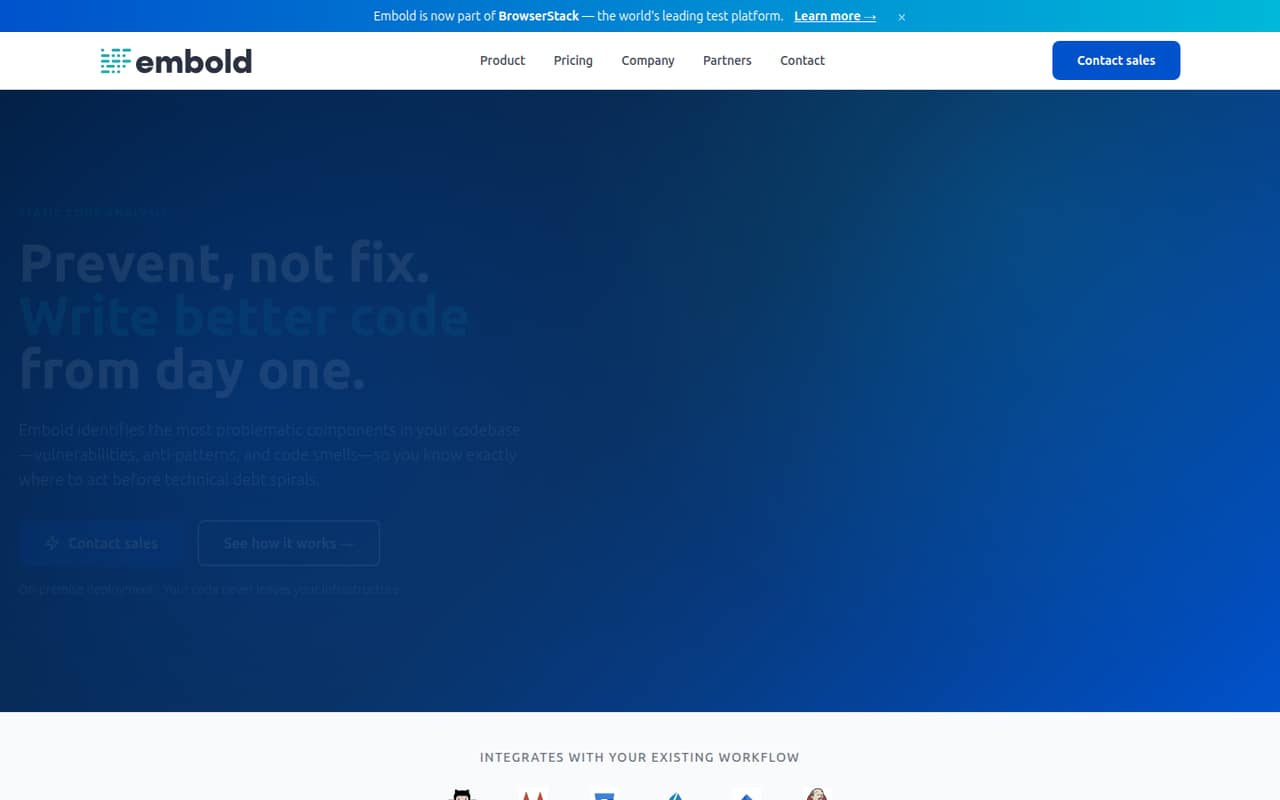
Embold is a static code analysis product that scans repositories and pull requests for security vulnerabilities, design issues, code smells and code metrics. Its web UI, IDE plugins and on-prem deployment make it relevant to teams that want findings in their existing workflow while keeping source code inside their infrastructure.
The trade-offs are limited public detail on its developer interfaces and custom-quote Enterprise pricing. The pricing page lists no free plan, and Reddit discussion does not provide product-specific feedback on Embold.
Good fit if
- Teams prioritizing code maintainability
- Organizations requiring on-prem analysis
- Teams reviewing pull requests
Skip it if
- Teams needing published usage pricing
- Developers seeking a free analysis tier
- Teams requiring documented export guarantees
ScoresHow it rates
What works
- Detects 30+ types of structural design issues
- Scans pull requests across four named platforms
- Offers on-prem deployment within your network
- Provides plugins for four named IDEs
- Tracks complexity, coupling, cohesion and custom KPIs
What doesn't
- Enterprise pricing requires a custom quote
- No free plan is listed
- Public API and SDK support need verification
- Licence and source availability are not published
- Data export and migration paths are not published
01What Embold is, technically
Embold is a static code analysis product that connects to source repositories, scans code and pull requests, and presents findings through a web UI and IDE plugins. It sits alongside source control and code review: the vendor says it can analyse pushes, commits and pull requests, then rank issues such as vulnerabilities, anti-patterns and code smells for developers to address.
The product can run in the cloud or on-premise. Embold says its on-prem deployment runs inside a team's own network, so source code stays within its infrastructure. The feature set includes security scans, duplicate-code detection, metrics such as complexity and coupling, and dependency diagrams for refactoring. It is an analysis layer, not a compiler or replacement for a test suite. The vendor also advertises Jira task creation from issues. Teams should confirm which scan modes and repository permissions their deployment requires before adding it to a production review pipeline.
02Embold API, SDKs and docs
The homepage shows a TypeScript example that imports EmboldScanner from @embold/core, configures a repository and rules, then calls scanner.scan(). That presents a library-style integration surface, but teams should confirm in the vendor's documentation whether this package, its API and its support status are available for their intended use. The homepage does not establish language coverage for the scanner.
The named workflow integrations are GitHub, GitLab, Bitbucket and Azure DevOps for repository and pull-request analysis, plus Jira task creation. IDE plugins are listed for IntelliJ IDEA, Android Studio, Visual Studio and VS Code; the Visual Studio plugin supports C/C++ and C#. The vendor describes results in a web UI and IDEs, but does not publish details here on a CLI, REST API, webhooks or language-specific SDK support. Confirm those integration options, setup requirements and documentation with Embold before building automation around them.
03Embold pricing for developers
The pricing information lists one plan, Enterprise, for teams needing private code analysis. It requires a custom quote and includes unlimited repositories, users and lines of code. Monthly and annual prices are not published, so there is no reliable starting price to use for a budget. The listed pricing data says there is no free plan and no free trial; the homepage's free IDE plugins are not the same as a free analysis plan.
The vendor does not publish a usage-based rate, seat price, request allowance, overage charge or add-on price. That means we cannot estimate how a bill changes as repositories or scanned code grow. Ask sales for a written quote covering the deployment model, repository and line-count definitions, support, renewals and any costs for additional environments. The listed Enterprise limits are unlimited for repositories, users and lines of code, but the custom quote means teams should confirm which features and services that offer includes. Treat the listed plan details as a starting point for procurement, not a public price schedule.
04Embold: open source, self-hosting and lock-in
The vendor does not publish an open-source licence or say that Embold's source code is available. It does advertise on-prem deployment, including operation inside a team's own network; that is a self-hosting option, not evidence that the software is open source. Ask the vendor about installation, upgrades, network access and operational requirements for the on-prem product.
The vendor does not publish a data-export format or a documented migration path. Findings, metrics and repository configuration may become part of a team's analysis workflow, so confirm what can be exported and retained if the contract ends. A move away would also require replacing repository and pull-request checks and any issue-tracking workflow built around Embold. Get export rights and retention terms in writing before depending on the service.
05Embold in production
Embold advertises scans on pushes, commits and pull requests, along with scheduled deep scans. For production use, confirm scan duration, queue behaviour, failure handling and how findings affect pull-request checks; the vendor does not publish rate limits, throughput figures or availability commitments in the published product details. Ask how on-prem deployments are secured, patched and backed up, and what repository credentials and network access they require.
The vendor says TÜV SÜD tested and certified Embold for ISO 26262 and IEC 61508. Teams in regulated environments should verify the scope and current validity of those certifications with the vendor. The Reddit discussion we found for this review focuses on desired codebase-level analysis and recommendations for other tools; it does not assess Embold's reliability or production behaviour. Request references and deployment-specific support terms before making it a required review gate.
From the threadsWhat users say
The Reddit discussion centres on buyers looking for whole-codebase structure analysis and refactoring guidance, but it does not rate Embold. We therefore treat product-specific user sentiment as unestablished rather than positive or negative.
Does it assess architecture across codebase? Class structures, file organization, implementation patters?
I'm looking for an AI-powered tool that can analyze my GitHub repo and provide high-level structural recommendations, code quality scores, and priority areas for improvement
Provides overall structure recommendations & refactoring suggestions
if you need more than lint, look for PR analysis that reads beyond the diff, pulls related files, and proposes acceptable fixes for code quality
Questions people ask
Does Embold offer a free plan?
The pricing information lists no free plan or free trial. The vendor does advertise free IDE plugins, but those are separate from a paid repository-analysis plan. Ask Embold whether it offers a time-limited evaluation or a way to assess scans before signing an Enterprise agreement.
How much does Embold cost?
The listed Enterprise plan requires a custom quote. Monthly and annual prices are not published, so there is no public starting price. Enterprise includes unlimited repositories, users and lines of code according to the pricing information. Ask for a quote that covers deployment, support and renewal terms.
Can Embold run on-premise?
Yes. Embold advertises on-prem deployment inside a team's own network, with source code staying within its infrastructure. The vendor also describes a cloud option. Confirm the on-prem installation, update process, security requirements and operational responsibilities with Embold before choosing a deployment.
Which repositories and IDEs does Embold support?
The vendor lists repository connections and pull-request scans for GitHub, GitLab, Bitbucket and Azure DevOps. It lists plugins for IntelliJ IDEA, Android Studio, Visual Studio and VS Code. The Visual Studio plugin supports C/C++ and C#. Confirm current compatibility and version requirements with the vendor.
Does Embold provide an API or SDK?
The homepage shows a TypeScript example importing EmboldScanner from @embold/core and calling scan(). That indicates a library-style integration example, but the available product details do not establish SDK availability or support terms. Check Embold's documentation or ask the vendor about package access, API stability and supported languages.