
We may earn a commission if you buy through links on this page. It never changes a score or a ranking. How we make money
The bottom line
A hosted API layer for triggering email templates through your existing delivery providers.
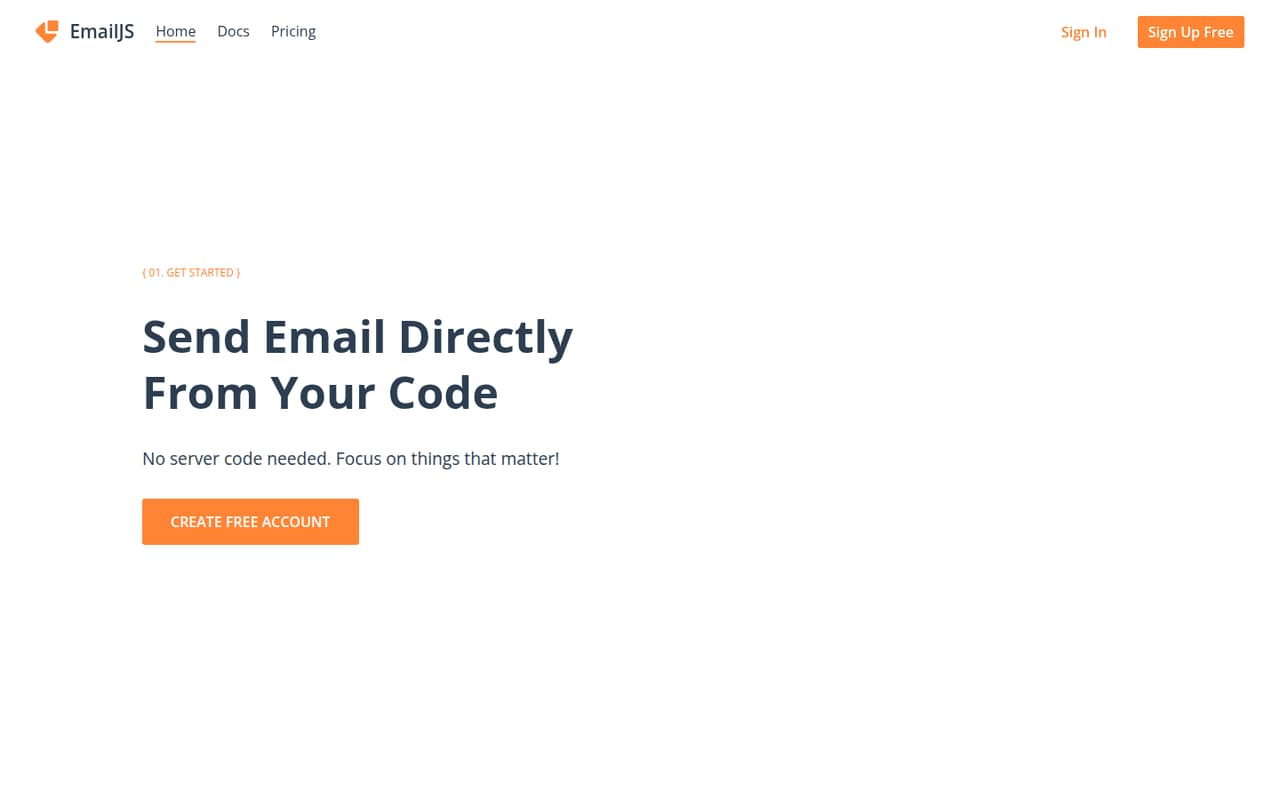
EmailJS is a hosted email orchestration service, not a mail delivery provider. It connects to services such as Gmail, SMTP, SendGrid and AWS SES, then lets client-side apps trigger predefined templates without holding provider credentials.
The SDKs and REST API make it straightforward to add template-based sending, and the free plan covers 200 monthly requests. Before production use, check the request and attachment caps, overage terms, reliability commitments and data-export options with the vendor.
Good fit if
- Client-side apps sending templated email
- Small projects with low request volume
- Teams switching between email providers
Skip it if
- Teams needing a delivery provider
- High-volume projects on a tight quota
- Organizations requiring self-hosted infrastructure
ScoresHow it rates
What works
- Provider credentials stay on EmailJS servers
- Connects to native APIs or standard SMTP
- Official SDKs cover several common runtimes
- REST API supports other languages
- Free plan includes 200 monthly requests
What doesn't
- Monthly request limits vary by plan
- Attachment ceilings range by plan
- Overage terms are not published
- Self-hosting and source availability are not published
- Reliability commitments and export terms need confirmation
01What EmailJS is, technically
EmailJS is a hosted email orchestration API and dashboard, not an email delivery provider or a library you run as a mail server. It sits between an application and an existing email service such as Gmail, SMTP, SendGrid or AWS SES. EmailJS stores the provider authentication details on its servers; an app calls EmailJS to send a predefined template rather than connecting to the provider with a secret key.
That arrangement addresses a common client-side problem: putting provider credentials in browser or mobile code can expose them. EmailJS instead lets the app supply template parameters and trigger an email using a public key. Developers can also call the REST API or use SDKs for supported environments. Provider connections and templates are managed through the dashboard, where the vendor says teams can switch or back up providers without changing application code. It adds a hosted service dependency and another request path to the email stack.
02EmailJS API, SDKs and docs
The integration model is template-triggered sending through client SDKs or a REST API. The homepage lists official SDKs for TypeScript, JavaScript, React, Vue, Svelte, Flutter and Node.js. Its example also shows Angular on the web and React Native and Flutter for mobile. Node.js uses the @emailjs/nodejs package; the browser example imports @emailjs/browser. Confirm package and framework support in the vendor’s docs before choosing an SDK.
For other runtimes, the universal REST API accepts a POST request to /api/v1.0/email/send; the homepage gives examples for cURL and names Rust, Python, PHP, C# and Go as possible REST API clients. The documented integration path is SDKs or REST, rather than a CLI workflow. The app sends a service ID, template ID, public key and template parameters. Templates are created in the dashboard with a rich-text or HTML editor. Provider setup and templates have vendor guides linked from the homepage; confirm details such as error handling and retries in the docs.
03EmailJS pricing for developers
The Free plan costs $0 and includes 200 monthly requests, two templates, requests up to 50Kb, 500 contacts and seven-day email history. It is a useful test tier, but a production app can hit the request cap quickly; the listed free-plan limit is not an estimate of how many recipients or messages your workflow will generate.
Personal costs $9 per month, or $7.20 per month with annual billing, for 2,000 requests, six templates, 500kb attachments, unlimited contacts and 30-day history. Professional costs $15 monthly or $12 with annual billing, with 5,000 or 10,000 requests, unlimited templates, 2mb attachments and three seats. Business costs $40 monthly or $32 with annual billing, with request options from 25,000 to 200,000, 30mb attachments and unlimited seats. The pricing page advertises yearly billing at 20% off.
The published plans list no add-ons. The vendor does not publish overage charges or what happens when an account exceeds its quota, so confirm that before launch. Support is listed as priority on Professional and Business.
04EmailJS: open source, self-hosting and lock-in
EmailJS is presented as a hosted service with a dashboard and server-side storage for provider credentials. The vendor does not publish an open-source licence or a self-hostable server option, so teams should not plan to run the service inside their own infrastructure without written confirmation. The SDKs and API are integration surfaces, not evidence that the service itself is open source.
The vendor does not publish data-export terms in the product material. Ask how to retrieve email history, templates, contacts and configuration before making EmailJS part of a critical workflow. The provider abstraction may reduce the work of changing delivery services, but it does not remove EmailJS from the sending path. A migration still means replacing SDK or REST calls and recreating templates and their parameter mappings in the next system.
05EmailJS in production
Plan around the monthly request quota, attachment ceiling, history window and seat count on your tier. The pricing page lists those caps, but does not publish overage behavior or numeric throughput limits. The dashboard offers origin whitelisting and IP-based rate limiting as abuse controls; configure both, and confirm their exact settings and interaction with your application’s traffic.
EmailJS keeps provider credentials server-side, while client code uses a public key to trigger predefined templates. That limits exposure of provider secrets, but it does not make a public endpoint immune to misuse. The vendor also says messages are sent in multipart format with HTML and plain-text alternatives. Before relying on the service, ask about uptime commitments, retry and failure behavior, compliance terms, data retention and export. The product description does not establish those operational guarantees.
Questions people ask
Is EmailJS a transactional email provider?
No. EmailJS describes itself as an orchestration layer that connects your app to existing providers, including Gmail, SMTP, SendGrid and AWS SES. It does not operate its own email delivery servers. You still need a connected provider to deliver messages.
Can I use EmailJS from client-side code safely?
EmailJS stores provider credentials on its servers so client code does not need those secrets. The app uses a public key to trigger predefined templates. The vendor offers origin whitelisting and IP-based rate limiting; configure these controls and confirm their settings for your deployment.
What does the EmailJS free plan include?
The Free plan includes 200 monthly requests, two email templates, requests up to 50Kb, 500 contacts and seven-day email history. The pricing page lists it at $0 per month.
Which SDKs and languages does EmailJS support?
The homepage lists official SDKs for TypeScript, JavaScript, React, Vue, Svelte, Flutter and Node.js. It also presents a REST API for applications in languages including Rust, Python, PHP, C# and Go. Check the vendor’s docs for current package and framework support.
Can I switch email providers without changing my app?
EmailJS says you can switch or back up connected providers from the dashboard without changing application code. Confirm that your templates, provider configuration and sending requirements work with the destination service before making a production switch.