
We may earn a commission if you buy through links on this page. It never changes a score or a ranking. How we make money
The bottom line
Good for building edge ML workflows; verify integration and production terms before adoption.
Edge Impulse is an MLOps platform for developing and deploying machine-learning solutions on edge devices. Its workflow spans sensor data, model development, deployment and monitoring, with a free Developer plan for small projects.
The main caveats are practical: the Developer plan limits projects, experiments and compute per job, while Enterprise pricing and Production Phase costs are custom or unpublished. Confirm the APIs, SDKs, export options and production terms your stack requires before building around it.
Good fit if
- Teams developing embedded ML products
- Prototyping with sensor data
- Small projects within free-tier limits
Skip it if
- Teams requiring confirmed self-hosting
- Buyers needing transparent enterprise pricing
- Projects requiring known API or SDK support
ScoresHow it rates
What works
- Covers data, model development, deployment and monitoring
- Free Developer plan includes three private projects
- Supports collaboration with up to three Developer-plan collaborators
- Targets MCUs, NPUs, CPUs, GPUs, gateways, sensors and cameras
- Enterprise plan lists unlimited experiments and compute time
What doesn't
- Developer plan caps experiments at 10 per project
- Each Developer-plan job is limited to 60 compute minutes
- Enterprise pricing and annual billing terms are unpublished
- Production Phase subscription price is unpublished
- License, self-hosting and data-export terms need confirmation
01What Edge Impulse is, technically
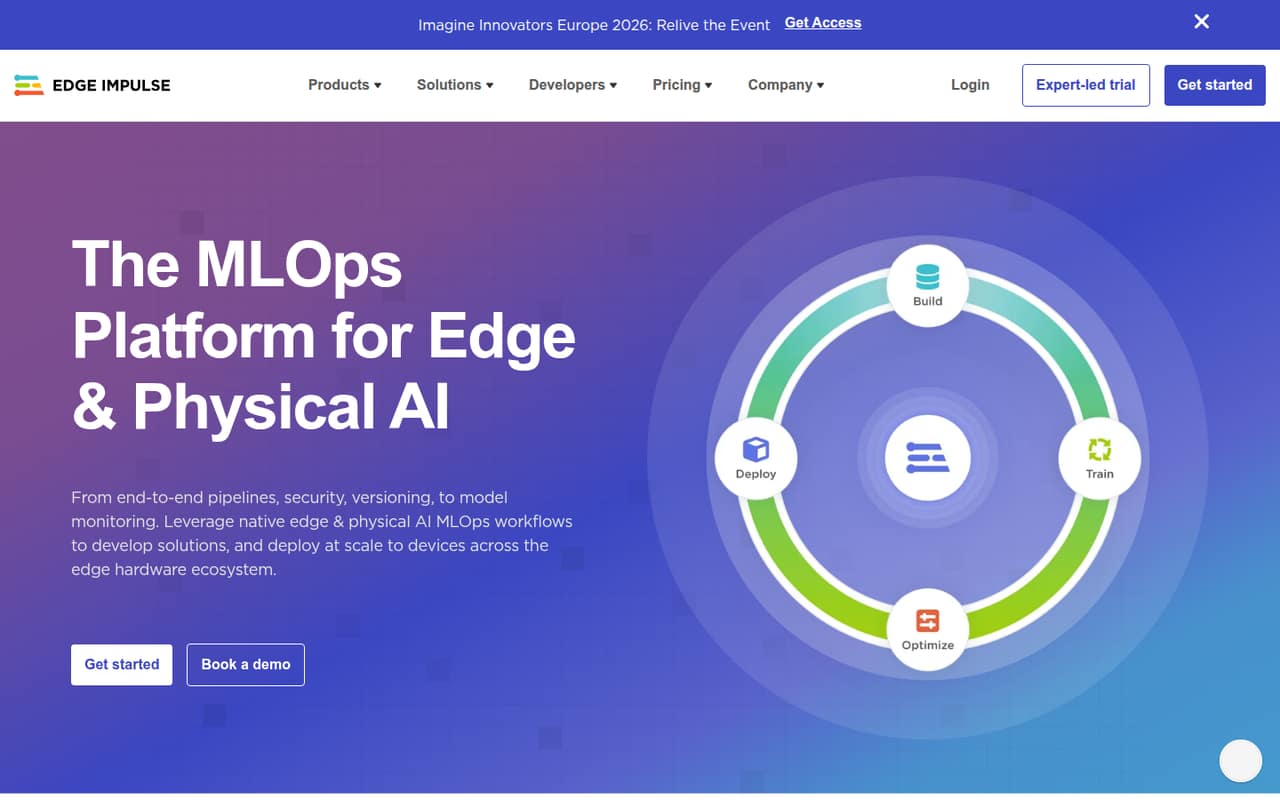
Edge Impulse is an MLOps development platform for machine-learning projects that run on edge devices. In a stack, treat it as the development and workflow layer: it supports work from sensor data and model development through deployment and model monitoring. It is not presented as just a model runtime or a standalone library.
The platform targets MCUs, NPUs, CPUs, GPUs, gateways, sensors and cameras. Its stated workflows cover pipelines, security, versioning and monitoring, then deployment across the edge hardware ecosystem. That makes it relevant when a team needs to move from collected device data to a model deployed on embedded or other edge hardware. The vendor also describes collaboration features for product development. The homepage names Arduino, Qualcomm and NVIDIA among its integrations, but teams should check the vendor’s docs against their exact board, model format and deployment path before choosing it as a core part of the stack.
02Edge Impulse API, SDKs and docs
The homepage presents a platform-centered workflow, with Docs, Projects and Forum links for developers. It names Arduino, Qualcomm and NVIDIA integrations, but does not name a programming language or SDK. Confirm in the vendor’s docs which language SDKs are supported, and whether a REST API, CLI, webhooks or plugins are available for your integration needs. Do not assume those interfaces exist based on the platform description alone.
The documented product workflow is broad: use sensor data to develop models, then deploy them across edge hardware and monitor models. The homepage also describes end-to-end pipelines, security and versioning. These features can reduce the amount of workflow tooling a team needs to assemble, but the actual code integration still depends on the device and supported deployment route. Before committing, check board-specific instructions, model export options and the maintenance path for generated device code. The homepage’s Arduino integration makes that ecosystem a useful place to start validating fit.
03Edge Impulse pricing for developers
The Developer plan costs $0 per month. It includes three private projects, unlimited public projects, 10 experiments per project and up to three collaborators per project. Each job gets 60 compute minutes and 16GB of CPU memory. That is a useful entry point for evaluation and smaller work, but the experiment and per-job compute limits matter if you train frequently or run larger workloads.
Enterprise pricing is custom. Its listed inclusions are 10 or more private projects, unlimited public projects, unlimited experiments and compute time, enterprise-wide collaboration, and up to 1,000 production units with an active Production Phase subscription. It also lists up to 120 minutes of synthetic testing data. The Production Phase subscription is an additional requirement for production deployment and external distribution; its price is not published. White labeling requires another license, and premium support is available, but neither price is published. Annual billing and Enterprise billing terms are not published, and no overage rates are listed. Ask for a quote that covers production units, support and any white-label requirements.
04Edge Impulse: open source, self-hosting and lock-in
Edge Impulse is presented as a platform, but the vendor does not publish a license or self-hosting option in the pricing details available here. The terms for exporting project data and moving models or workflows to another tool also need confirmation. Do not treat the platform as open source or assume it can run inside your own infrastructure without checking with the vendor.
Migration risk depends on what your team stores and builds in the platform. Before adoption, establish which datasets, labels, models, generated code and project metadata you can export, in what formats, and whether those exports remain usable without an active account. Also ask whether deployed models can continue running independently of the platform. If portability is a requirement, test the full export and rebuild path as part of procurement rather than relying on a general claim of device support.
05Edge Impulse in production
The Developer plan is not an unlimited production tier: it limits projects, experiments, collaborators and compute per job. Enterprise lists unlimited compute and experiments, but production deployment and external distribution require an active Production Phase subscription. Its price is not published, and the plan lists up to 1,000 production units. Confirm how units are counted, what happens above that limit and which support and service terms apply before rollout.
Reddit users report device-level integration problems, including a classifier failure tied by a commenter to TensorFlow Lite tensor-arena allocation and an ESP32-S3 camera capture issue involving board configuration. Other commenters offered troubleshooting steps, and one reported getting the code running. These are individual reports, not evidence of a platform-wide reliability issue, but they show that generated model code still has to fit device memory, camera setup and board-specific pin configurations. Validate the exact hardware and deployment path, and ask the vendor about security, compliance, uptime and incident support requirements.
From the threadsWhat users say
Reddit discussion is mixed: users describe hands-on troubleshooting and helpful replies, alongside device-specific failures that can take time to resolve. The small set of comments points to integration friction rather than a clear verdict on the platform as a whole.
failed to run classifiers and I'm really trouble by this because I didn't sleep all night
Real experience with a real person.. ;)
The example code has lots of different board definitions you can try if you need
I managed to run this code smoothly
Questions people ask
Is Edge Impulse free?
Yes. The Developer plan is listed at $0 per month. It includes three private projects, unlimited public projects, 10 experiments per project and up to three collaborators per project. Each job is limited to 60 compute minutes and 16GB of CPU memory. Enterprise pricing is custom.
What are Edge Impulse’s free-tier limits?
The Developer plan allows three private projects and unlimited public projects, with 10 experiments per project and up to three collaborators per project. Each job includes up to 60 compute minutes and 16GB of CPU memory. The pricing details do not list overage rates, so ask the vendor how work is handled when a project hits those limits.
What hardware does Edge Impulse support?
The homepage names MCUs, NPUs, CPUs, GPUs, gateways, sensors and cameras as part of its edge hardware ecosystem. It also lists Arduino, Qualcomm and NVIDIA integrations. Confirm that your exact board, sensor and deployment configuration are supported in the vendor’s docs before starting a production project.
Does Edge Impulse provide an API or SDK?
The homepage links to developer docs, projects and a forum, and names Arduino, Qualcomm and NVIDIA integrations. It does not name programming languages or SDKs. Check the vendor’s docs for the specific language SDK, REST API, CLI or other interface your codebase needs before designing an integration around it.
Can I self-host Edge Impulse or export my data?
The vendor does not publish a self-hosting option, open-source license or data-export terms in the pricing details available here. Ask which datasets, models, generated code and project metadata can be exported, whether they remain usable outside the platform, and whether your deployed models need an active account.
Sources
- Edge Impulse homepage
- Edge Impulse pricing page
- Reddit: Hello everyone, so I have a problem with my code from edge impulse it is saying failed to run classifiers and I'm really trouble by this because I didn't sleep all night cause after I fixed 1 problem it just give me another problem. Im willing to learn can anyone plss teach me or help me fix my code
- Reddit: ESP32-S3-Cam 'Camera capture failed' with Edge Impulse
- Reddit: We tested on-device object detection on an ESP32-S3 camera using Edge Impulse