
We may earn a commission if you buy through links on this page. It never changes a score or a ranking. How we make money
The bottom line
A managed or self-hosted Iceberg query platform; budget around DCU use and validate migration paths.
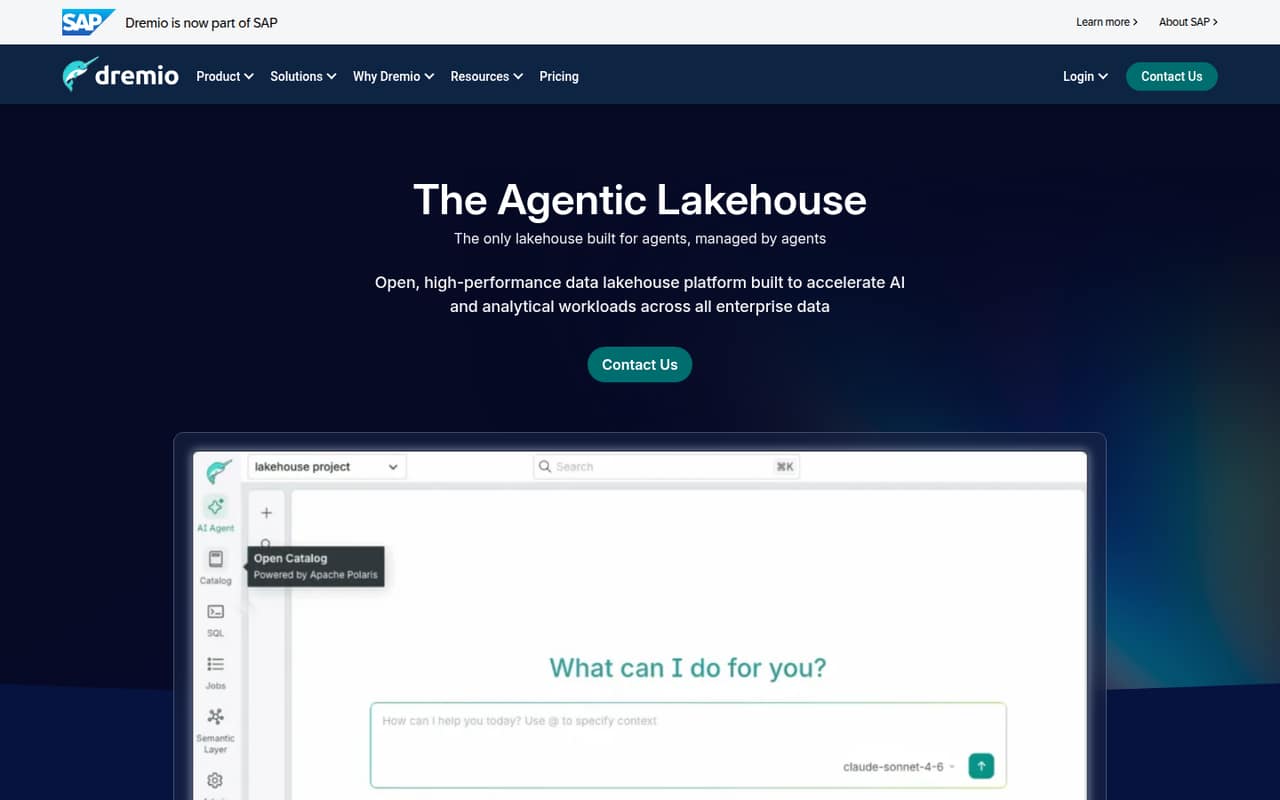
Dremio combines a query engine, semantic layer, Apache Polaris catalog and AI agent for analytics and agent access to enterprise data. It supports managed cloud and self-managed deployments, with MCP connectivity and a CLI for coding agents.
Cloud pricing is $0.20 per DCU pay-as-you-go, with a 30-day trial and $400 credit. Reddit discussions are mixed: some users value the platform and its Iceberg focus, while others flag self-hosting costs and a confusing product pitch.
Good fit if
- Teams building on Apache Iceberg
- Analytics teams connecting AI agents
- Organizations needing deployment control
Skip it if
- Teams seeking a published fixed bill
- Small deployments needing zero operations
- Buyers requiring a named open-source license
ScoresHow it rates
What works
- Queries Iceberg data without format conversion
- Apache Polaris supports Iceberg REST engines
- MCP connects named AI agents
- CLI gives coding agents lakehouse access
- Fine-grained and role-based access controls
What doesn't
- Enterprise consumption rate is not published
- Cloud pricing is tied to DCU consumption
- Self-managed upgrades and scaling are manual
- License and export procedures need confirmation
- Reddit users report self-hosting can be expensive
01What Dremio is, technically
Dremio is a lakehouse query platform offered as a managed cloud service or self-managed software. It sits between data stored in lakehouse formats and the analytics tools or AI agents that need to query it. Its components include an Arrow-based query engine, an AI semantic layer, an Apache Polaris catalog and a built-in AI agent.
The engine queries Apache Iceberg data natively, without format conversion. Dremio also describes federating queries across data sources without moving data, and querying structured, semi-structured and unstructured data. Polaris supports read and write across Iceberg REST engines, giving teams a catalog layer for Iceberg interoperability.
For cloud users, Dremio manages infrastructure on AWS and lists automatic upgrades and scalability. The Enterprise option is self-managed on Kubernetes or AWS, Azure and GCP, with manual upgrades and scaling. The platform is intended to serve analytics and AI workloads over enterprise data; it is not just a client library or an agent SDK.
02Dremio API, SDKs and docs
The homepage names MCP as the integration surface for connecting agents, including Claude, ChatGPT and Gemini. Dremio also offers a CLI that gives coding agents such as Claude Code and Codex direct lakehouse access. The catalog supports the Iceberg REST protocol through Apache Polaris, but that is a catalog interoperability surface, not a general-purpose Dremio API description.
The product page names no programming languages or SDKs. Confirm supported SDKs, client libraries and authentication flows in Dremio’s developer documentation before choosing an application integration. The homepage also says Dremio connects analytics tools and BI tools, but does not name specific products in that integration claim.
For data teams, the semantic layer holds metrics, definitions and relationships for analytics and agents. Access controls are described as fine-grained and role-based, with OAuth tokens passing through credential vending to data sources. Validate the CLI’s supported operations, MCP permissions and documentation for your chosen deployment before relying on them in production.
03Dremio pricing for developers
Dremio Cloud is listed at $0.20 per DCU, pay as you go. The pricing page also lists a 30-day trial with $400 in credit and Dremio-managed AWS infrastructure. A free plan is listed, but the published offer describes the trial; ask Dremio to confirm any continuing free-tier allowance, its limits and what happens when credits run out.
Cloud cost follows DCU consumption, so query volume and workload patterns affect the bill. The pricing page does not publish a fixed monthly or annual rate, DCU consumption examples, request limits, or overage terms. Annual contracts with committed pricing are available, but the rates are not published. Estimate costs with your expected workload and ask how consumption is metered before moving production traffic.
Dremio Enterprise uses consumption-based pricing, with the rate not published. It supports self-managed deployment on Kubernetes or AWS, Azure and GCP; contact sales about a trial. No add-on prices are listed. Budget separately for the operational work of managing infrastructure, upgrades and scaling in a self-managed deployment.
04Dremio: open source, self-hosting and lock-in
Dremio calls its platform open and bases key parts of its offering on Apache Iceberg and Apache Polaris. Its homepage does not name a license for the complete Dremio product, so confirm which components are open source, their licenses and any Enterprise restrictions before planning a self-managed deployment.
Self-hosting is available through Dremio Enterprise on Kubernetes or AWS, Azure and GCP. That deployment gives organizations more control over where the software runs, but Dremio lists manual upgrades and scaling for Enterprise. A Reddit commenter describes self-hosting and scaling as expensive, so include operating costs and staffing in the comparison.
Iceberg and Iceberg REST interoperability can reduce dependence on a single table format or catalog. Dremio says data can live in open formats on an organization's object storage. The published product details do not establish a complete export or migration procedure. Ask Dremio how to export catalog metadata, semantic definitions and workload configurations, and test another engine against representative tables before committing.
05Dremio in production
Dremio says its serverless architecture scales on demand and that Autonomous Reflections use query patterns to accelerate queries without manual tuning. It also lists end-to-end caching and automatic Iceberg table optimization. These are product claims, not a substitute for validating latency, concurrency and cost with your own workload. The homepage publishes no API rate limits or service-level target; ask Dremio for current limits, availability commitments and incident procedures.
The security model includes fine-grained and role-based access controls, agent identity inheritance and OAuth tokens passed through credential vending to data sources. Map those claims to your identity provider, source systems and compliance requirements before rollout; the homepage does not name compliance certifications.
Reddit sentiment is mixed. One commenter says Dremio is expensive to host and scale yourself; another says the product pitch has changed enough to cause suspicion. A different commenter praises its cloud offering and Iceberg focus. For self-managed deployments, account for manual upgrades and scaling, and test recovery and capacity procedures before making it a critical service.
From the threadsWhat users say
Reddit sentiment is mixed: commenters cite Iceberg strengths and a solid cloud option, alongside concerns about self-hosting costs and product positioning. The comments are opinions, not workload benchmarks.
Dremio is great but it is expensive to host and scale yourself
They have been around for ages but switch their pitch so often that it makes me feel suspicious
after restructuring they dominate in the iceberg space and their cloud offering is pretty strong nowadays
you're not going to know which one is superior for your use case without implementing them and testing them with your real-world workloads
Questions people ask
How much does Dremio Cloud cost?
Dremio Cloud is listed at $0.20 per DCU, pay as you go. The pricing page lists a 30-day trial with $400 in credit. Annual contracts with committed pricing are available, but their rates are not published. Ask Dremio how your expected workload maps to DCU consumption and what terms apply after trial credits are used.
Does Dremio have a free plan?
A free plan is listed, and Dremio promotes a 30-day Cloud trial with $400 in credit. The trial terms do not establish the ongoing limits or conditions of a continuing free tier. Confirm the available allowance, credit expiry and billing behavior with Dremio before connecting production workloads.
Can I self-host Dremio?
Yes. Dremio Enterprise is available as self-managed software on Kubernetes or AWS, Azure and GCP. The pricing information describes Enterprise upgrades and scaling as manual and uses consumption-based pricing, with the rate not published. Contact Dremio for a trial and current pricing, then account for infrastructure and operational work.
Does Dremio work with Apache Iceberg?
Dremio describes its engine as Iceberg-native and says it queries Iceberg data without format conversion. Its Apache Polaris catalog supports read and write across Iceberg REST engines. The platform also lists automatic Iceberg table optimization. Validate compatibility with your catalog, engines and table workloads before adopting it.
Can AI agents connect to Dremio?
Dremio lists MCP integration for agents including Claude, ChatGPT and Gemini. Its CLI gives coding agents such as Claude Code and Codex direct lakehouse access, and its built-in AI agent is described as ready out of the box. Confirm authentication, permission inheritance and supported operations for your deployment.