We may earn a commission if you buy through links on this page. It never changes a score or a ranking. How we make money
The bottom line
DreamFactory turns enterprise data sources into governed REST and MCP APIs, but production pricing is substantial.
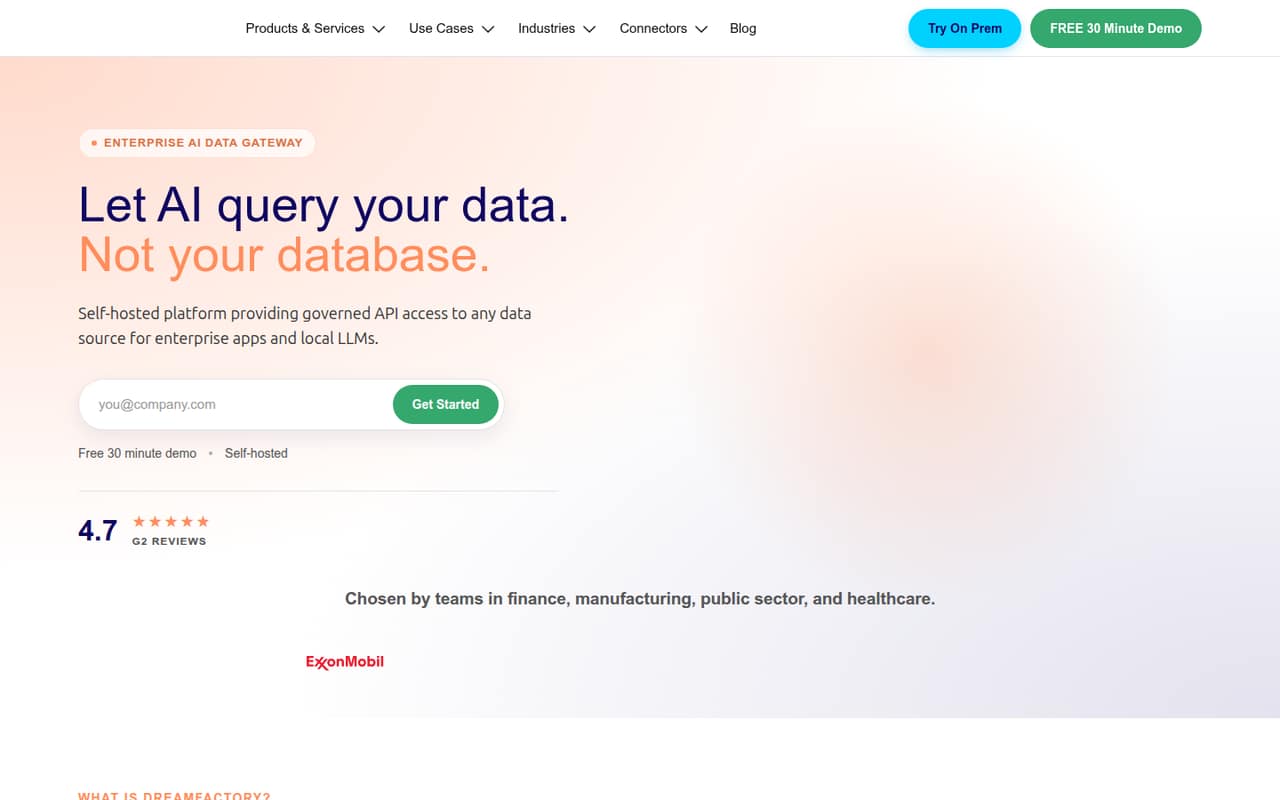
DreamFactory is a self-hosted API gateway that puts governed REST and MCP access between enterprise data and applications or local LLMs. Its broad connector set, identity controls and deployment options suit organizations that need to keep data access inside their environment.
The free Open Source plan is limited to PostgreSQL, while paid plans start at $1,500/month billed annually. Reddit reports are mixed: one user describes a service-rename issue, while another says clearing the affected service cache resolves the API rename behavior.
Good fit if
- Teams wrapping databases and legacy systems
- Self-hosted enterprise AI data access
- Organizations reusing existing identity controls
Skip it if
- MySQL users seeking a free tier
- Teams needing published SDK details
- Small projects on tight budgets
ScoresHow it rates
What works
- Generates REST APIs across databases, files, SaaS and legacy systems
- Provides REST and MCP access with policy controls
- Supports on-prem, private cloud, edge and hybrid deployment
- Maps to existing identity, roles and entitlements
- Includes routing, rate limits, throttling and observability
What doesn't
- Free Open Source plan includes only a PostgreSQL connector
- Paid plans start at $1,500/month, billed annually
- Vendor does not publish separate month-to-month prices
- SDK and programming-language support needs confirmation
- A Reddit user reports service renaming can break an API
01What DreamFactory is, technically
DreamFactory is a self-hosted server and API gateway, not a hosted API service, client library or command-line tool. It sits between applications or local and on-prem LLMs and the data sources they need to access. The platform generates standardized REST APIs over databases, file stores, SaaS and legacy systems, and also provides MCP access for AI agents.
That layer centralizes authentication, role-based access, request controls and audit visibility instead of giving each application or model direct database credentials. The vendor says credentials stay within DreamFactory and that the platform maps to existing security infrastructure and preserves roles and entitlements. Deployment options include on-prem, private cloud, edge and hybrid environments.
For a team, the architectural tradeoff is clear: DreamFactory adds a server to operate, but can replace hand-built connectors and place a consistent policy boundary around varied backends. It is aimed at governed data access and API generation, rather than general-purpose API hosting.
02DreamFactory API, SDKs and docs
The primary integration surface is generated REST APIs: DreamFactory creates a consistent API layer over connected data sources. For AI workflows, the vendor also describes MCP access, with MCP tools backed by DreamFactory APIs. Its homepage lists more than 30 connectors, including PostgreSQL, MySQL, SQL Server, Oracle, DynamoDB, MongoDB, S3, Azure Blob, SFTP, Salesforce, REST and SOAP services.
The homepage links to an API Generation guide and API Management concepts, and describes automatic API creation and testing. Its stated gateway controls include routing, authentication, rate limits and observability. The vendor homepage does not name programming-language SDKs or a CLI. Teams planning to build around a particular language should confirm SDK support in the vendor's docs and check how generated API schemas and authentication fit their clients.
This makes the integration model API-first: connect a backend, configure access, then call its generated endpoints. Confirm connector-specific behavior, write support and MCP requirements before choosing a production architecture.
03DreamFactory pricing for developers
The Open Source plan is free and includes a PostgreSQL connector. The pricing page lists DF Linux Lite at $1,500/month, billed annually, with one database connector and unlimited roles, keys, API creation and requests. DF Linux Professional is $4,000/month, billed annually; it adds unlimited connectors and includes all connectors except Oracle, Snowflake and DB2.
Docker/Kubernetes plans start at $6,000/month, billed annually, at 4 vCPU, with each additional vCPU listed at $1,500. They include all connectors and API scripting, authentication, rate limiting, network APIs, logging and governance. Custom-priced enterprise and federal plans are also listed. The page gives no separate month-to-month prices.
The listed plans specify unlimited requests, so the published pricing does not describe per-request overages. Compute can still raise the bill on Docker/Kubernetes deployments as vCPU needs grow. Support is an add-on: Basic is listed at $500/month billed annually; Pro and Enterprise each show two prices on the page, so confirm the applicable rate and terms with the vendor before budgeting.
04DreamFactory: open source, self-hosting and lock-in
DreamFactory offers a free plan labeled Open Source and paid self-hosted deployments, including Linux, Docker and Kubernetes options. The vendor's homepage describes on-prem, private cloud, edge and hybrid deployment, so the product is not limited to a vendor-hosted service.
The vendor does not publish the software license terms on the homepage. Confirm which components and connectors are covered by the license, and whether the free plan permits your intended production use, before adopting it. A plan labeled Open Source does not by itself establish the license or source availability for every edition.
DreamFactory creates REST interfaces over existing systems, but the vendor does not describe a data-export or configuration-export process on its homepage. Your source data remains in its connected systems, but moving the API layer means recreating endpoint, policy and connector configuration elsewhere. Ask about export formats and migration support before building extensive service-specific configuration.
05DreamFactory in production
DreamFactory lists rate limits, throttling, quotas, logging, observability, request validation and threat protection as gateway controls. Its identity and role features are intended to keep existing entitlements in force, and the vendor positions the platform for sensitive enterprise data. Teams should validate connector behavior, authorization rules, audit coverage and capacity under their own workloads before putting production traffic behind it.
The pricing page lists unlimited requests for several paid plans, but does not publish request-rate ceilings or service-level commitments. Docker/Kubernetes pricing starts at 4 vCPU and charges $1,500 per additional vCPU, so deployment sizing affects cost. Ask the vendor for supported scaling patterns, operational requirements and reliability commitments for your chosen plan.
A Reddit user reports that renaming a service broke an API; another commenter says renaming can work after flushing the affected service cache. Treat cache behavior and configuration changes as release checks, and test rename or deployment workflows in a non-production environment before relying on them.
From the threadsWhat users say
The small set of Reddit comments is mixed. One user reports a service-renaming problem; another describes a cache-flush workaround and says a fix was ticketed.
I've used DreamFactory. It has a few quirks. For Example if you setup a API and then rename services it will break
I just updated the rows in the database. It wasn't a big deal but wasn't helpful
you will need to clear the service cache because for performance reasons DreamFactory caches API settings
The free version doesn't support MySQL and I need something similar that supports MySQL
Questions people ask
How much does DreamFactory cost?
The free Open Source plan includes a PostgreSQL connector. Paid plans start with DF Linux Lite at $1,500/month billed annually. DF Linux Professional is listed at $4,000/month, and Docker/Kubernetes plans start at $6,000/month for 4 vCPU, billed annually. Additional vCPU is listed at $1,500.
Does DreamFactory have a free plan?
Yes. The pricing page lists a free Open Source plan with a PostgreSQL connector. It does not list MySQL in that plan. The vendor labels the plan Open Source, but confirm the software license and permitted use with the vendor before relying on it for a production deployment.
Can I self-host DreamFactory?
Yes. The vendor describes on-prem, private cloud, edge and hybrid deployment. Paid options include Linux, Docker and Kubernetes plans. Confirm the deployment requirements and compute sizing for your environment; Docker/Kubernetes pricing starts at 4 vCPU, with additional vCPU listed at $1,500.
Does DreamFactory support MCP?
Yes. The vendor describes MCP access to enterprise data, with MCP tools backed by DreamFactory APIs. It positions this as a governed path for AI agents to access data through policy-controlled APIs rather than direct database connections. Confirm the MCP setup and supported model architecture with the vendor.
What happens if I rename a DreamFactory service?
A Reddit user reports that renaming services broke an API. Another commenter says to flush the affected service cache after renaming and reports adding a ticket for automatic cache flushing. Test this workflow in a non-production environment and verify the current behavior with the vendor before making service renames part of a release process.