
We may earn a commission if you buy through links on this page. It never changes a score or a ranking. How we make money
The bottom line
Dots combines global payouts, payee onboarding and tax workflows behind a hosted API.
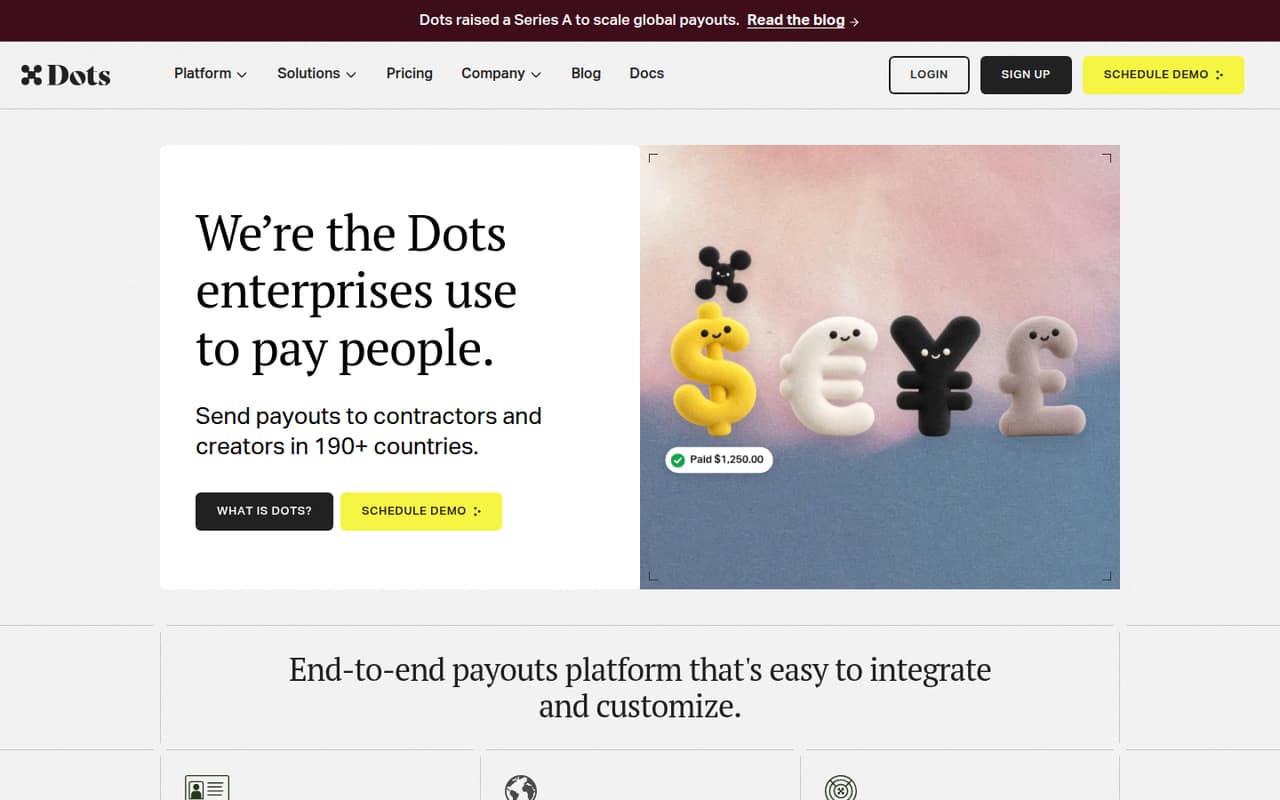
Dots is a hosted, API-first platform for paying contractors, creators and other recipients. It combines payouts across 190+ countries and 300+ rails with payee onboarding, identity checks and tax workflows for the US and Canada.
The platform has a no-code dashboard and white-label recipient flows, but Core and Scale have monthly fees plus transaction charges. Confirm API integration details, limits and export options with Dots before making it a core payment dependency.
Good fit if
- Platforms paying recipients internationally
- Teams consolidating payout and tax workflows
- Products needing branded recipient onboarding
Skip it if
- Projects that require a free tier
- Teams requiring self-hosted payment infrastructure
- Developers needing published rate limits upfront
ScoresHow it rates
What works
- Coverage across 190+ countries and 300+ rails
- Payouts, onboarding and tax workflows in one platform
- White-labeled recipient onboarding and payout options
- Automatic payout routing and payment tracking
- Scale includes dedicated support and recipient support
What doesn't
- Core and Scale require monthly plan payments
- Transaction fees add to plan costs
- Enterprise transaction fees require a sales quote
- API rate limits and reliability targets need confirmation
- Source availability and data export options are unclear
01What Dots is, technically
Dots is a hosted payout API and SaaS platform, not a payment library, CLI or self-hosted server. It sits between a business's application and the people it pays: the business uses Dots to onboard recipients, collect payout details, initiate payments and track transfers. The vendor says the platform supports 190+ countries through 300+ payment rails.
The product also includes a dashboard and recipient-facing flows. Dots Onboard can collect payout information, verify identity and screen against sanctions lists. Dots Tax collects and validates tax information and supports filing forms in the US and Canada. White-label options range from a hosted recipient experience to embedded components and wallets, according to the product details. This makes Dots relevant to marketplaces, creator platforms and other services that need to move money to external recipients without building every payout and compliance workflow themselves. The platform is managed by Dots; it is not positioned as infrastructure you run inside your own environment.
02Dots API, SDKs and docs
The main developer integration surface is the Dots Payouts API. The homepage links to complete API documentation and describes the API as a way to integrate payouts into an application. It also presents payout automation, payment tracking and reporting as platform capabilities. Use the API docs to confirm supported SDKs, languages, authentication, request patterns and any webhook support before choosing an integration approach.
Dots also offers a dashboard, payout links and white-labeled recipient onboarding. The product details describe no-code setup, a one-line embed, drop-in components and white-labeled wallets. Those options can reduce the amount of recipient-facing UI a team must build, while the API supports application-level integration. Dots does not name a CLI or specific programming-language SDKs in its homepage material, so confirm SDK support in the vendor's docs. The key implementation questions are how your system creates and reconciles transfers, handles failed payments and receives status changes; verify the relevant API behavior and examples with Dots before production.
03Dots pricing for developers
Dots has no listed free plan or free trial. Dots Core starts at $19 per month and includes domestic and international payouts, ID verifications and 1099 tax compliance. Its transaction charges include $2 for domestic payouts and 3.9% + $2 for international payouts. Other listed Core charges include $5 for 1099s, $5 for ID verification and $40 for international wires.
Dots Scale costs $999 per month and adds API access, wallets, a white-labeled experience, an assigned support contact and 24/7 recipient support. Its listed payout charges are $1 for domestic payouts and 2.9% + $1 for international payouts. Push-to-card, crypto, tax and wire fees are separate. Dots Enterprise has no published monthly price; transaction fees are quoted by sales. The pricing page lists monthly plan prices but does not state whether annual billing is available. Model fees against payout volume and rail mix rather than treating the monthly plan price as the full cost.
04Dots: open source, self-hosting and lock-in
Dots presents itself as a managed platform accessed through its API and dashboard, not as a self-hosted server or installable library. The vendor does not publish a source-code licence or describe an open-source edition in the product material, so teams should treat Dots as hosted infrastructure unless the vendor confirms otherwise.
The vendor also does not describe data-export formats or a migration path. Ask how to export recipient records, tax data, transfer history and reconciliation reports, and whether those exports remain available after a contract ends. Moving away would likely require replacing the payout integration and reworking recipient onboarding, payment status handling and tax workflows. The difficulty depends on how much of the application is built around Dots-specific flows and data. Keep an internal record of payment states and recipient identifiers where permitted, and confirm contractual access to historical records before relying on the platform.
05Dots in production
Dots says it supports 190+ countries and 300+ rails, with automatic routing intended to select a fast, cost-effective rail. That reach does not remove the need to verify which payout methods are available for your recipient countries, currencies and business model. Dots also advertises identity checks, sanctions screening and tax collection, with tax filing in the US and Canada; confirm which checks and filings apply to your use case.
Before launch, ask Dots for API rate limits, retry and idempotency behavior, payment-status guarantees, uptime targets and incident procedures. The public product details do not publish those limits or service targets. Confirm how exchange rates and fees are presented, how failed or returned transfers are handled, and what reporting or data exports your reconciliation process can use. The platform's support offer differs by plan: Scale lists an assigned support contact, a dedicated Slack channel and 24/7 recipient support. Include those operational terms, transaction fees and country coverage in production planning.
Questions people ask
What does Dots do?
Dots provides a hosted payout API and dashboard for businesses paying contractors, creators and other recipients. The platform combines global payouts with recipient onboarding, identity checks, sanctions screening, tax information collection and payment tracking. Dots says its payout coverage spans 190+ countries and 300+ rails.
Does Dots provide an API?
Yes. Dots promotes a Payouts API for integrating payout workflows into an application and links to API documentation. The vendor's homepage does not name particular SDKs or programming languages. Confirm supported SDKs, API patterns and any webhook options in Dots' documentation before implementation.
What countries and payment rails does Dots support?
Dots says it supports payouts in 190+ countries through 300+ rails, including local methods such as bank transfers, mobile money and digital wallets. Availability depends on the destination and payment method. Check Dots' coverage information for the countries, currencies and specific rails your recipients need.
Can Dots handle tax compliance?
Dots Tax collects and validates tax information and supports filing tax forms in the US and Canada. Dots Core includes 1099 tax compliance, with separate listed charges for 1099s and mailing. Confirm which forms, filing services and recipient situations are covered for your business.
Can I self-host Dots?
Dots is presented as a managed API and SaaS platform, not as a self-hosted server. The vendor's product material does not describe an open-source or self-hosted edition. If deployment control or data residency is a requirement, ask Dots about its hosting, data handling and export options before signing up.