
We may earn a commission if you buy through links on this page. It never changes a score or a ranking. How we make money
The bottom line
A centralized secrets service for teams and agents, with cloud and enterprise on-prem deployment.
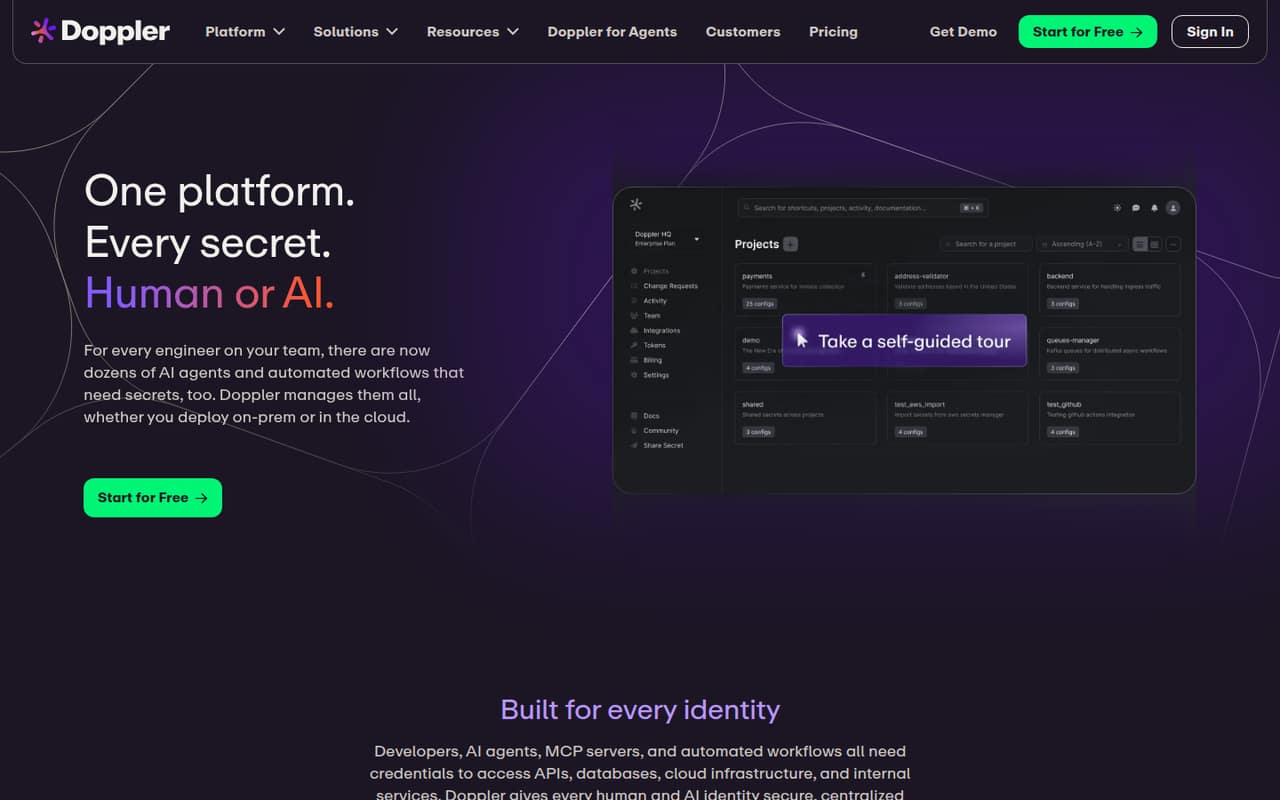
Doppler is a secrets management platform with a dashboard, API and CLI. It centralizes credentials for developers, automated workflows and AI agents, with integrations across cloud platforms, Kubernetes and CI/CD. Its MCP server and agent-scoped access target teams that need to control credentials used by AI tools.
The Developer plan is free for three users, and Team costs $21 per user per month. Enterprise adds cloud or on-prem deployment and custom rate limits. Check export and migration options, deployment terms, and the limits that apply to your workloads before putting it in a critical path.
Good fit if
- Teams centralizing application secrets
- Workflows and agents needing credentials
- Teams using Kubernetes and CI/CD
Skip it if
- Projects requiring a verified open-source licence
- Teams needing published API rate limits
- Teams requiring published export formats
ScoresHow it rates
What works
- Free Developer plan for up to three users
- MCP server supports native agent secret requests
- OIDC-scoped service accounts separate agent access
- Integrations span cloud, Kubernetes and CI/CD
- Enterprise supports cloud or on-prem deployment
What doesn't
- Developer plan limits projects, environments and syncs
- Team add-ons can increase per-seat costs
- Enterprise pricing is custom
- Programming languages and SDKs are not named
- Source licence and export details need confirmation
01What Doppler is, technically
Doppler is a secrets management platform: a dashboard and API for centralizing credentials, plus a command-line tool and integrations that deliver them to applications and workflows. It sits between the people and services that manage secrets and the applications, infrastructure and automation that consume them. Rather than keeping credentials scattered across project files and deployment systems, teams manage them in one place and control access by identity.
The platform is designed for human users as well as non-human identities, including AI agents and automated workflows. Its MCP server lets agents request secrets without custom scripts or hardcoded credentials, while OIDC-scoped service accounts give each agent its own access. Doppler also offers dynamic secrets that issue fresh credentials on deploy and revoke them automatically. Deployment can be in Doppler's cloud or, on Enterprise, on-prem. It is a service in the application stack, not a secrets library that replaces the need to configure secret delivery in each workload.
02Doppler API, SDKs and docs
Doppler offers a dashboard, API and CLI, with integrations across cloud platforms, Kubernetes, CI/CD, webhooks and SDKs. The homepage does not name programming languages or specific SDK packages, so confirm SDK support for your language in Doppler's docs before choosing an integration path. It also does not describe the API protocol or style; check the API documentation for authentication, request formats and versioning details.
The CLI and integrations give teams options for connecting secret management to developer workflows and deployment pipelines. The MCP server is the native path described for AI agents to request secrets, rather than relying on custom scripts or hardcoded credentials. Doppler also supports agent-scoped access through OIDC-scoped service accounts. Map those identity controls to your CI/CD jobs, runtime workloads and agents, and verify that the integrations cover your deployment targets. The vendor describes broad integration categories, but teams should check the docs for the specific connector and setup steps they need.
03Doppler pricing for developers
The Developer plan is free for three users and includes 10 projects, four environments, five config syncs and three days of activity logs. Each additional user costs $8 per month. That makes it a workable starting point, but teams can hit project, sync or log-retention limits as they move toward production.
Team costs $21 per user per month and includes a 14-day free trial, 250 projects, 15 environments, 100 config syncs and 90 days of activity logs. The bill scales with human seats, not the number of AI agents; the homepage says there is no per-agent charge. Team add-ons cost $9 per seat per month each for custom roles and user groups. Integration syncs cost $9 per seat per month and raise the limit from 100 to 500. Enterprise has custom pricing, unlimited config syncs, custom activity-log retention and custom rate limits. The pricing page lists monthly prices and does not publish annual rates.
04Doppler: open source, self-hosting and lock-in
Doppler offers cloud deployment and an on-prem option on Enterprise, so it is not limited to a hosted-only setup. On-prem availability is not the same as an open-source release: the vendor doesn't publish a source licence or source-availability policy. The vendor doesn't publish a data-export format, so ask how secrets, configuration history and audit records can be exported before signing up.
Doppler centralizes secrets and connects them to workloads through integrations, the CLI, API and MCP server. Moving away would mean replacing those connections, re-establishing access controls and rotating or transferring credentials. The effort will depend on how many applications, pipelines and agents rely on Doppler-specific integrations. Keep an inventory of secret consumers and confirm migration support and export options with the vendor before making it the only path to production credentials.
05Doppler in production
Doppler says it logs and traces secret access by humans and AI, and identifies the platform as SOC 2 / ISO 27001 compliant. Dynamic Secrets issue a fresh credential on deploy and revoke it automatically. These features can support audit and credential-rotation workflows, but teams should confirm how they map to internal controls and the specific systems they operate.
Plan limits matter when sizing a production deployment. Developer includes five config syncs and three days of activity logs; Team includes 100 config syncs and 90 days. Enterprise offers unlimited config syncs, custom log retention and custom rate limits. The pricing information does not publish API rate limits for Developer or Team, so ask the vendor about expected request volume and throttling behavior. Doppler reports 99.99% historical annual uptime on its homepage; Enterprise lists a 99.95% SLO. Clarify which service commitments apply to your deployment and plan.
Questions people ask
What does Doppler do?
Doppler centralizes application secrets and manages access for people and non-human identities. Teams can use its dashboard, API, CLI and integrations to deliver credentials to applications, cloud platforms, Kubernetes, CI/CD pipelines and automated workflows.
Can AI agents access secrets through Doppler?
Yes. Doppler's MCP server lets AI agents request secrets natively without custom scripts or hardcoded credentials. The platform also describes OIDC-scoped service accounts that give each AI agent its own access, plus audit logging for secret access by humans and AI.
Can I deploy Doppler on-prem?
Doppler supports cloud or on-prem deployment on Enterprise. The Developer and Team plan details list no on-prem option. Confirm deployment requirements, pricing and the support model with the vendor if on-prem hosting is a requirement.
Does Doppler charge for AI agents?
The homepage says Doppler does not charge per agent: its pricing is user-based, and deploying more agents does not change the cost. Human seats still affect the bill. Developer includes three users free, while additional Developer users cost $8 per month each.
What should I check before adopting Doppler?
Check that the API, CLI and integrations fit your applications and deployment targets. Confirm SDK support for your language, plan limits, production rate limits, export and migration options, and which security or uptime commitments apply to your deployment.