
We may earn a commission if you buy through links on this page. It never changes a score or a ranking. How we make money
The bottom line
A broad live-sports platform, but paid streaming starts at $495/month and API details need confirmation.
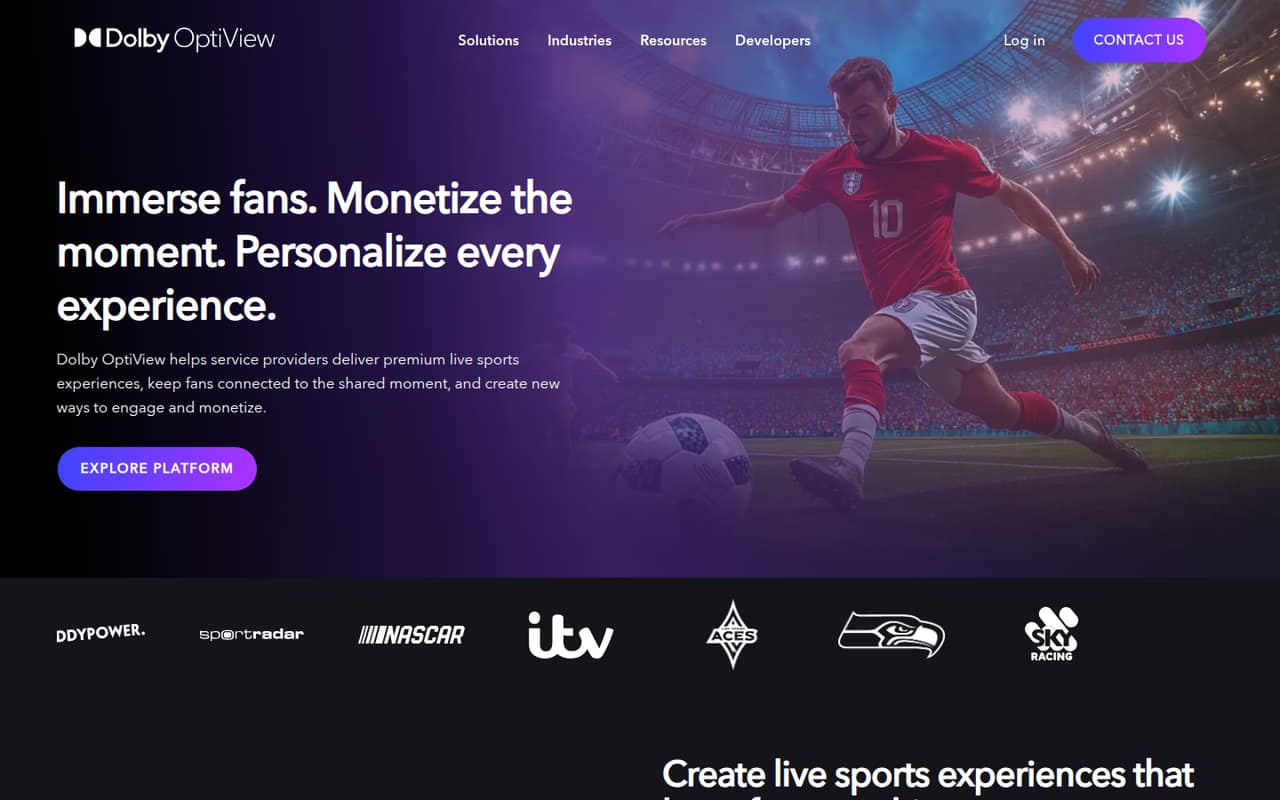
Dolby.io is a managed platform for live sports streaming, playback, advertising and fan engagement. Its Dolby OptiView products target service providers building premium experiences across devices, with separate solutions for streaming, a video player, ad insertion and Sports Intelligence.
A free tier offers 50 GiB of CDN streaming bandwidth per month, but the paid Standard streaming plan starts at $495/month. Dolby’s homepage links to documentation and customer support, but does not name SDKs, programming languages or protocols. Confirm the integration surface and production terms with Dolby before committing.
Good fit if
- Live sports service providers
- Teams needing streaming and ads
- Platforms prioritizing viewer insights
Skip it if
- Low-volume, price-sensitive streams
- Teams requiring self-hosted software
- Buyers needing published SDK details
ScoresHow it rates
What works
- Separate streaming, playback, advertising and insights offerings
- Free tier includes 50 GiB of monthly CDN bandwidth
- Standard plan includes up to 500 concurrent viewers
- Advanced and Elite plans list unlimited concurrent viewers
- Usage-based Communications and Media API pricing is available
What doesn't
- Standard streaming starts at $495/month
- OptiView plan prices are custom
- SDKs, languages and protocols are not named on the homepage
- Open-source licensing and self-hosting details are not published
- A Reddit user calls the $500 monthly cost steep for lower throughput
01What Dolby.io is, technically
Dolby.io is a managed platform for service providers building live sports streaming experiences. Dolby OptiView combines products for stream delivery, playback, advertising and fan engagement insights; it is not presented as a self-hosted server, standalone library or command-line tool. Its position in a stack is between a provider’s live content and the apps or websites where fans watch: Dolby provides streaming and player capabilities, along with advertising and viewer-metric tools.
The product targets live sports, sports betting and esports. Sports Intelligence is intended to help providers understand when fans engage or lose attention, while streaming and playback support delivery across devices. Dolby also offers ad experiences and an ad engine for insertion into live streams. The homepage describes each solution as usable on its own and stronger together. Treat the OptiView offering as a managed service, and clarify which components your deployment needs before planning an integration.
02Dolby.io API, SDKs and docs
Dolby’s homepage links to Documentation and Customer support, and presents OptiView as a set of streaming, player, advertising and Sports Intelligence solutions. The pricing information also lists consumption-based Communications and Media APIs, with charges for audio calls, video calls and media processing. These are distinct integration paths: confirm which product and API apply to a live-sports deployment rather than assuming the general API pricing covers OptiView.
The homepage does not name programming languages, SDKs, protocols, a CLI, webhooks or plugins. Use Dolby’s documentation as the integration entry point, then confirm the supported API surface, SDKs, authentication method, player integration requirements and deployment workflow with Dolby. For a production evaluation, ask for a representative integration guide and test the required app and device targets against the player’s documented compatibility. The site also directs prospective customers to contact the team, which is relevant because OptiView streaming, playback and advertising plans are custom.
03Dolby.io pricing for developers
The pricing page lists a Free Tier at $0/month with 50 GiB of CDN streaming bandwidth per month and a 50 GiB/month real-time streaming bandwidth option. The Standard plan is $495/month for 500 GiB of included CDN bandwidth and up to 500 concurrent viewers. Advanced costs $1,495/month and includes 5,000 GiB with unlimited concurrent viewers; Elite costs $4,995/month and includes 50,000 GiB with unlimited concurrent viewers. Enterprise pricing is custom.
Overages raise the bill as delivery grows: additional CDN bandwidth is $0.45/GiB on Standard, $0.15/GiB on Advanced and $0.09/GiB on Elite. Video archive is listed at $0.19/GiB on Advanced and $0.09/GiB on Elite. Dolby OptiView Streaming, Playback and Advertising plans are custom-priced. Separately, Pay-As-You-Go Communications and Media APIs list audio calls at $0.004/participant/minute, video calls at $0.01/participant/minute and media processing from $0.05/minute. Annual pricing is not published; confirm which pricing model applies to your use case.
04Dolby.io: open source, self-hosting and lock-in
Dolby presents OptiView as a platform for service providers and lists custom plans for streaming, playback and advertising. The vendor doesn’t publish an open-source licence, self-hosting path or data-export process on the product homepage. Plan for a vendor-managed dependency unless Dolby confirms that a component can run in your environment.
Lock-in risk depends on how much of the delivery path you build around Dolby’s player, streaming configuration, ad insertion and audience metrics. Before adopting those components, ask what stream formats and configuration data can be exported, whether viewer metrics can be retrieved in bulk, and what happens to archived video when a contract ends. Also confirm whether your team can retain its existing player or ad systems, and what migration assistance or transition period a custom contract includes.
05Dolby.io in production
The listed streaming plans put explicit limits on included CDN bandwidth: 500 GiB on Standard, 5,000 GiB on Advanced and 50,000 GiB on Elite. Standard also caps its listed concurrent-viewer allowance at 500; Advanced and Elite list unlimited concurrent viewers. Those viewer limits do not remove bandwidth limits, so model peak events and overage costs separately. The pricing page also lists archive charges on Advanced and Elite.
A Reddit user evaluating low-latency WebRTC streaming says the $500/month price felt steep because their throughput was below 500 GB. That is an individual report, not a service-wide reliability assessment, but it highlights the fixed-plan tradeoff for lower-volume workloads. Before a major event, ask Dolby for the applicable SLA, regional delivery details, security and compliance documentation, scaling behavior, support response terms and operational controls. Confirm how real-time viewer metrics and streaming configuration changes work during an event.
From the threadsWhat users say
The limited Reddit discussion is mixed: one poster questions the monthly cost for lower-volume streaming, while commenters praise other providers or point to Dolby’s hosted-player and SRT-ingest convenience. These comments do not establish broad sentiment about Dolby.io.
$500/month is a bit steep as we don't do 500GB/month throughput
Wowza has been fantastic for us in every use case
Big advantage of dolby is srt ingest and hosted player link we can just forward to client
ant media is good they are the cheapest and does the work. good documentation also
Questions people ask
How much does Dolby.io cost?
The listed Free Tier costs $0/month and includes 50 GiB of CDN streaming bandwidth monthly. Standard costs $495/month, Advanced $1,495/month and Elite $4,995/month. OptiView Streaming, Playback and Advertising plans are custom-priced. Usage-based Communications and Media APIs have separate per-participant-minute and media-processing rates.
What does Dolby.io’s free tier include?
The pricing page lists 50 GiB of CDN streaming bandwidth per month and a 50 GiB/month real-time streaming bandwidth option. The free tier does not include the higher monthly bandwidth allowances listed for paid streaming plans. Confirm how the real-time option applies to your intended product and workload before relying on it.
Does Dolby.io provide SDKs or support my programming language?
Dolby’s homepage links to Documentation and Customer support but does not name SDKs, languages or protocols. Check the vendor’s docs for the specific OptiView component you plan to use, and ask Dolby to confirm SDK availability, supported platforms, authentication and integration requirements for your application.
Can I self-host Dolby OptiView?
Dolby presents OptiView as a platform for service providers, and its streaming, playback and advertising plans are custom-priced. The vendor doesn’t publish a self-hosting option or open-source licence on the product homepage. Ask Dolby whether any components can run in your environment and what data or configuration you can export.
What should I check before using Dolby.io for a live event?
Compare expected peak bandwidth with the plan’s included CDN allowance and account for overage rates. Confirm concurrent-viewer terms, archive charges, the applicable SLA, support response expectations, regional delivery, security and compliance requirements, and how streaming configuration and real-time viewer metrics work during an event.