
We may earn a commission if you buy through links on this page. It never changes a score or a ranking. How we make money
The bottom line
A cloud and local coding agent with a useful PR workflow, but limited public detail on APIs and production limits.
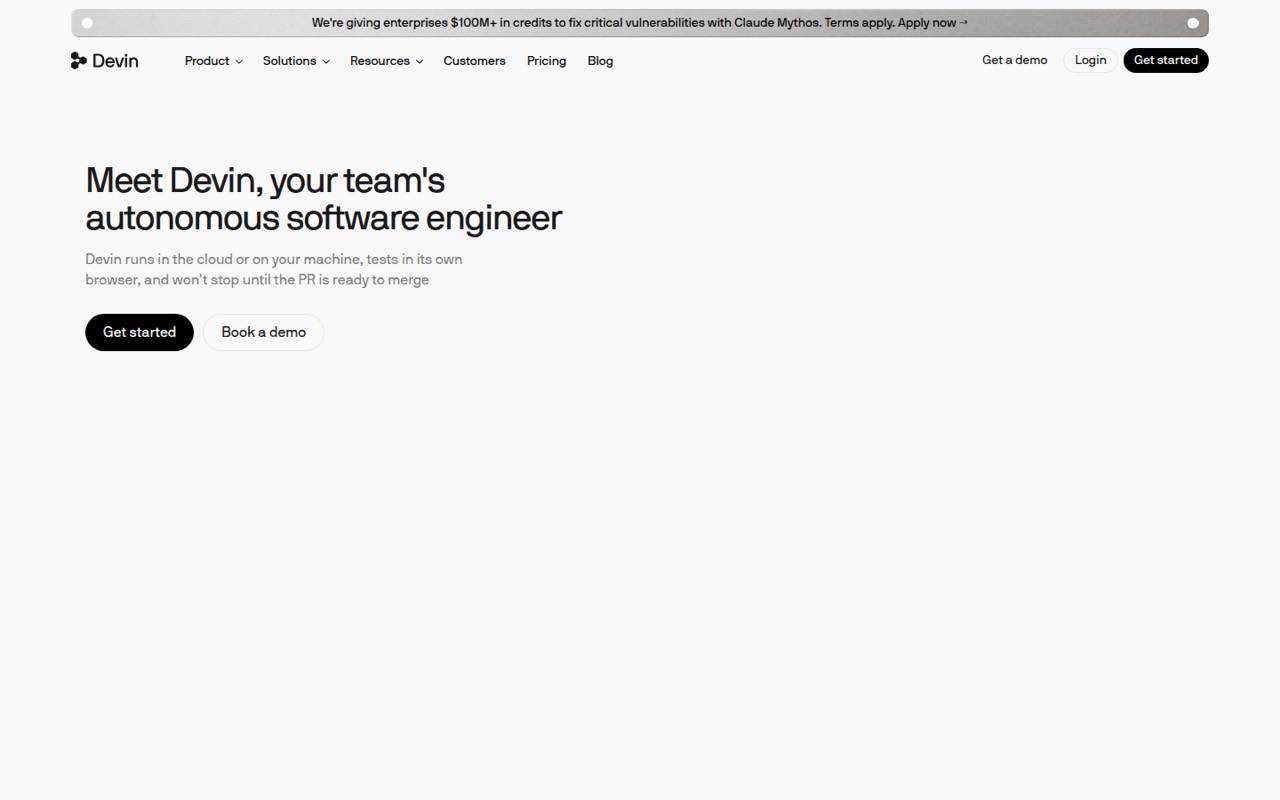
Devin is a software-engineering agent that works in cloud or local environments, tests changes in its own browser-based VMs, and opens pull requests. Slack and Teams handoffs, parallel agents, automations and Devin Wiki extend it beyond a coding chat interface.
The main trade-off is control: teams must review agent-written code and confirm quotas, integration support and production terms with Cognition. The Free plan is limited; Pro starts at $20 per month, with extra usage billed at API pricing.
Good fit if
- Teams delegating scoped repository tasks
- Slack- or Teams-based engineering support
- Teams automating routine CI fixes
Skip it if
- Developers requiring a documented public API
- Teams needing a source-available agent
- Projects needing predictable uncapped usage
ScoresHow it rates
What works
- Runs tasks in Windows, Mac and Linux virtual machines
- Tests changes in its browser before opening a PR
- Supports task handoffs through Slack and Teams
- Can run multiple cloud agents in parallel
- Devin Wiki maps architecture and updates diagrams
What doesn't
- Free plan has a light quota and limited model availability
- Extra usage is billed at API pricing
- Public product details leave API and SDK support unclear
- Source licence and data-export terms are not published
- Reddit users report model quotas can run out quickly
01What Devin is, technically
Devin is a commercial AI software-engineering agent delivered as a SaaS app, with work running in Devin Cloud or on a developer’s machine. It sits above a code repository and development environment: a user delegates a task, Devin explores code, edits files, runs builds and tests in its own browser-based virtual machine, then opens a pull request. The product is meant for work that can be specified as a task and checked through repository changes, from bug fixes and dependency upgrades to feature work and security scans.
The stack is more than a chat pane. Devin’s environment can use Windows, Mac and Linux VMs; agents can run tasks in parallel, and Devin Wiki maps architecture and updates diagrams. Slack and Teams let a developer hand work off from a thread, while automations can watch for bugs, failed CI or security alerts. That places Devin between task intake and code review—not as a replacement for repository controls, CI or human review. The PR remains the integration boundary.
02Devin API, SDKs and docs
Devin’s named integration surfaces are its web app and agent sessions, Slack and Teams handoffs, browser-based test environments, and pull requests. The vendor describes work happening in Devin Cloud or on a local machine, but the homepage does not establish a programming interface for building a custom integration. It also names no language-specific SDK, CLI, REST API or webhook workflow. Before designing around programmatic access, confirm current API, SDK and CLI support in Devin’s documentation and ask which endpoints are supported for your plan.
For day-to-day use, a developer delegates a task, reviews the agent’s changes and handles the resulting PR through the repository workflow. The product can respond when tagged in Slack or Teams and can run proactive automations for alerts. Devin Wiki provides a codebase map and diagrams. Those surfaces may reduce context switching, but teams should confirm how authentication, repository permissions, audit logs and automation triggers fit their existing stack. Model routing includes Claude, GPT and Gemini, according to the vendor's site.
03Devin pricing for developers
The Free plan costs $0 per month and includes a light usage quota, limited model availability, unlimited inline edits and unlimited Tab completions. It is a way to try the workflow, not a published allowance for ongoing team workloads. Pro costs $20 per month and adds increased quotas, full model availability, free use of SWE-2 and access to Devin Cloud agents. Extra usage is billed at API pricing; the vendor does not publish the overage rates in the listed plan details.
Max costs $200 per month and includes everything in Pro with significantly higher usage quotas. Teams costs $80 per month for the team fee, plus $40 per month for each full developer seat; the plan supports up to 200 users and includes centralized billing, an admin dashboard and priority support. Each additional full developer seat is $40 per month. Enterprise pricing is custom and includes SAML/OIDC SSO, enterprise controls and a dedicated deployment option. The pricing page lists flat monthly fees and no annual-billing discount. Confirm quota sizes and API-priced overages before budgeting production use.
04Devin: open source, self-hosting and lock-in
Devin is presented as a commercial product, not as an open-source package. Cognition does not publish a source-available licence for the agent or a standard self-hosted edition in the listed plans. Devin can run on a developer’s machine, and Enterprise includes a dedicated deployment option; ask Cognition what that deployment means for data residency, operations and control before treating it as self-hosting.
The vendor does not publish data-export or migration terms in the plan details. The code Devin writes ends up in pull requests, which gives teams a familiar way to retain and review changes. Sessions, automations and Devin Wiki are more product-specific surfaces, so ask how to export their records and architecture data if you may leave. Lock-in risk depends on how much your process relies on those features and on any undocumented integration interface. Confirm repository access, retention, deletion and export terms in the contract.
05Devin in production
Devin’s cloud agents, parallel task handling and alert-driven automations are designed for delegated engineering work, but teams still need ordinary production controls: scoped repository permissions, mandatory review, CI checks and a way to stop or roll back unwanted changes. The listed plans describe quotas but not their numeric sizes, reset rules, rate limits or API overage rates. Ask Cognition for those figures, along with service availability commitments, data retention, audit logging and security documentation.
Enterprise lists SAML/OIDC SSO, centralized controls and a dedicated deployment option; Teams and Enterprise list priority support. The public plan details do not give compliance certifications or an SLA, so confirm requirements directly. Reddit reports are mixed: one commenter says Devin’s Slack bot works well for internal customer support, while another reports that a few prompts can exhaust daily and weekly model allowances. Those are individual accounts, not published service limits. Treat quotas and model access as changeable until your contract states otherwise.
From the threadsWhat users say
Reddit opinion is sharply divided, with skepticism about autonomous coding and some reports of useful team workflows. Complaints focus on trust, changing model access and usage quotas.
We've employed devin's slack bot as internal customer support. It works really well for this!
Yeah that’s not me. I read every line of code produced by it
People realized Auto GPT couldn't be a software engineer
just a few prompts can blow through both the daily and weekly usage limits
Questions people ask
Can Devin work with a private codebase?
Devin is designed to explore codebases and make changes that become pull requests. Before connecting a private repository, confirm supported repository providers, permission scopes, data retention and deletion terms with Cognition. Enterprise lists centralized admin controls, SAML/OIDC SSO and a dedicated deployment option.
Does Devin run tests before opening a pull request?
The vendor says Devin builds and tests changes in its own browser-based virtual environment before opening a PR. Its environments can use Windows, Mac and Linux VMs. Teams should still require their own CI checks and review; the product description does not make agent-run tests a substitute for repository controls.
Can developers use Devin through Slack or Teams?
Yes. Devin's website says it can be tagged in Slack and Teams threads and assigned work there. It can also run proactive automations for issues such as failed CI or security alerts. Confirm which integrations and automation controls are available for your plan before relying on them.
Does Devin have a public API or SDK?
The vendor's site names Slack and Teams, cloud and local sessions, browser-based testing, and pull requests as integration surfaces. It does not name a public API, SDK, CLI or supported programming language. Check Devin’s current documentation or ask Cognition about supported programmatic access before building an integration.
Can Devin run on a developer’s machine?
Yes. Devin says it runs in the cloud or on a local machine, and its test environments can use Windows, Mac and Linux virtual machines. That is distinct from a standard self-hosted server offering; Enterprise lists a dedicated deployment option, whose operating and data-control details should be confirmed with Cognition.