
We may earn a commission if you buy through links on this page. It never changes a score or a ranking. How we make money
The bottom line
Descope covers customer and agent identity, with pricing and deployment details to verify before adoption.
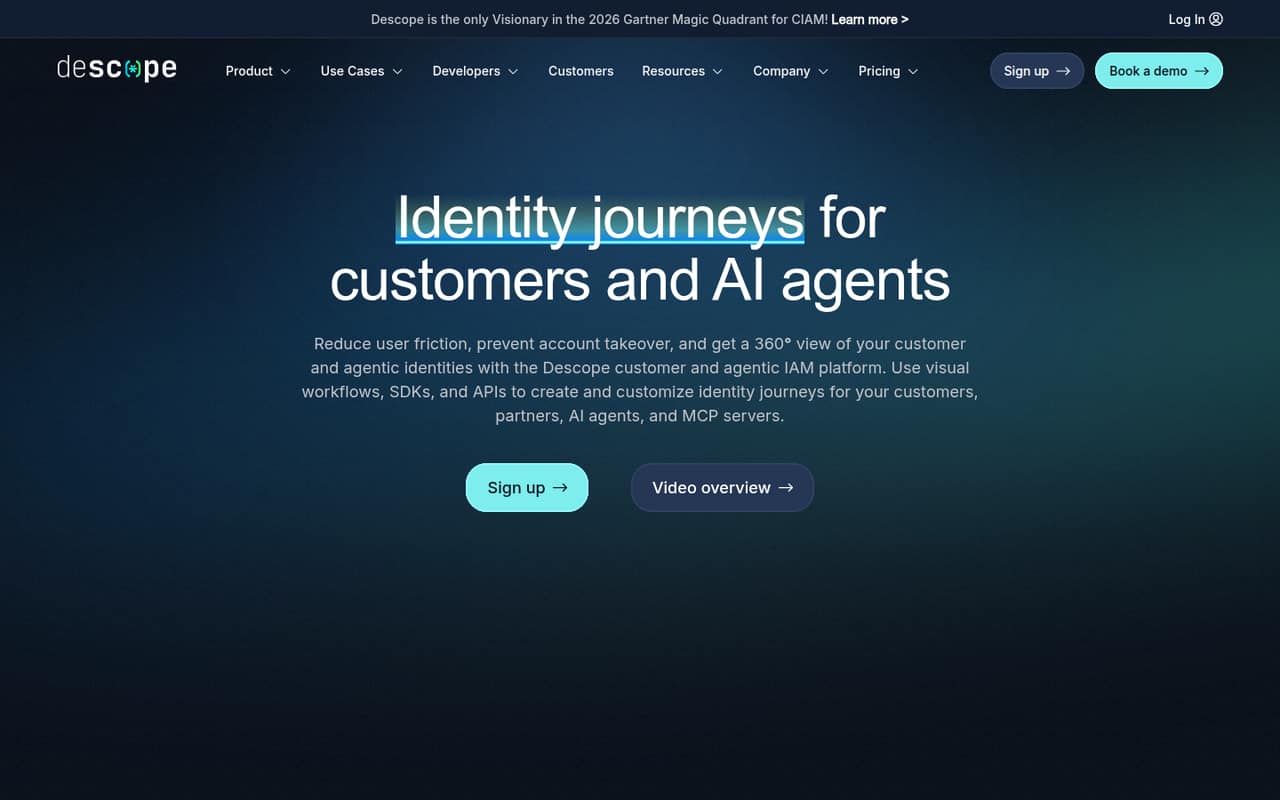
Descope is an identity platform for customer, partner and AI-agent journeys. Visual workflows sit alongside SDKs and APIs for authentication, identity management, access control, consent and token management. The range is useful for teams that want to manage authentication flows and authorization in one system.
The trade-off is that teams need to confirm implementation details before choosing it: the homepage does not name SDK languages or API protocols, and the vendor does not publish licensing, self-hosting or data-export terms in the published material. Reddit discussion mentions Descope as an option but offers little direct product feedback.
Good fit if
- Teams building customer identity flows
- B2B products with tenant-aware identity
- Teams adding agent authentication and consent
Skip it if
- Teams requiring verified self-hosting
- Teams needing published API limits
- Projects seeking direct user feedback
ScoresHow it rates
What works
- Visual workflows cover signup, login, MFA, SSO and step-up journeys
- Supports passwords, passkeys, social login and passwordless options
- Offers RBAC, ReBAC and ABAC capabilities
- Includes identity features for AI agents and MCP servers
- Free Forever plan includes 7,500 MAUs
What doesn't
- SDK languages and API protocols are not named on the homepage
- Rate limits and reliability commitments are not published here
- Self-hosting, open-source licensing and data export need confirmation
- Pro and Growth require annual billing
- Reddit discussions provide little direct Descope product feedback
01What Descope is, technically
Descope is an identity platform for building authentication and authorization journeys for customers, partners, and AI agents. It combines visual workflows with SDKs and APIs; it is not described as a standalone library or command-line tool. Its workflows cover signup, login, MFA, SSO, and step-up checks, while its identity-management features handle identity verification, merging, and syncing.
In a typical application stack, Descope sits between your product and its users or agents as the identity layer. The product can use it for authentication, tenant-aware identity, access control, consent, and token management. The homepage positions workflows as a way to change journeys without changing the application codebase, while also offering SDKs and APIs for integration. Teams can add RBAC, ReBAC, or ABAC capabilities, and use adaptive MFA based on risk signals. Descope also targets AI agents and MCP servers with scope-based access and consent. Confirm the deployment model and system boundaries with the vendor before making it a core dependency.
02Descope API, SDKs and docs
The homepage describes three integration surfaces: visual workflows, SDKs, and APIs. Workflows let teams configure frontend experiences and backend logic, including signup, login, MFA, SSO, and step-up journeys. The platform also supports extending or replacing existing identity flows, according to the homepage.
The vendor does not name SDK languages or an API protocol in the homepage material. Before implementation, confirm supported languages, SDK packages, API formats, authentication requirements, versioning, and whether a CLI is available in Descope’s developer docs. Do not assume a specific REST interface or programming-language binding from the general API claim. The homepage also says identity orchestration connects with more than 50 third-party tools, but it does not enumerate those integrations there. Check whether your identity providers, web and mobile clients, and provisioning systems are supported, and whether the integration covers your required flows. For production use, ask about API limits, error handling, and compatibility guarantees.
03Descope pricing for developers
The Free Forever plan costs $0 per month and includes 7,500 MAUs, 10 active tenants, 3 SSO connections, 10,000 M2M exchanges, and 5 test users. It is suitable for experiments, but those allowances can constrain a production app as its user, tenant, or SSO counts grow. The pricing page lists Pro at $249 per month and Growth at $799 per month; both are billed annually, and monthly billing prices are not published. Pro includes 10,000 MAUs, 35 tenants, 5 SSO connections, 2 federated apps, and 100 test users. Growth raises those limits to 25,000 MAUs, 100 tenants, 10 SSO connections, unlimited federated apps, and 500 test users.
The listed overages are $0.05 per MAU, $1 per tenant, $50 per SSO connection, $2 per 1,000 M2M exchanges, and $0.05 per MAC and MATK. SSO and audit-retention add-ons, a FedRAMP High add-on, premium support, and SMS packages are listed, but their prices are not published. Enterprise pricing is custom.
04Descope: open source, self-hosting and lock-in
The vendor does not publish an open-source license or state that Descope can be self-hosted in the published product material. It also does not publish data-export details there. Teams that require source availability, deployment in their own infrastructure, or a documented export path should ask Descope for those terms before adopting the platform.
The platform’s workflows and identity-management features can become part of application behavior, so migration scope depends on how much authentication and authorization logic you put there. A Reddit commenter discussing B2B identity architecture recommends keeping organizations, memberships, invites, and base roles in the application database, with the identity provider handling authentication. That is one architectural approach, not a Descope-specific migration report. Keeping core domain data in your own database can make provider changes easier, but you still need to plan for user identifiers, sessions, credentials, and flow behavior. Confirm export formats and migration support with the vendor.
05Descope in production
Before production, check the plan limits against expected MAUs, tenants, SSO connections, M2M exchanges, and test users. The pricing material lists overage rates, but the homepage does not provide API rate limits, uptime commitments, incident history, or recovery targets. Ask the vendor for those operational terms, along with details on security controls, compliance coverage, audit retention, and how risk signals are handled. A FedRAMP High add-on is listed, but the published material does not describe its scope.
Reddit discussion offers little direct experience with Descope. One r/aws thread lists it as an alternative during an Amazon Cognito discussion, without a detailed evaluation. Other identity-provider discussions raise architectural concerns about where to keep roles and tenant data, and how provider changes affect migration. Those are general integration questions, not reports of Descope failures. For a production rollout, test your own flows, failure handling, identity linking, tenant boundaries, and provider exit path, then confirm limits and support terms with Descope.
From the threadsWhat users say
Reddit material gives little direct feedback on Descope itself: one thread mentions it as an option, while other discussions focus on identity architecture and provider switching. We treat user sentiment as inconclusive rather than as a clear endorsement or complaint.
descope is also an option - has less rev
keep orgs, memberships and roles in your postgres and let entra do authentication only
Once the B2B model lives in your DB, the provider is just "auth in, token out", so it becomes a swappable OIDC component and lock-in is basically zero
Still 10 times more expensive than the product it replaced. Azure B2C was a lot cheaper
Questions people ask
What is Descope?
Descope is a customer and agentic identity platform. It provides visual workflows, SDKs, and APIs for authentication and authorization journeys, including signup, login, MFA, SSO, access control, consent, and token management.
Does Descope support AI agents and MCP servers?
Yes. Descope positions its platform for AI agents and MCP servers, with authentication, consent, scope-based access control, and token management. Confirm the specific protocols and integration requirements for your agent stack with the vendor.
Can Descope handle authorization as well as authentication?
Descope lists RBAC, ReBAC, and ABAC capabilities alongside authentication features. Teams should decide which authorization data belongs in Descope and which belongs in their application database, then define a source of truth for roles, tenants, and permissions.
Can I self-host Descope?
The vendor does not publish self-hosting availability in the published product material. If your deployment requires running identity infrastructure in your own environment, ask Descope about deployment options, licensing, support, and any differences from its standard offering.
What does Descope’s free plan include?
Free Forever costs $0 per month and includes 7,500 MAUs, 10 active tenants, 3 SSO connections, 10,000 M2M exchanges, and 5 test users. Check the current plan terms and overage rules before using it for a production workload.