
We may earn a commission if you buy through links on this page. It never changes a score or a ranking. How we make money
The bottom line
A straightforward hosted API with flexible compatibility, variable token costs and model-specific concurrency limits.
DeepSeek API is a hosted service for calling deepseek-flash and deepseek-v4-pro through OpenAI- and Anthropic-compatible formats. Existing SDK-based applications can point to DeepSeek’s base URL, while Search and Fetch are available as separate request-billed APIs.
Token rates vary by model, cache status and time of day. There is no free plan; check peak costs and concurrency limits against your expected traffic before putting it in a production path.
Good fit if
- Teams using OpenAI-compatible SDKs
- Applications with variable token workloads
- Agents needing Search or Fetch APIs
Skip it if
- Teams requiring a free API tier
- Projects requiring a documented self-hosted server
- Workloads needing published support commitments
ScoresHow it rates
What works
- Supports OpenAI- and Anthropic-compatible API formats
- Python and Node.js examples use the OpenAI SDK
- Flash offers thinking and non-thinking modes
- Chat completions support streaming responses
- Search and Fetch have published request prices
What doesn't
- No free plan is listed
- Token rates change by cache status and peak period
- Flash and Pro have different concurrency limits
- No self-hosting or licence details are documented
- Production reliability and support commitments need confirmation
01What DeepSeek API is, technically
DeepSeek API is a hosted, token-billed service for sending chat requests to DeepSeek models. It sits behind an application or agent as an external inference endpoint; it is not a library or a CLI you install in your codebase. The docs provide OpenAI-compatible and Anthropic-compatible API formats, so an application can call DeepSeek using an existing compatible SDK or software and change its endpoint and API key.
The service offers deepseek-flash and deepseek-v4-pro. Flash supports thinking and non-thinking modes, with thinking enabled by default. Chat requests can stream responses. Separate Search and Fetch APIs add web search and fetch capabilities, billed per successful request. This makes DeepSeek API an option for applications that need hosted model inference without managing model-serving infrastructure. The trade-off is that requests, model availability and usage billing depend on DeepSeek’s hosted service; the docs do not describe this API as a self-hosted deployment.
02DeepSeek API API, SDKs and docs
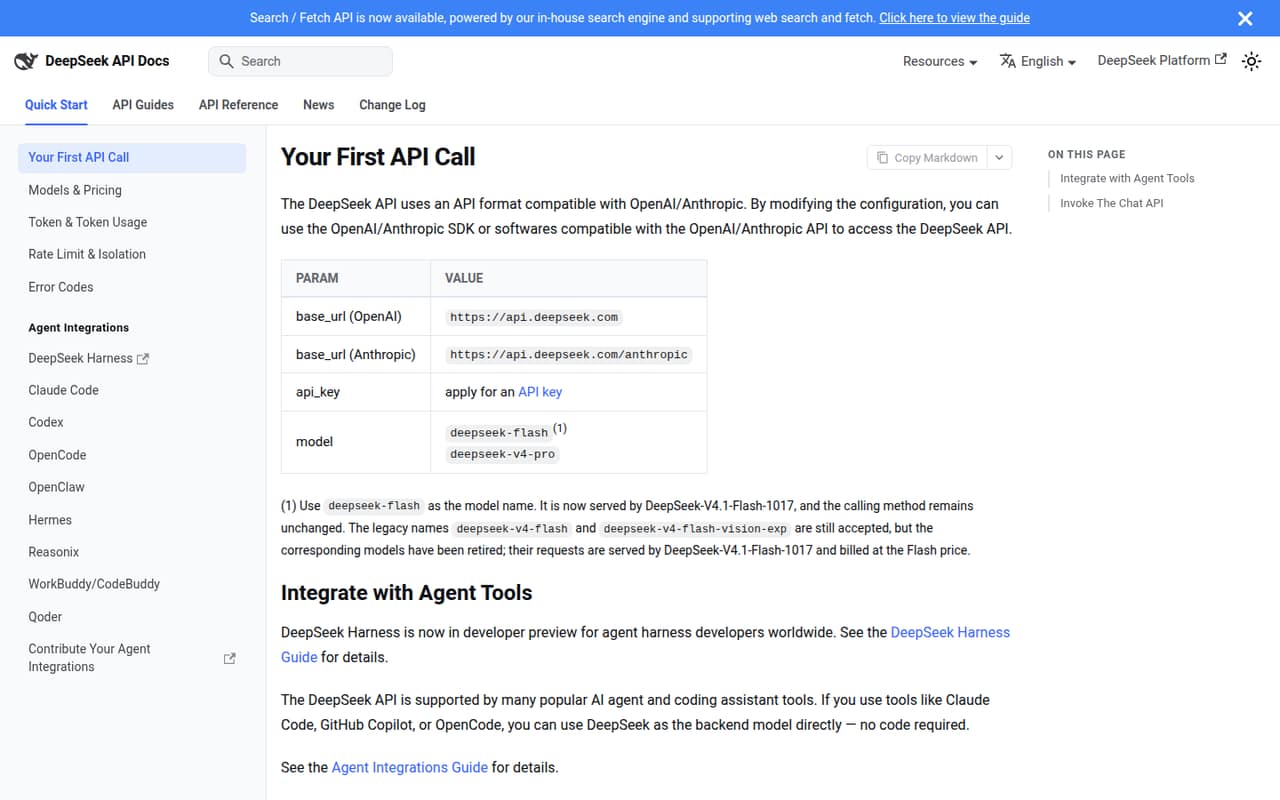
The API uses OpenAI- and Anthropic-compatible formats. For OpenAI format, the documented base URL is https://api.deepseek.com; for Anthropic format, it is https://api.deepseek.com/anthropic. The quick-start examples use curl, Python and Node.js. Python installs the openai package and uses OpenAI; Node.js installs the openai npm package and imports OpenAI. Both examples set the API key through DEEPSEEK_API_KEY.
The chat completions example accepts a stream parameter, and the docs show thinking and reasoning_effort fields. The site also has API guides, reference material, model and pricing information, token usage, rate-limit and isolation guidance, and error codes. Agent integrations include Claude Code, GitHub Copilot and OpenCode, among others. The docs describe API and SDK integration rather than a DeepSeek CLI; confirm support for any other language or SDK in the vendor’s docs. The deepseek-flash name now serves DeepSeek-V4.1-Flash-1017; retired legacy model names are still accepted and routed to that model.
03DeepSeek API pricing for developers
There is no free plan or monthly or annual subscription listed. Model usage is charged per 1 million tokens and deducted from your balance. For deepseek-flash, cache-hit input costs $0.003 off-peak or $0.006 at peak; cache-miss input costs $0.15 or $0.30; output costs $0.60 or $1.20. Flash has a 1M context and a 384K maximum output, with a concurrency limit of 2,500.
For deepseek-v4-pro, cache-hit input is $0.022 off-peak or $0.044 at peak; cache-miss input is $0.66 or $1.32; output is $1.98 or $3.96. Its concurrency limit is 500. Peak rates apply 01:00–04:00 and 06:00–10:00 UTC on weekdays. The bill therefore depends on model, input cache status, output volume and request timing. Search API and Fetch API each cost $0.75 per 1,000 successful requests. Budget for cache misses and peak periods rather than estimating from cache-hit or off-peak rates alone.
04DeepSeek API: open source, self-hosting and lock-in
DeepSeek API is presented as a hosted service. The vendor doesn't publish an open-source licence or a self-hosting deployment path for this API, so teams should plan for vendor-hosted inference unless they confirm another option directly. The docs also don't describe a data-export workflow; ask what request, response and usage records can be exported before making the service a system of record.
The OpenAI- and Anthropic-compatible formats can reduce application-level migration work: compatible SDK calls can use a different base URL, and the model is selected by name. That does not guarantee a drop-in move to another provider. Model behavior, thinking fields, pricing, availability and any provider-specific integrations may need changes. Keep provider-specific parameters behind an adapter, and retain a fallback plan for switching endpoints or providers.
05DeepSeek API in production
DeepSeek publishes concurrency limits of 2,500 for deepseek-flash and 500 for deepseek-v4-pro. Its docs include a Rate Limit & Isolation guide, but the pricing facts do not give a request-per-minute or token-per-minute figure; confirm applicable limits, queueing behavior and what happens at the cap before sizing a service. Peak periods can double the listed rates, so schedule-sensitive jobs should account for weekday pricing windows.
The API examples show bearer-key authentication and recommend setting the key in an environment variable. Apply your own secret-management, logging and retry controls, and ask the vendor about data handling, uptime commitments and support before sending sensitive or critical workloads. Reddit discussion is mostly positive about perceived value, but it is not uniform: one thread says prices rose sharply, and users also discuss how long sessions and high token use affect bills. Treat community reports as anecdotal; model your own expected input, output and cache mix.
From the threadsWhat users say
Reddit sentiment is positive about the API’s perceived value, with some users calling it unusually cheap. Other comments flag price increases and the effect of long, token-heavy sessions, so enthusiasm is not a substitute for estimating actual usage.
the deepseek api directly is the cheapest way to go as I understand it
I believe Liang is doing charity. Insane
recently it raised prices four-fold, and even in off-peak hours it is twice as expensive as it was before in normal hours
Are you letting sessions run up to 800k+ tokens? I don’t get these kinds of numbers and I think it may be because I let sessions run too long. I spend far more
Questions people ask
Is DeepSeek API free to use?
No free plan is listed. Model usage is charged per token and deducted from your balance. The Search API and Fetch API are billed per successful request. Before integrating, check your expected cache-hit and cache-miss input, output and request volumes against the published rates.
Which models can I call through DeepSeek API?
The API offers deepseek-flash and deepseek-v4-pro. The docs say deepseek-flash is served by DeepSeek-V4.1-Flash-1017. The legacy names deepseek-v4-flash and deepseek-v4-flash-vision-exp are still accepted, but those models have been retired and requests are served by the current Flash model.
Can I use the OpenAI SDK with DeepSeek API?
Yes. The docs show the OpenAI SDK for Python and Node.js and set the API base URL to https://api.deepseek.com. The API also supports an Anthropic-compatible format at https://api.deepseek.com/anthropic. You need a DeepSeek API key and must select one of its model names.
Does DeepSeek API support streaming and thinking?
The chat API example supports streaming by setting stream to true. Flash supports thinking and non-thinking modes, and thinking is the default. The quick-start examples also show thinking and reasoning_effort parameters; check the API guide for the parameters supported by your chosen model and request format.
What are DeepSeek API’s concurrency limits?
The listed concurrency limit is 2,500 for deepseek-flash and 500 for deepseek-v4-pro. These are concurrency limits, not a published requests-per-minute or tokens-per-minute allowance. Consult the Rate Limit & Isolation guide and confirm applicable caps and throttling behavior for your deployment.