We may earn a commission if you buy through links on this page. It never changes a score or a ranking. How we make money
The bottom line
A lifecycle platform for enterprise agents; custom pricing and unverified developer interfaces are the main hurdles.
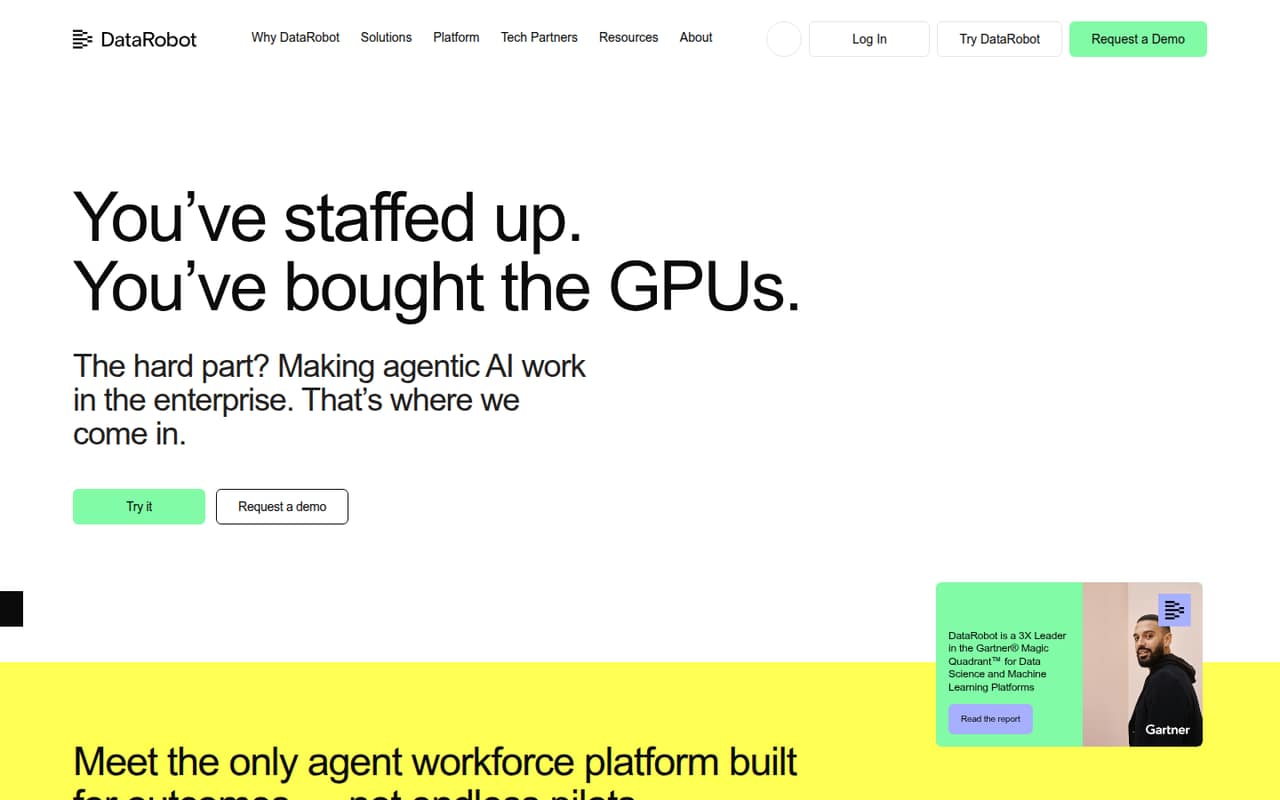
DataRobot AI Platform is an enterprise platform for building, deploying, monitoring, and governing AI agents. Its stated strengths are flexible deployment across on-premises, cloud, and edge environments, plus controls for access, quality, and compliance.
It may fit organizations that need centralized agent lifecycle management, but pricing is custom and the public product copy gives few specifics about APIs, SDKs, or languages. Confirm those integration details and production terms with DataRobot before committing.
Good fit if
- Enterprises deploying agents across environments
- Teams needing agent governance controls
- Organizations integrating agents with SAP
Skip it if
- Developers seeking a self-serve API
- Teams requiring public usage-based pricing
- Projects needing a documented open-source stack
ScoresHow it rates
What works
- Build, operate, and govern agents in one platform
- Deployment options include on-premises, cloud, and edge
- Select LLMs, embeddings, and other components
- Built-in integrations and customizable agent blueprints
- Monitoring, access controls, and audit documentation
What doesn't
- Enterprise pricing requires a custom quote
- Seat and usage limits are not published
- Public product copy names no SDKs or languages
- Open-source licence and data export terms are unclear
- Reddit discussions offer little independent user feedback
01What DataRobot AI Platform is, technically
DataRobot AI Platform is an enterprise software platform for building, deploying, monitoring, and governing AI agents. Treat it as a lifecycle layer in an AI stack, rather than just a model endpoint: teams can assemble agents from LLMs, embeddings, and other components, then manage access, quality, and governance around them.
DataRobot says teams can build in their own development environment or DataRobot’s, using customizable blueprints and built-in integrations. The platform is designed to deploy agents on-premises, in the cloud, or at the edge. That makes it relevant to organizations with mixed infrastructure or data systems that cannot all move to one hosting environment. DataRobot also describes integrations and UIs for building agents into SAP tools, and offers a service-led option for agents it builds and manages. The public product copy does not position the platform as a standalone library or CLI; buyers should establish the exact runtime and control-plane architecture for their deployment.
02DataRobot AI Platform API, SDKs and docs
The described developer workflow centers on customizable agent blueprints, built-in integrations, and selecting LLMs, embeddings, and other components for each use case. DataRobot says teams can work in their own development environment or its environment. Its integration examples include SAP tools, while its access controls cover agents and users connecting to data and APIs.
The public product copy does not name an API protocol, SDK, programming language, CLI, or package manager. It also does not describe webhooks or plugins. That makes it hard to judge how much agent code can live in a normal application repository or how to automate builds and deployments. Before choosing the platform, ask DataRobot’s documentation and technical team to confirm API style, SDK support by language, authentication flow, versioning, and whether deployments can be managed through code. Also verify what the built-in integrations expose and how custom integrations are implemented.
03DataRobot AI Platform pricing for developers
DataRobot’s pricing page lists custom quotes for enterprise deployments; it does not publish a starting price or monthly and annual rates. The published pricing information lists a 30-day free trial, but no free plan. Seat limits, usage limits, and plan inclusions are not itemized, so developers cannot estimate a production bill from public rates.
The platform’s costs may depend on the organization’s deployment and usage, but DataRobot does not publish a per-seat, per-request, or compute rate in the pricing information. It also does not itemize overages or add-ons. Ask for a quote that separates platform fees from model, infrastructure, and service costs, and clarifies how agent activity, environments, users, and support affect the bill. Confirm whether the trial has feature, seat, or usage restrictions before using it to size a production rollout. For budget planning, get the expected annual total and any renewal or expansion terms in writing; a custom quote makes comparisons with metered APIs difficult.
04DataRobot AI Platform: open source, self-hosting and lock-in
DataRobot does not publish an open-source licence for the Agent Workforce Platform. Its deployment options include on-premises, cloud, and edge, so it is not limited to a vendor-hosted environment. That deployment flexibility is useful, but it does not establish that customers can inspect or modify the platform’s source code.
The vendor does not publish data export or migration details in its product copy. Before adopting the platform, ask how agent definitions, prompts, evaluation records, audit logs, and configuration can be exported, and in what formats. Also establish what remains portable if you move an agent to another runtime: the model choice may be separable, while blueprints, integrations, governance records, and deployment workflows may depend on DataRobot. Confirm licence terms for on-premises and edge deployments, too. Without those details, estimate lock-in by the lifecycle assets your team will store and manage inside the platform.
05DataRobot AI Platform in production
DataRobot describes agent monitoring, real-time issue mitigation, dynamic compute orchestration, access controls, enforceable approvals, testing frameworks, and automated audit documentation. These are relevant production controls, but buyers should verify what is configurable in their deployment and how monitoring alerts, audit records, and access policies integrate with existing operations.
Before depending on it, get written terms for service availability, support response, capacity, and any limits on agents, requests, or compute. Confirm how the platform behaves during model or integration failures, and test deployment and rollback procedures in the target environment. DataRobot says agents can run on-premises, in the cloud, or at the edge; validate which features and controls apply in each mode. Two r/FutureTechFinds Reddit posts have zero comments and provide generic product descriptions, not reports of production reliability or failure. They do not offer meaningful independent evidence about operational outcomes.
From the threadsWhat users say
Reddit sentiment is too sparse to establish a reliable user consensus: two r/FutureTechFinds posts have zero comments. Their wording is positive but generic, with no firsthand deployment reports.
The DataRobot AI Platform is an open and flexible tool designed to meet the AI needs of your team
quickly deliver AI solutions for your business
connect and assess data, engineer new features
Pricing: No pricing
Questions people ask
How much does DataRobot AI Platform cost?
DataRobot’s pricing page lists custom enterprise quotes and does not publish monthly or annual prices. The published pricing information lists a 30-day free trial but no free plan. Seat limits, usage limits, and itemized plan inclusions are not published, so ask DataRobot for a quote based on your deployment and expected usage.
Can DataRobot AI Platform run on-premises?
Yes. DataRobot says agents can be deployed on-premises, in the cloud, or at the edge. Confirm which platform features, governance controls, and integrations are available in the specific deployment model you plan to use, and clarify the relevant licence terms before rollout.
Which SDKs and programming languages does DataRobot support?
The public product copy describes agent blueprints, built-in integrations, SAP tools, and controls for access to data and APIs, but names no SDKs or programming languages. Ask DataRobot to confirm the supported API protocol, language-specific SDKs, authentication approach, and deployment automation options before designing an integration.
Does DataRobot AI Platform include agent monitoring and governance?
DataRobot describes monitoring agent quality and mitigating issues in real time, along with access controls, lifecycle tracking, enforceable controls, testing frameworks, and automated audit documentation. Confirm which of these controls are configurable in your deployment and how their records and alerts connect to your existing operational systems.
Is DataRobot AI Platform open source?
DataRobot does not publish an open-source licence for the Agent Workforce Platform. It does describe deployment on-premises, in the cloud, and at the edge, but those options do not establish source-code access. Ask about licence terms, export formats, and how agent assets can be migrated if you later leave the platform.